Why Are Data Centers Growing Faster Than the Grid?
Discover why are data centers growing so quickly and how grid constraints limit expansion. Explore the impact of AI and energy demands in 2026.
15 min read
Data centers are growing because cloud migration, AI workloads, and edge connectivity are multiplying power needs faster than grids can add deliverable capacity. McKinsey says global data center demand could more than triple by 2030, while BCG expects global data center power demand to rise about 16% annually from 2023 to 2028 and reach about 130 GW by 2028, so the headline is not just more compute, it's a larger and denser power system being built around compute.
The popular answer says AI caused the boom. That's too simple, and it misses the key bottleneck. The harder truth is that growth now depends on whether utilities, transmission planners, and permitting systems can deliver power fast enough to turn land into usable capacity. In many markets, the project that looks viable on paper is the one that can secure a substation, an interconnection path, and a cooling plan before someone else does.
Table of Contents
- Beyond the AI Hype What Is Driving Data Center Growth
- How Massive Is the Current Data Center Buildout
- Regional Patterns in Data Center Expansion
- The Bottleneck: Power Availability and Grid Constraints
- Environmental and Community Impacts of Rapid Expansion
- What the Next Decade of Data Center Growth Looks Like
- Frequently Asked Questions
Beyond the AI Hype What Is Driving Data Center Growth
The cleanest explanation for why are data centers growing is not AI alone. AI matters, but it sits on top of a much older force, the steady migration of enterprise workloads into cloud environments that need far more concentrated power than legacy server rooms ever did. BCG says traditional enterprise workloads still make up roughly 55% of data-center power demand in 2028, which is a reminder that the cloud transition is still the base layer of demand, not a side story. BCG
Three demand engines, one supply problem
Cloud migration continues because firms want scalability and lower operating friction, and that creates a persistent pull toward larger facilities. AI training and inference then stack on top of that base, raising rack density, cooling load, and electrical demand per deployment. Edge and 5G-related deployments add a different kind of pressure, more distributed sites, more local power requirements, and more stress on regional distribution networks.
Practical rule: follow the power, not the headline. The best site is rarely the one with the most available land, it is the one that can secure power, cooling, and permitting on a timeline the developer can actually finance.
That is why the binding constraint is shifting from chip supply to grid access. McKinsey's projection that global data center demand could more than triple by 2030 and that companies may invest almost $7 trillion in infrastructure capex by 2030 points to a buildout that is no longer incremental. It is a wholesale reworking of where digital infrastructure can exist, and that change is visible in the project pipeline itself. McKinsey
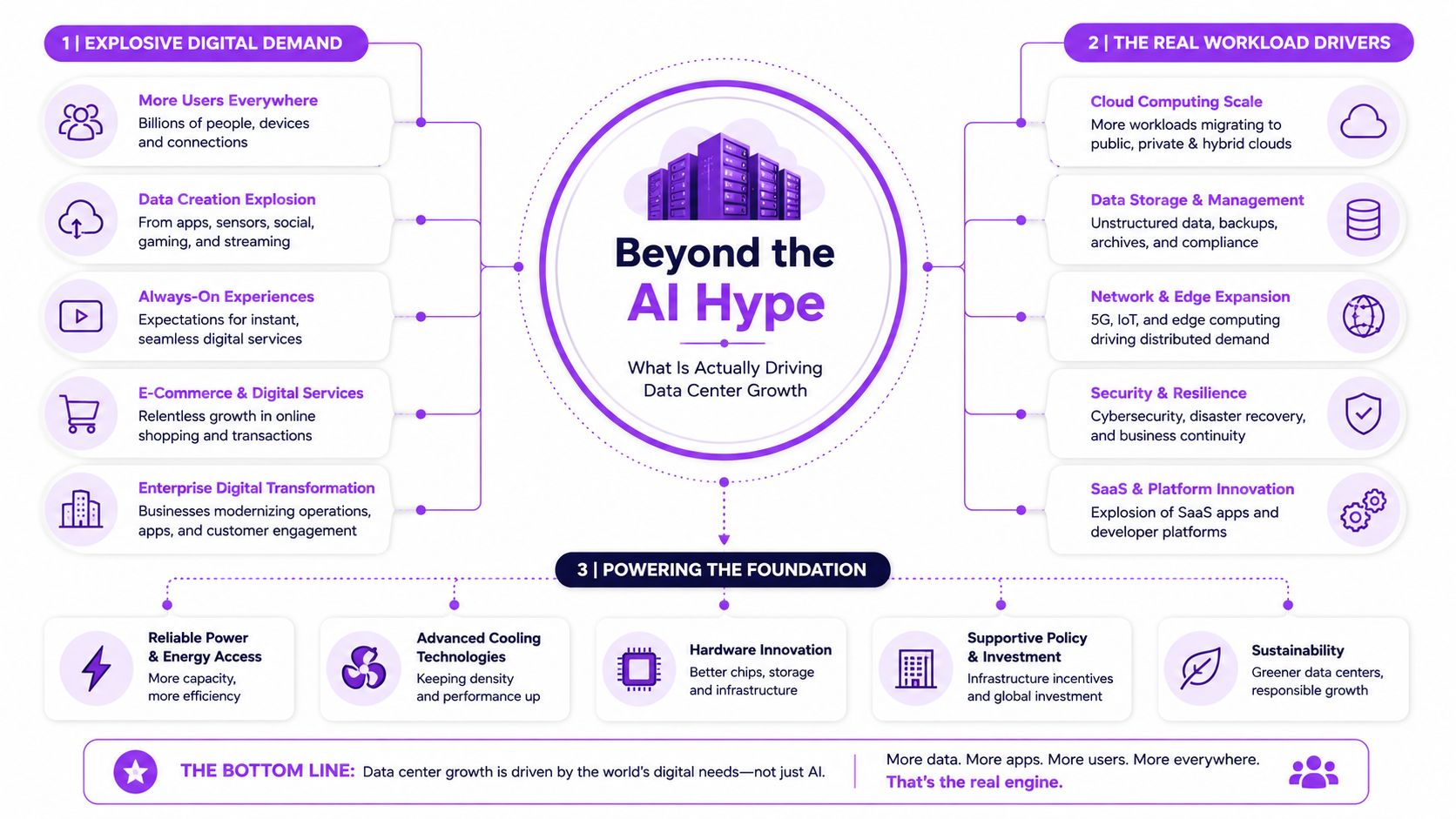
The internal logic is simple. Cloud demand makes the baseline bigger, AI makes the load denser, and edge deployments make the network more distributed. Together, they turn data center development into a power-planning problem first and a real-estate problem second. For a concrete example of how that shows up in market tracking, see the Meta 1GW Alberta campus listing, which sits in the same universe of large-scale planning decisions that now define the sector.
How Massive Is the Current Data Center Buildout
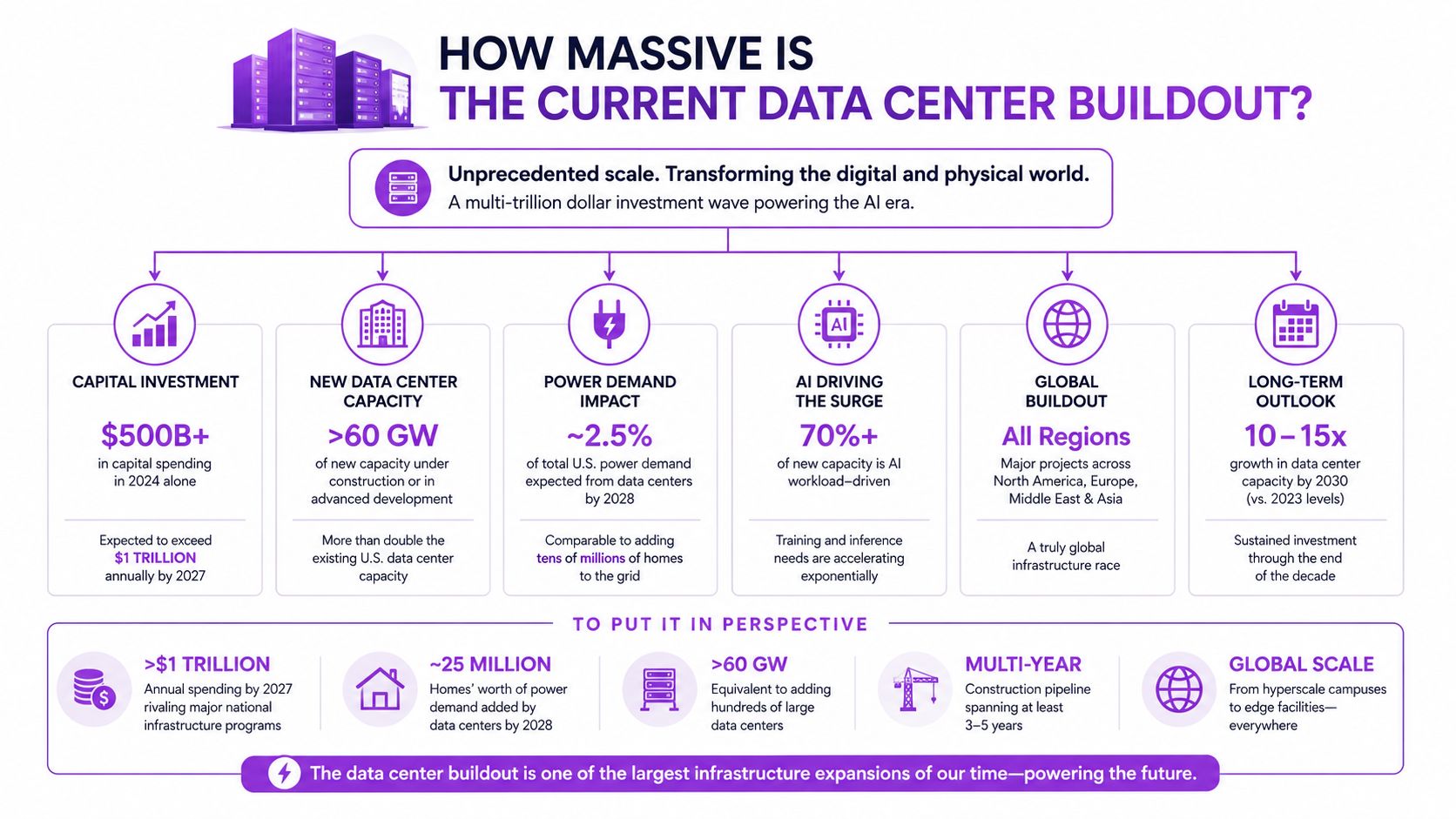
The current buildout is large enough to change how analysts should think about infrastructure cycles. JLL projects the sector will add 97 GW between 2025 and 2030, which would effectively double global capacity in five years. It also says about 10 GW is expected to break ground globally in 2025, with around 7 GW likely to complete, a pace that says a lot more about execution risk than about demand optimism. JLL
What the pipeline means in physical terms
A facility measured in hundreds of megawatts is not a normal warehouse conversion or a modest enterprise park. It requires a deeper electrical connection, larger cooling systems, and a planning process that looks more like utility infrastructure than commercial real estate. That is why the industry's recent growth feels discontinuous, it is moving from dispersed server rooms to a small number of very large campuses.
McKinsey's estimate of almost $7 trillion in global data center infrastructure capex by 2030, with more than $4 trillion going to computing hardware and over 40% of that spending in the United States, reinforces that point. The money is not just buying equipment. It is underwriting a physically heavier and more power-intensive version of the internet. McKinsey
Supply is not keeping up
CBRE's Q1 2025 data shows why the market still feels tight even as construction continues. The global weighted average vacancy rate fell by 2.1 percentage points year over year to 6.6%, and Paris tightened from 16.1% to 7.7%. In North America, primary market supply rose 36% year over year to 9,432 MW, while record net absorption reached 2,497.6 MW in 2025, which means leased demand is still eating through new supply almost as fast as it arrives. CBRE
That combination, more capital, tighter vacancy, and large net absorption, tells a blunt story. Developers are not building into slack. They are building into scarcity, which is why permitting, land assembly, and utility coordination now shape deal flow as much as demand forecasts do. A useful market example is the Quincy facility profile, because it reflects the kind of capacity concentration that makes local market conditions matter so much.
Regional Patterns in Data Center Expansion
Data center growth does not spread evenly. It clusters where power is available, permitting is predictable, and fiber, labor, and operator ecosystems already exist. That is why places like Northern Virginia, Dublin, London, Frankfurt, Amsterdam, and Paris keep surfacing in market discussions, even as those hubs become harder to expand in.
Why established hubs keep pulling demand
Northern Virginia benefits from a mature digital infrastructure base and close connectivity to major network routes. Dublin, London, Frankfurt, Amsterdam, and Paris attract large-scale investment because they already have the market depth hyperscalers need, but each one also faces different constraints, from land pressure to regulatory friction to local energy limits. The result is not a simple winner-take-all map. It is a hierarchy of feasible sites.
JLL's forecast of 97 GW of added capacity between 2025 and 2030 helps explain the geography. A buildout that large cannot stay concentrated in only a few crowded hubs, especially when the available, deliverable space in those hubs is already tight. Developers keep looking at secondary markets with more room, better power access, or faster interconnection paths. JLL
Growth follows the easiest path through the grid. When a primary market slows, capital does not disappear, it moves to the next location that can offer power, land, and a workable permitting path.
The geographic logic of dispersion
CBRE's Q1 2025 vacancy data showed Paris tightening sharply, while North America's primary market supply kept rising. That contrast matters because it shows how quickly market conditions can diverge from one region to another. A location can still have headline demand and already be functionally constrained if vacancies fall, power delivery slows, or buildable parcels become scarce. CBRE
The Quincy market profile is a useful reminder that secondary sites often win because they solve a power problem more cleanly than a marquee metro does. The point is not that one region is universally better. The point is that the buildout now rewards markets that can clear the utility hurdle first.
The Bottleneck: Power Availability and Grid Constraints
Data center growth keeps getting described as an AI story, but the binding constraint is still power. Deloitte and industry sourcing cited by BOMA project global data-center electricity use could rise from 536 TWh in 2025 to about 1,065 TWh by 2030. That scale of growth collides with a grid that was not built for a load ramp that steep. McKinsey likewise expects U.S. data-center demand to keep rising quickly through 2030, which is exactly why interconnection, transmission, and utility timing now matter more than the headline demand story.
Why sites stall even when demand is obvious
A project can have a leaseable shell, a credible customer, and a strong market location, and still stall if the utility cannot deliver power on time. That is the part many market discussions skip. Interconnection queues, transformer availability, and substation timing can push a viable project into years of delay, and once that happens, the economics of the site start to break down.
Bottom line: the site with power today is often more valuable than the site with the best long-term address.
That is why siting decisions have become more technical and less intuitive. Operators are comparing utility lead times, feeder capacity, and grid upgrade requirements with the same seriousness that older generations once reserved for fiber proximity or tax treatment. In many markets, power has become the first filter and land the second.
The market is already signaling shortage
CBRE's Q1 2025 market data showed tight vacancy in core hubs, including sharper compression in Paris, while North America's primary market supply kept rising. That contrast matters because it shows how quickly market conditions can diverge from one region to another. A location can still have headline demand and already be functionally constrained if vacancies fall, power delivery slows, or buildable parcels become scarce.
JLL's outlook points to a large amount of construction underway, but that does not erase the bottleneck. New supply can still lag behind the pace at which power-hungry projects are lining up for connection. CBRE JLL
The Lancium Clean Campus listing shows the kind of development logic that now matters most, access to large-scale power, not just a desirable address. Grid modernization, on-site generation, and better interconnection planning are no longer optional extras. They are the conditions that determine whether the next tranche of growth can physically happen.
Environmental and Community Impacts of Rapid Expansion
Large-scale data center growth brings local trade-offs that are easy to understate from a distance. Cooling demand drives water use, electricity sourcing affects emissions, and rapid industrial buildout can change traffic patterns, land values, and community expectations. Those impacts are not abstract, they show up in permitting hearings, utility filings, and local planning meetings.
The local cost of a power-hungry campus
A modern campus does not just consume land. It can reshape the infrastructure around it, especially when utilities need to upgrade transmission or distribution assets to serve a concentrated load. That is one reason environmental review has become a standard part of the development process, even when the project is economically attractive to a region.
BCG's projection that global data center power demand could reach about 130 GW by 2028 gives the scale context. The more load the sector adds, the more pressure it puts on energy sourcing decisions, cooling design, and the regional grid mix that serves it. BCG
Community concerns are now part of the feasibility test
Local support tends to depend on whether the promised benefits are visible and the burdens are manageable. Jobs and tax base matter, but so do noise, road use, water strain, and the possibility that the surrounding area ends up absorbing the costs of faster infrastructure expansion. In places where land is cheaper and grid capacity is available, projects can move quickly, yet that speed can make community engagement more important, not less.
CBRE's tightening vacancy and JLL's large pipeline show why this pressure will not ease soon. When supply stays tight, developers chase the sites that can move, and those sites often sit in communities that are less prepared for industrial-scale change. CBRE JLL
That is also why operators are under growing pressure to pair expansion with more credible energy planning, including renewable sourcing and cooling approaches that reduce local strain. The buildout is not just a capital story anymore. It is a land-use, utility, and community planning story.
What the Next Decade of Data Center Growth Looks Like
The next decade will probably bring more growth, but less of the easy kind. Demand is still rising, yet the pace of expansion will be set by where power can be delivered, where permits can clear, and where utilities can absorb another large load without putting existing customers at risk. That shifts the story away from a pure technology cycle and toward a longer infrastructure buildout.
The market is likely to reward sites that can move through the full chain, from land control to grid access to local approval, without getting stuck in one of the failure points that now slow so many projects. In practice, that means the binding constraint is no longer just compute demand. It is whether the physical system around the project can keep up.
What to watch through 2030
Interconnection queues will remain the cleanest signal of whether growth can keep pace with demand. Where queues are lengthening, the issue is not speculative interest. It is that projects are colliding with limited transmission capacity, slow studies, and utility processes that were not designed for this volume of load. Utility lead times will matter in the same way, because a project that cannot get power on a workable schedule is effectively stranded, even if the demand case is strong.
Regulatory decisions will also matter more than headline forecasts. The key question is who pays for the upgrades, how much load a utility can absorb, and whether state and local officials are willing to treat large data centers as ordinary commercial loads or as special cases that require new rules. That policy choice will shape where development concentrates and where it stalls.
The broader implication is that the sector is moving into a phase where access to power is being rationed by infrastructure, not enthusiasm. BCG and McKinsey both point to continuing expansion, but the more interesting question is which markets can deliver it. The winners will be the places that combine capital with grid capacity, permitting speed, and utility alignment.
What the industry will likely look like
Modular and containerized builds will keep drawing attention because they can reduce some deployment friction, especially for distributed and edge use cases. On-site generation and battery storage will also become more common as operators try to reduce dependence on congested grid paths and improve the resilience of individual sites. Those choices help at the margin, but they do not remove the core constraint. They shift part of the load-management problem onto the project itself.
A more important change is that growth will be allocated by infrastructure readiness. Markets with power, land, fiber, and permitting alignment will keep winning the next wave of projects. Markets without that alignment will continue to lose deals to regions that can clear the same hurdles faster, even if the demand case is equally strong. That is the harder conclusion for the next decade. Demand may justify the buildout, but infrastructure will decide where it lands.
Frequently Asked Questions
Why are data centers growing so fast?
They are growing because digital demand keeps rising and the facilities serving that demand are getting larger, denser, and more power-intensive. Cloud migration remains the base layer, AI adds a heavy new load, and distributed connectivity expands the number of sites that need power and cooling. The buildout is fast because the market is trying to add capacity into a persistent shortage of powered, deliverable space.
What is the biggest constraint on new data centers?
Power availability is the biggest constraint. A site can have land and customer demand and still fail if the utility cannot deliver electricity fast enough or if the interconnection path is too slow. That is why grid access has become the first question in site selection, not the last.
Why do data centers cluster in certain markets?
They cluster where utilities, permits, fiber, and land line up. Mature markets attract more investment because the ecosystem is already there, but those same markets can tighten quickly when supply is absorbed. When that happens, developers move toward secondary markets that can offer faster delivery or more available capacity.
Are environmental concerns slowing growth?
They are changing how projects get approved and where they get built. Water use, cooling needs, and community impacts are now part of the feasibility test, especially in places facing grid strain or competing land use. That does not stop growth, but it does shape the timeline and the location of the next wave of projects.
What signals should investors and operators watch next?
Interconnection timelines, vacancy rates, utility upgrade plans, and power procurement strategy matter most. Those indicators show whether a market can support the next project wave or whether it is already approaching a physical ceiling. The key is to watch infrastructure readiness, not just demand headlines.
How should readers interpret the next phase of growth?
As a power-market story, not just a tech story. Demand is still rising, but the places that win future capacity will be the ones that can clear grid, land, and permitting hurdles at the same time. That makes infrastructure planning the competitive edge.
Data Centers List tracks existing, planned, and under-construction facilities, so it's useful for seeing where growth is clustering instead of where the headlines say it should be. It also provides location, capacity, and market context that help connect demand stories to the physical buildout. Visit Data Centers List to compare facilities and follow the markets shaping the next phase of data center expansion.