What a National Data Center Really Means in 2026
Learn what a national data center is, how governments use them, and why power, water, and policy now shape every country's digital backbone.
15 min read
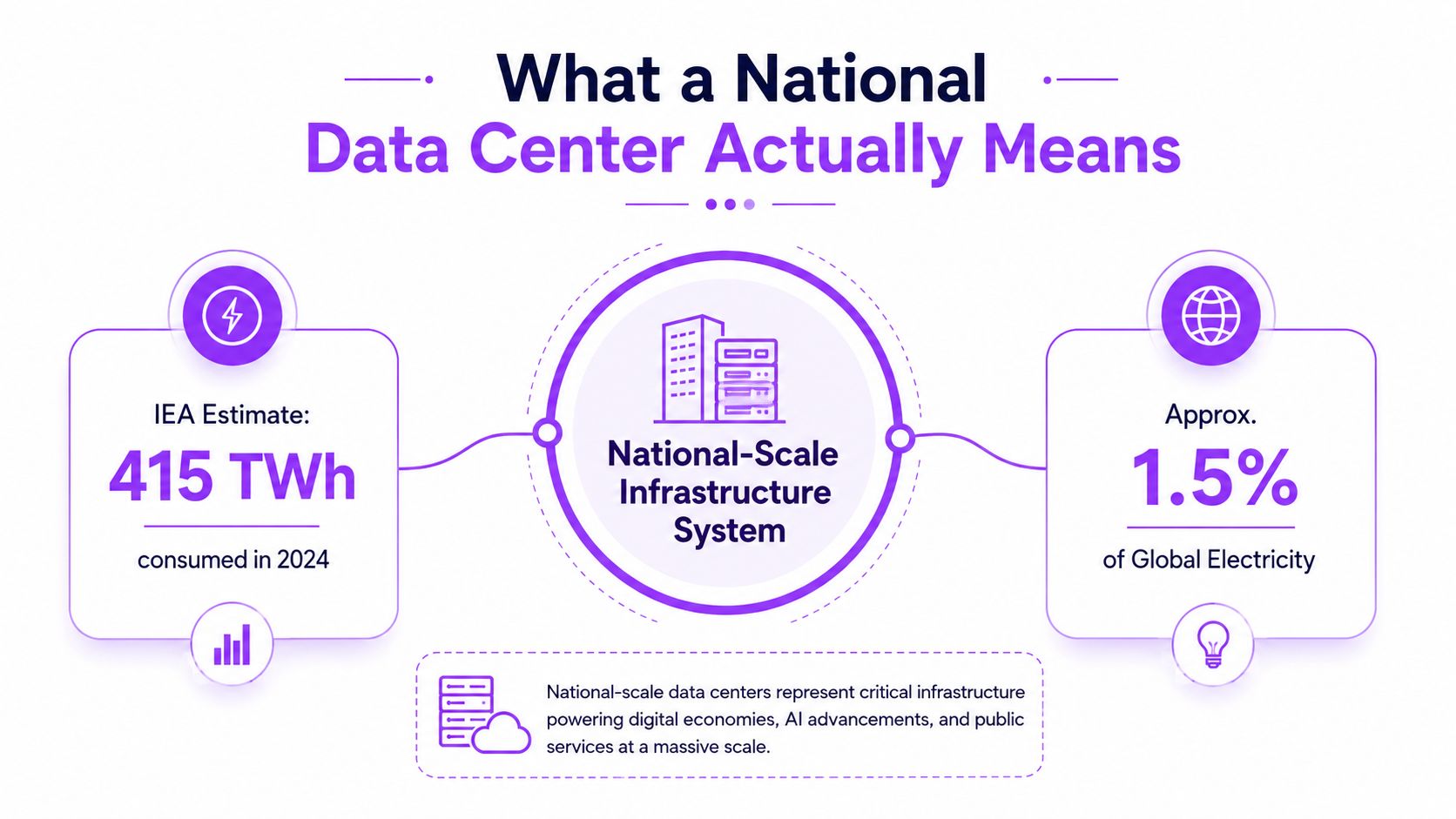
Data centers consumed about 1.5% of global electricity, or 415 TWh, in 2024, while U.S. data centers used roughly 4.4% of national electricity. That makes a national data center a country-scale infrastructure system, not a single building.
The label matters because compute capacity now connects decisions that are usually handled separately. A facility may be approved locally, supplied through a regional grid, cooled from a shared water basin, and supported by national rules on data sovereignty and energy procurement. Treating those decisions as one system reveals risks that a site-by-site inventory can hide.
The International Energy Agency data cited in the industry infrastructure overview shows why the distinction is urgent. Global data center power capacity reached an estimated 67.7 GW in 2024, a 36% increase over the prior two years, while the United States represented 43% of global consumption, with 29.2 GW and about 6% of national electricity use in that estimate. The figures differ by methodology, but they point to the same conclusion: national systems now shape the data center market.
Table of Contents
- What a National Data Center Actually Means
- Why Capacity Numbers Look Like National Infrastructure
- Four Governance Levers That Shape Every Country
- How the Largest National Markets Are Responding
- The Real Bottleneck Is Contracting Not Generation
- Water Footprint Is Bigger Than the Building
- Turning the National Lens Into a Searchable Directory
What a National Data Center Actually Means
A national data center is the combined digital infrastructure operating within a country. It includes hyperscale campuses, colocation facilities, carrier sites, sovereign cloud regions, edge locations, and government compute environments. The term describes an infrastructure layer, not a building class.
A sovereign data center is narrower. It generally refers to a facility or controlled environment created to satisfy jurisdiction-specific requirements for domestic data storage, processing, access, or governance. A national data center can include foreign-owned facilities serving international workloads, while a sovereign data center is defined primarily by legal and operational control.
The national lens becomes necessary once electricity, water, and permitting decisions extend beyond the property boundary. Grid operators assess large-load connections, utilities plan substations and transmission, water authorities manage basin pressure, and governments set rules for zoning, taxation, resilience, and digital sovereignty. A facility map alone can't show how those systems interact.
The country is the useful unit of analysis
The IEA estimate of 415 TWh, or about 1.5% of global electricity consumption in 2024, provides a national-scale starting point in the IEA-linked sector analysis. The United States accounted for 43% of global data center consumption in that same estimate, demonstrating how concentrated national infrastructure systems can influence worldwide demand.
A practical analysis should therefore ask four questions:
- What operates inside the country? Separate active, planned, and under-construction capacity.
- How does the grid serve it? Examine generation mix, transmission headroom, and interconnection status.
- What resources does cooling require? Compare direct water demand with the water intensity of electricity generation.
- Who carries the cost? Identify whether developers, utilities, governments, or households fund new infrastructure.
The most useful measures aren't limited to square footage. They include megawatts, TWh, PUE, WUE, basin stress, permitting status, and interconnection queue positions. That framework turns “national data center” from a broad label into a measurable infrastructure question.
Why Capacity Numbers Look Like National Infrastructure
Global data center power capacity rose from 26 GW in 2015 to 81 GW in 2024, a 211% increase over nine years, and the Macquarie analysis projects 222 GW by 2030 in its analysis of AI and cloud infrastructure. At that scale, a data center campus starts to resemble a utility customer. Its effect reaches beyond the building into grid connections, transmission planning, equipment procurement, and public infrastructure.
The same source projects worldwide data center electricity demand increasing from 447 TWh in 2025 to 565 TWh in 2026, while total power demand rises from 105 GW to 133 GW over that period. These are forecasts rather than measured outcomes, but they show why AI workloads can change national infrastructure planning within a short planning cycle.
Capacity is concentrating, not merely expanding
Cloud and AI demand is clustering in large campuses rather than spreading evenly across small enterprise facilities. Developers concentrate compute, cooling, backup systems, and network connections where they can secure suitable land and firm power. A country may have enough generation in aggregate while a specific region lacks transmission capacity or an interconnection path.
The commissioning schedule therefore matters beyond construction. A delayed connection can affect cloud-region redundancy, procurement commitments, utility capital plans, and a country's ability to provide domestic compute capacity. The indirect footprint also includes transmission upgrades and the water used by electricity generation, not only cooling water at the site.
| Year | Global operational capacity | Key driver |
|---|---|---|
| 2015 | 26 GW | Enterprise and early cloud expansion |
| 2024 | 81 GW | Hyperscale, cloud, and AI workloads |
| 2030 projection | 222 GW | Projected AI and cloud demand |
The available evidence identifies the United States, China, and Western Europe as major markets, although consistent per-country capacity shares are not published. That concentration gives national policy a direct role in global compute supply, because decisions about electricity, land, and permitting can shift where future capacity becomes operational.
A large campus listing for Alberta shows why facility-level records remain necessary. A national inventory must distinguish announced, planned, under-construction, and commissioned capacity, while separating IT load from total facility demand. Without those fields, an aggregate can overstate usable capacity and understate the grid and water systems needed to support it.
Analytical rule: A national capacity forecast is only as reliable as its treatment of project status, grid access, and actual operating load.
Four Governance Levers That Shape Every Country
A country can announce substantial digital infrastructure ambitions and still fail to deliver usable capacity. The outcome depends on four governance levers: siting, energy access, water permissions, and digital sovereignty. Together, they determine whether new facilities connect smoothly or accumulate in planning and interconnection queues.
Siting and zoning
Local authorities control much of the immediate land-use process. They assess noise, backup generation, construction impacts, land compatibility, and community infrastructure. When local governments restrict new development, demand doesn't disappear. Developers search for alternative metros, often moving pressure toward regions with less established planning capacity.
This creates a coordination problem. A national strategy may treat capacity as interchangeable, but a new site can't substitute for another if it lacks network routes, power availability, water permissions, or the right latency profile.
Energy policy
Grid access is often more decisive than land availability. A project can have a signed site agreement and still wait for studies, transmission work, equipment, or a final service arrangement. The relevant question isn't whether a country has enough generation. It is whether the local network can deliver firm or flexible power on the required schedule.
The government data center example in Thimphu also shows why public-sector facilities belong in the national analysis. Government compute may have different resilience, sovereignty, and procurement requirements from commercial campuses, but it still competes for the same physical infrastructure.
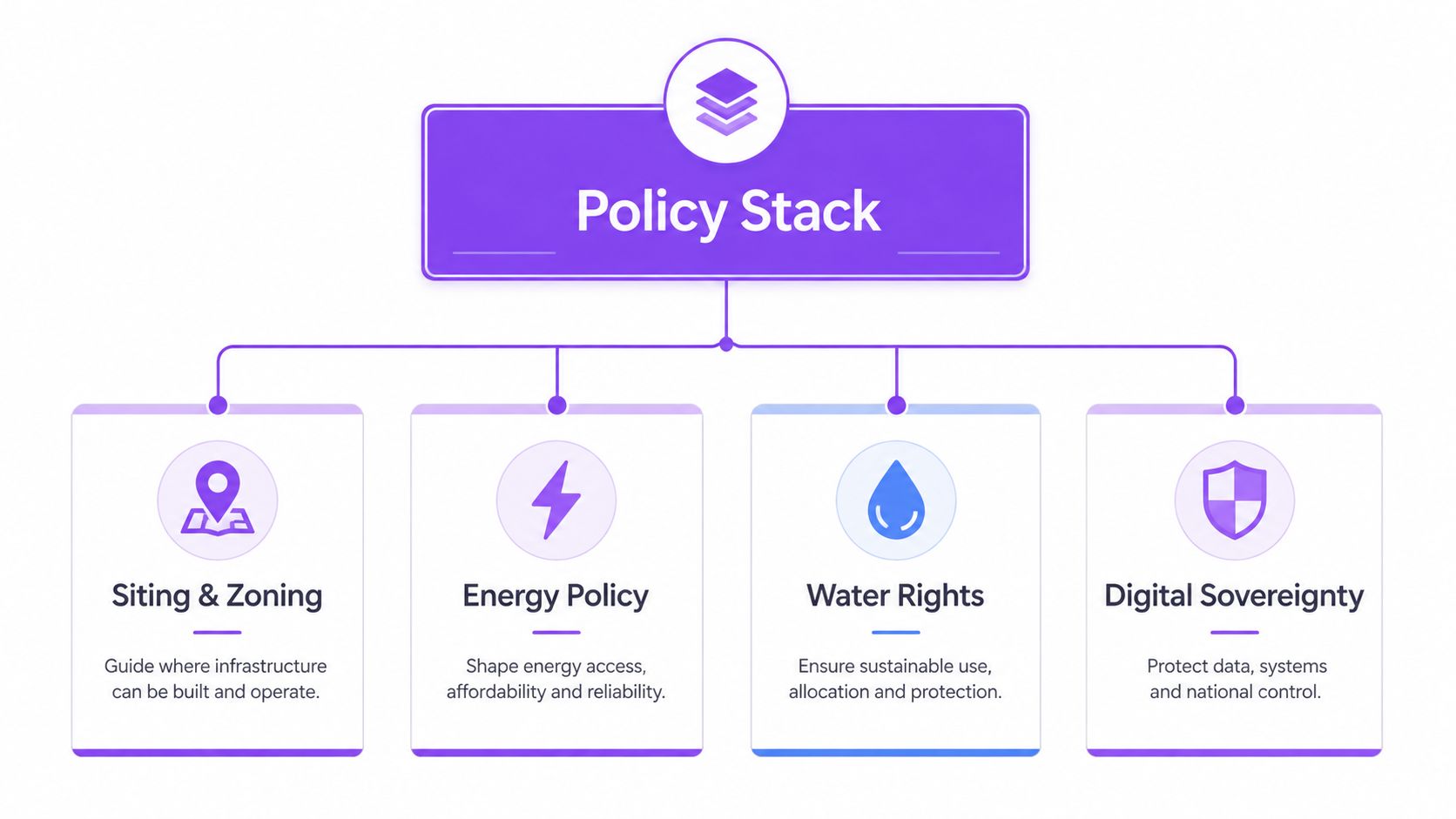
Water rights and digital sovereignty
Cooling restrictions can change which technologies and regions remain viable. Air cooling, closed-loop systems, and liquid cooling each shift the balance between electricity, water, equipment design, and operating risk. A national strategy that counts megawatts without checking basin conditions can approve capacity that later faces environmental or permitting constraints.
Digital sovereignty adds a separate layer. Governments may require domestic control over sensitive workloads, but sovereignty rules don't remove the need for grid capacity or cooling resources. They can instead increase the importance of local facilities, domestic operators, and resilient national networks.
The policy stack must work together
The strongest national strategies align all four levers. Subsidizing construction while leaving interconnection, water, and tariff rules unresolved creates nominal capacity without dependable service. Policymakers should evaluate each proposed campus against the full stack before treating it as a national infrastructure gain.
How the Largest National Markets Are Responding
The largest national markets face different binding constraints, so their data center strategies diverge. The IEA-linked figures identify the United States, China, Germany, the United Kingdom, and Japan as major markets by power demand. Comparing them requires more than a capacity ranking. Their practical limits arise from governance, electricity delivery, planning, and regional resource conditions.
United States
The United States has the largest national demand profile in the available IEA-linked figures. Its defining challenge is fragmentation. State and local authorities influence siting, utilities manage connections, and large customers negotiate procurement structures across multiple jurisdictions.
This structure can accelerate projects when a utility, developer, and regulator align. It can also distribute infrastructure costs across broader rate structures if regulators do not set clear cost-recovery rules. Recent policy coverage describes 2025 and 2026 activity around interconnection, rate design, energy, water, zoning, and taxes in multiple states through the state data center policy overview.
The national issue is therefore coordination. A country can have strong aggregate demand and still experience local shortages where transmission, substations, permits, or water availability lag behind proposed load.
China
China's approach is more centrally coordinated. Provincial and national compute priorities can direct investment, while domestic policy determines where strategic workloads and supporting infrastructure should develop. The binding challenge is matching compute ambitions with reliable electricity, transmission capacity, and cooling resources.
Central direction can align infrastructure decisions across regions, but it does not remove physical constraints. A designated compute corridor still depends on deliverable power and suitable water conditions.
Germany
Germany's posture is shaped by energy security, environmental requirements, and a tightly regulated planning environment. A national strategy must balance digital capacity with reliability and resource constraints. Permitting and grid compatibility consequently carry more weight than a simple search for available land and power.
The relevant question is whether a proposed facility fits the surrounding energy and environmental system, not merely whether its site can accommodate equipment.
United Kingdom and Japan
The United Kingdom's national approach is closely connected to planning reform and the allocation of grid capacity. Project sequencing matters because an approved facility without a timely connection remains pipeline capacity rather than operational infrastructure. Planning approval, network studies, equipment delivery, and energization must therefore advance on compatible schedules.
Japan faces a different balance. Grid stability, regional load distribution, and baseload reliability shape where new digital infrastructure can be absorbed. Its national question is tied to resilience and power-system reform, not only demand growth. Concentrating new load in one region can create a network problem even when national generation appears sufficient.
| Country | Primary policy emphasis | Grid status |
|---|---|---|
| United States | State-level siting, procurement, and rate design | Nationally significant load with local constraints |
| China | Sovereign compute and coordinated development | Requires regional assessment |
| Germany | Energy security and environmental regulation | Requires regional assessment |
| United Kingdom | Planning and connection reform | Requires project-level assessment |
| Japan | Grid stability and resilience | Requires regional assessment |
The comparison shows why a single global ranking can mislead. National capacity is shaped by the constraint that binds first, whether fragmented governance, sovereign compute planning, energy security, planning law, or grid stability. The same logic extends beyond the campus: indirect transmission needs and cooling resources determine whether announced capacity becomes usable national infrastructure.
The Real Bottleneck Is Contracting Not Generation
Generation supply matters, but it doesn't automatically translate into connectable data center capacity. The practical bottleneck often sits in the agreements that determine who receives power, when the connection becomes firm, how upgrades are paid for, and whether the load can be curtailed.
A national strategy has to manage three contractual layers. First, power purchase agreements define the commercial relationship between large customers and generators. Second, interconnection agreements determine the engineering and administrative path to the grid. Third, tariffs establish how the customer pays for demand, timing, flexibility, and network investment.
Procurement determines usable capacity
A developer may announce a large campus before the local grid can serve it. The project then depends on a sequence of studies, permits, equipment orders, transmission work, and commercial approvals. If those steps aren't coordinated, a country can have abundant theoretical generation and insufficient deliverable capacity.
This is why “more generation” is an incomplete answer. New generation may sit in a different region, lack transmission access, or arrive on a schedule that doesn't match the data center's commissioning plan. A national infrastructure model must connect generation, network, contract, and load timing.
Tariffs turn flexibility into infrastructure
Rate design determines whether a data center behaves as a flat, inflexible customer or a participant that can adjust demand. Time-based pricing, curtailment arrangements, and dedicated large-load tariffs can make flexibility economically visible. Without those structures, utilities may treat every project as a firm peak obligation.
Practical rule: A project shouldn't be counted as national capacity until its power arrangement identifies the connection path, cost responsibility, and operating conditions.
The policy implication is significant. Regulators should test whether large-load contracts protect existing customers from unallocated upgrade costs, while developers should disclose the difference between requested capacity, contracted capacity, and commissioned capacity. That distinction provides a clearer basis for national forecasts than headline project announcements.
Water Footprint Is Bigger Than the Building
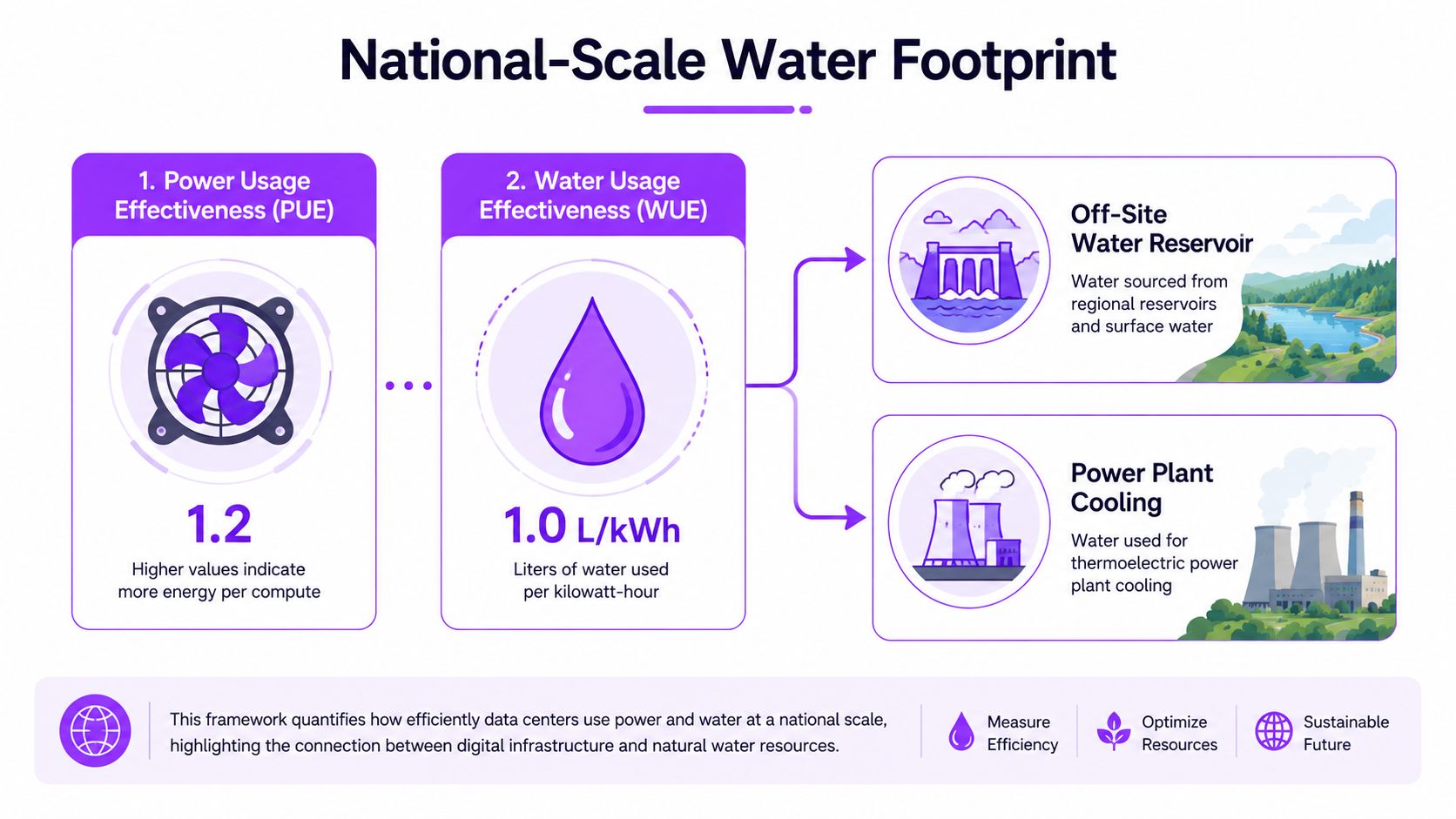
PUE and WUE are useful because they translate facility operations into comparable efficiency measures. Power Usage Effectiveness divides total facility electricity demand by IT equipment electricity demand. Water Usage Effectiveness divides total water consumption by IT energy and is expressed in liters per kWh, as defined in the Lawrence Berkeley National Laboratory report.
Lower PUE indicates less non-IT electricity overhead. Lower WUE indicates lower direct water intensity, especially from cooling. Neither metric, by itself, captures the water consumed to generate the electricity that powers the facility.
The off-site water burden
A 2026 sector fact sheet estimates that U.S. data centers indirectly consumed roughly 800 billion liters of water through electricity generation in 2023, according to the Environmental Law Institute's water fact sheet.pdf). That figure changes the site-selection question. A facility with modest direct cooling demand can still impose substantial water pressure through the generation mix supplying its electricity.
The same fact sheet estimates global data center electricity use at about 415 TWh in 2024, or roughly 1.5% of global electricity demand, and U.S. data centers at about 176 TWh in 2023, or 4.4% of U.S. electricity consumption. These figures connect water risk to the power system rather than leaving it at the building fence line.
National planning needs a water ledger
A country-level assessment should combine:
- Direct water use: Cooling withdrawals, consumption, treatment, and discharge.
- Indirect water use: Water consumed by the generation sources serving the facility.
- Basin exposure: Drought, competing municipal demand, agricultural use, and ecological limits.
- Disclosure quality: Whether operators and utilities publish comparable PUE and WUE data.
The indirect share can dominate in water-intensive generation systems. A Bluefield Research analysis projects that 72% of total water consumption associated with data centers could occur off-site through electricity generation by 2030, with indirect use rising from 54 billion gallons in 2025 to 91 billion gallons by 2030. Those are projections, but they support a critical policy conclusion: national data center planning must track water embedded in electricity procurement.
Turning the National Lens Into a Searchable Directory
A national data center strategy becomes testable when it can be expressed as a repeatable directory workflow. The first step is to define the country and decide whether the research covers active facilities only or also includes planned and under-construction sites.
The second step is classification. A useful scope can separate colocation, hyperscale, sovereign, government, carrier, and edge facilities. That prevents unlike assets from being blended into one national total.
A practical research sequence
- Define the country. Set geographic boundaries before collecting facilities, operators, and power data.
- Set facility class thresholds. Decide which facility types belong in the analysis and how mixed-use campuses will be treated.
- Filter capacity and efficiency. Use IT power, PUE, WUE, status, and available grid information where disclosed.
- Apply the policy overlay. Add zoning, water-stress, interconnection, tariff, and sovereignty conditions.
- Validate each row. Separate disclosed figures from estimates and distinguish announced projects from commissioned capacity.
The Data Centers List directory supports this workflow with a searchable global facility inventory, status labels, operator information, IT power fields, map views, and contextual overlays where data is available. Its value in national analysis isn't the map alone. The useful output is a comparable set of facility records that can be checked against policy and infrastructure conditions.
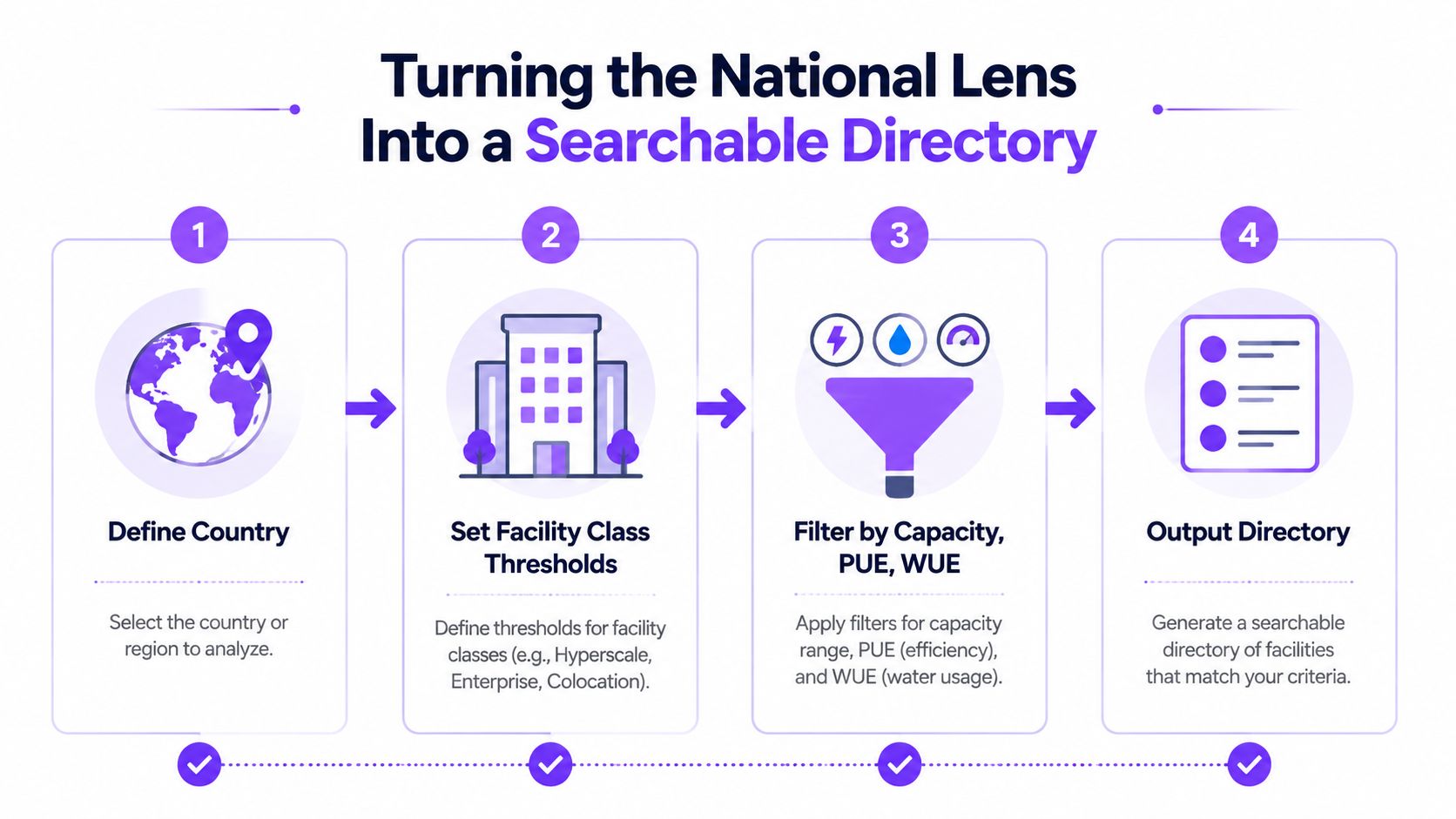
From inventory to infrastructure judgment
Analysts should cross-check water-stress overlays against facility WUE values and verify announced projects against commissioned megawatts. A country may appear to have extensive pipeline capacity while lacking the grid connections, permits, or water arrangements needed to operate it.
The final checklist is straightforward:
- Country selection: Define the jurisdiction and relevant policy authorities.
- Site scope: Include only the facility classes needed for the question.
- Infrastructure filters: Review capacity, status, efficiency, grid mix, and water context.
- Policy overlay: Record zoning, interconnection, tariffs, water rules, and sovereignty requirements.
- Operator due diligence: Verify ownership, disclosures, project stage, and update dates.
That process turns a broad national data center claim into an auditable research set. It also exposes the conclusion many facility explainers miss: compute capacity is national infrastructure only when the country can connect it, cool it, regulate it, and allocate its costs transparently.
Data Centers List offers an interactive directory and map for comparing facilities by country, status, operator, and available power information. Analysts, developers, and infrastructure researchers can visit Data Centers List to build a facility-level view of national capacity and assess the grid and water context behind each project.