Colocation Data Centers Explained for Modern Teams
Learn how colocation data centers work, retail vs wholesale models, costs, and how to evaluate power, uptime and location before you choose.
16 min read
A growing team usually reaches colocation at an awkward moment. The office server room is full, hardware refreshes are becoming disruptive, and the cloud bill no longer behaves like a fixed operating expense. The business needs more control and capacity, but building a private facility would create a second company to operate.
Colocation data centers offer a middle path. A tenant owns its servers and software, while an operator supplies the engineered environment around them. That arrangement can preserve hardware control without requiring the tenant to design the building, electrical system, cooling plant, security perimeter, and network room.
The market is expanding, but growth alone doesn't answer the buyer's most important question. The global data center colocation market is estimated at USD 91.1 billion in 2025 and projected to reach USD 184.4 billion by 2033, according to Grand View Research's colocation market analysis. A separate forecast places the market at USD 84.05 billion in 2024 and projects USD 204.41 billion by 2030, with a 14.4% CAGR, in MarketsandMarkets' industry forecast. Different forecasts use different methods, but both point to sustained demand.
This guide is for infrastructure operators, prospective tenants, site selectors, and analysts. It moves from the basic operating model to cloud comparisons, then into the constraints that increasingly determine whether a facility is useful: power availability, rack density, cooling design, interconnection, permitting, and delivery timing.
The central idea is simple. A colocation facility isn't merely a building in a convenient city. It is a position in a power, network, and permitting system. Geography still matters, but queue position and infrastructure readiness may matter more.
Table of Contents
- Introduction Why Colocation Still Matters in 2026
- How Colocation Data Centers Actually Work
- Colocation Versus Hyperscale and Private Cloud
- Power Density and Cooling Define the Design Limits
- Uptime Interconnection and Latency That Actually Matters
- Evaluating Operators Markets and Hidden Costs
- Putting It All Together and Choosing Your Next Step
Introduction Why Colocation Still Matters in 2026
A company may start with a few servers under a desk or in a small locked room. As the workload grows, the problems arrive together: heat accumulates, circuits become difficult to document, maintenance interrupts office operations, and physical access controls remain weaker than the applications require. Moving everything to a hyperscale cloud can solve the facility problem, but it may introduce variable costs, less hardware control, or constraints around specialized equipment.
Colocation changes the division of labor. The tenant continues to select, own, install, and manage its hardware. The operator manages the facility systems that keep that hardware available, including electrical distribution, cooling, physical security, fire protection, and network access. The tenant buys access to professional infrastructure without owning the entire property.
That middle position makes colocation useful for several different situations:
- Stable workloads: Dedicated hardware can suit applications that run continuously and need predictable resource planning.
- Hardware-specific workloads: Specialized servers, storage, or accelerators remain under the tenant's control.
- Regulated environments: Physical custody, access procedures, and audit evidence can be managed alongside the tenant's own controls.
- Hybrid architectures: Colocated equipment can connect privately to cloud resources, offices, partners, and other facilities.
The difficult part begins after the basic definition. A facility can advertise available space while lacking the power delivery, cooling architecture, or interconnection options that a particular deployment requires. A city can look attractive on a map while a project remains delayed by grid access, permitting, or construction sequencing.
Practical rule: Treat the facility as an operating system for physical infrastructure. Floor space is only one resource, and often not the scarce one.
The useful decision is therefore not whether colocation is cheaper than cloud or better than an office server room. The useful decision is whether a specific workload fits a specific facility's power profile, availability objectives, network design, compliance needs, and deployment timetable.
How Colocation Data Centers Actually Work
The clearest analogy is commercial real estate. A business can own a building and operate every utility, or it can rent space in a professionally managed property. Colocation resembles renting space in a highly engineered building, except the property has carefully designed electrical paths, cooling systems, security controls, and network connections.
The tenant brings the computing equipment. The operator provides the environment that supports it.
The shared-responsibility boundary
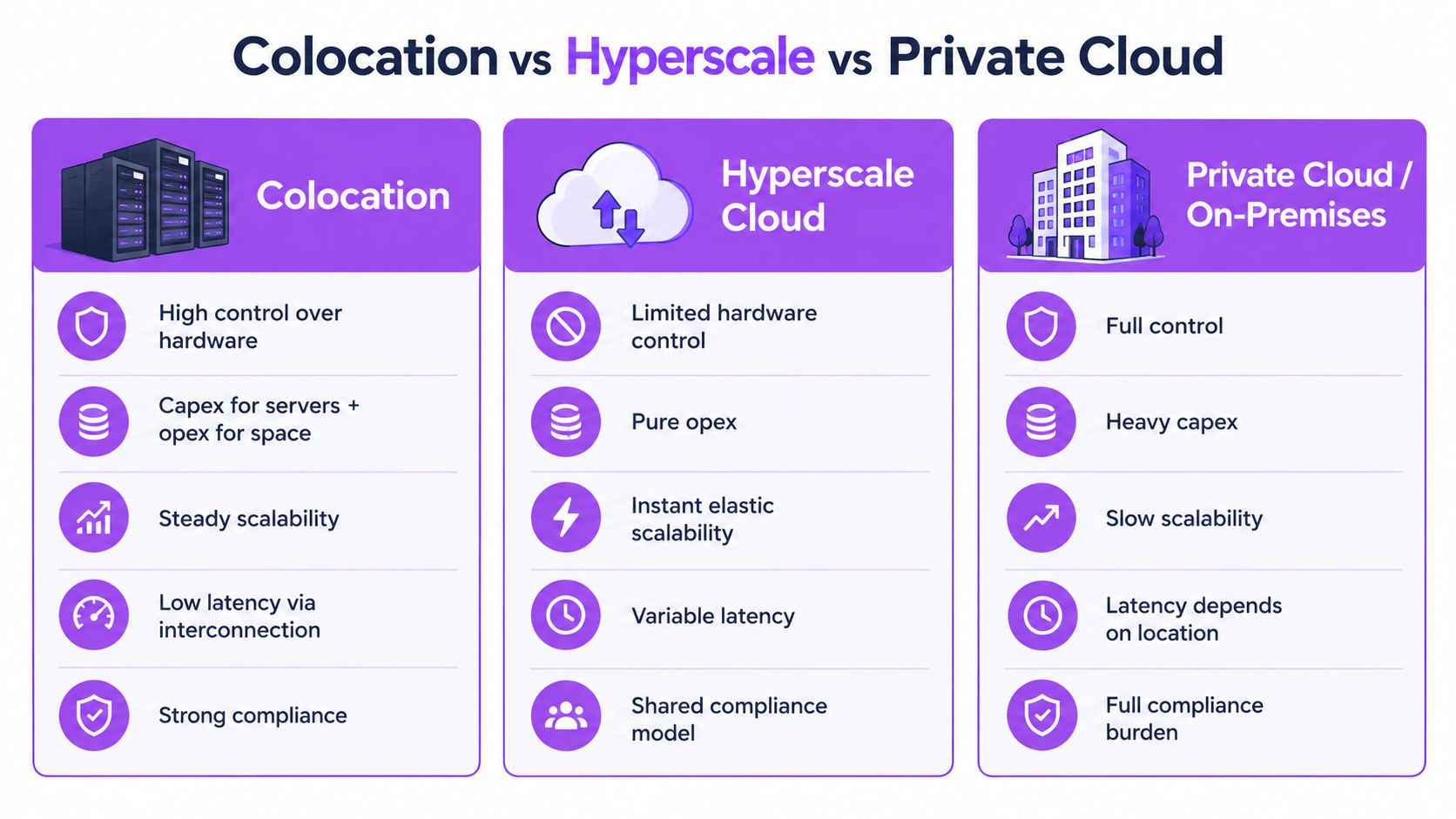
A typical arrangement divides responsibilities into two layers:
- The operator's layer: Building systems, utility feeds, UPS equipment, generators, cooling, fire suppression, physical access, monitoring, and facility connectivity.
- The tenant's layer: Servers, storage, operating systems, applications, data, device configuration, patching, and workload-level resilience.
The boundary must be documented rather than assumed. If a server fails, the tenant may own replacement and diagnosis. If the power path fails, the operator may carry responsibility under the service agreement. If an application depends on two independent facilities, the tenant must design that redundancy even when each individual site has resilient infrastructure.
Colocation may also include managed services. An operator can perform remote hands tasks, equipment installation, basic checks, or other agreed activities while the tenant retains ownership of the hardware. That option can help a distributed team reduce travel without surrendering control.
Retail and wholesale arrangements
Retail colocation generally serves smaller footprints, such as cabinets, cages, or a limited number of racks. It suits tenants that need a professional facility but want to expand in increments.
Wholesale colocation serves larger power blocks or dedicated halls. The tenant usually commits to a more substantial environment and may control more of the internal fit-out. The commercial model is less about renting a few positions and more about reserving dependable capacity for a large deployment.
The most important comparison field is not just square footage. Buyers should compare usable IT power, reserved power, delivered power, and expansion power. Those labels can mean different things, so the operator should define them in writing and express capacity consistently in MW or kW.
Ask for the status behind every capacity number. “Available,” “planned,” “energized,” and “ready for customer load” describe different procurement realities.
A good evaluation also identifies who controls each decision, what happens during a maintenance event, how access is approved, and whether network services come from one provider or a broad carrier ecosystem. The contract matters because the physical building is only half of the operating model.
Colocation Versus Hyperscale and Private Cloud
The choice becomes clearer when each model is judged against the workload rather than against a generic feature list.
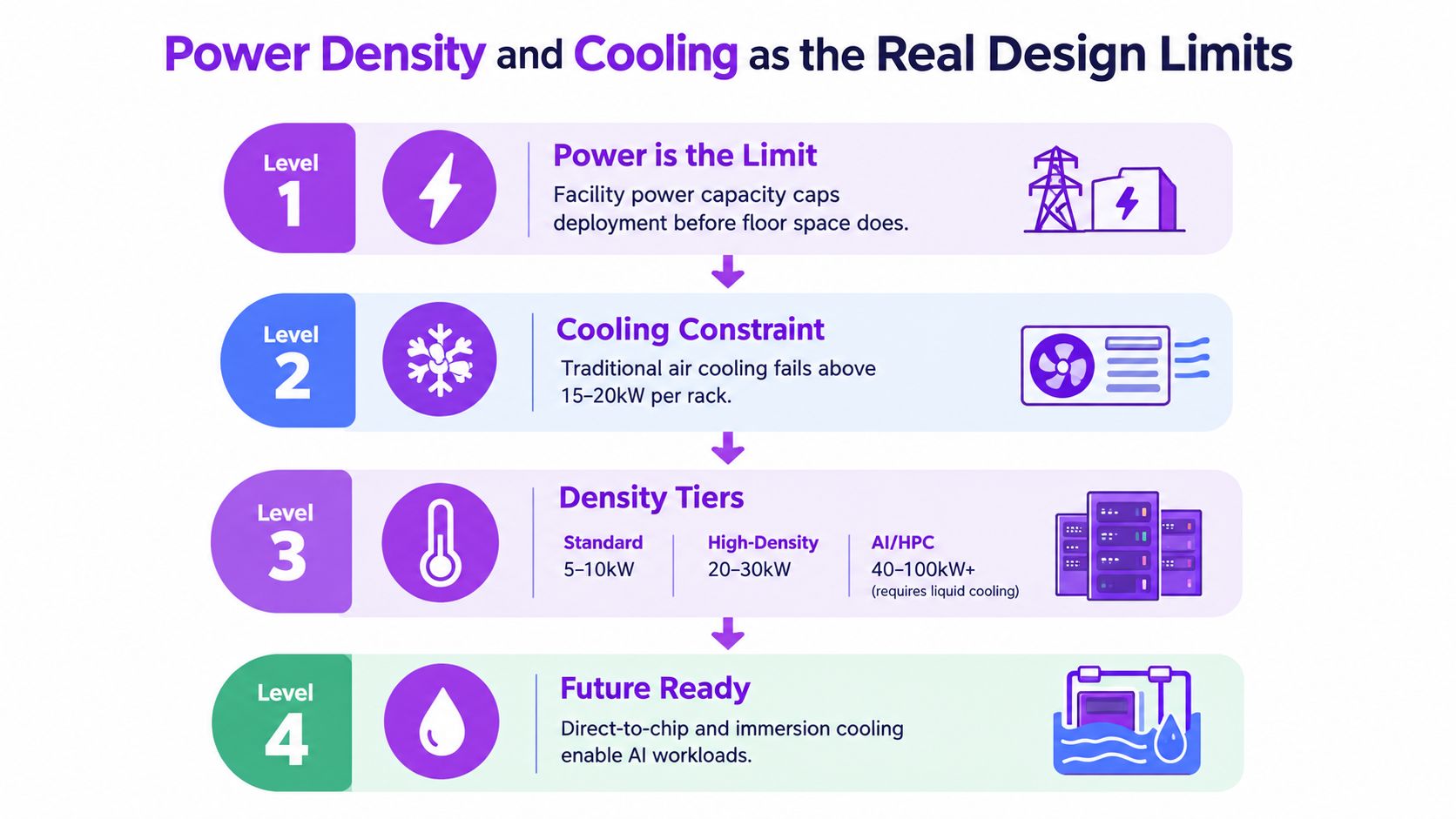
With colocation, the tenant controls physical hardware and chooses how to configure it. Capital spending still covers servers and related equipment, while space, power, and facility services become operating expenses. Scaling is steady rather than instantaneous, but the tenant can optimize a fixed environment for a known workload.
With hyperscale cloud, the provider owns the infrastructure and exposes virtualized or managed services. The tenant gains rapid provisioning and elastic capacity, which is valuable for bursty workloads, experimentation, and services that depend on managed databases or analytics. The trade-off is less physical control and a cost model that can become difficult to predict when usage changes.
With private cloud or on-premises infrastructure, the organization owns the hardware and the facility responsibility. That offers maximum control, but also makes the organization responsible for construction, power, cooling, security, staffing, maintenance, and expansion.
A practical comparison
| Decision criteria | Colocation | Hyperscale cloud | Private cloud on premises |
|---|---|---|---|
| Hardware control | High, the tenant owns and manages equipment | Limited, the provider owns the physical platform | Full |
| Cost pattern | Server capital expense plus facility operating expense | Primarily operating expense | Heavy capital expense plus facility operations |
| Scaling | Planned, physical expansion | Rapid and elastic | Slowest, because the organization builds capacity |
| Latency | Can be optimized through private interconnection | Depends on region, service path, and network design | Depends on the facility's location and connectivity |
| Compliance responsibility | Shared between tenant and operator | Shared between tenant and cloud provider | Fully carried by the organization |
| Best fit | Stable, specialized, controlled workloads | Bursty demand and managed services | Maximum ownership and policy control |
Consider an AI inference service with a known hardware profile. Colocation may fit when the organization needs direct control over accelerators, network design, and data placement. The tenant still has to reserve suitable power and cooling, but the hardware remains available for its own operating model.
A regulated data platform may also suit colocation when physical custody and dedicated equipment matter. The facility can provide physical controls and audit evidence, but the tenant remains responsible for application security, identity, configuration, and data governance.
A seasonal analytics workload points in another direction. If demand rises and falls sharply, cloud elasticity may outweigh the benefit of owning fixed hardware. A hybrid model can place the predictable baseline in colocation and send temporary demand to cloud resources.
The right question isn't “Which model is cheapest?” It is “Which cost, control, and scaling behavior matches the workload?”
A useful decision lens has three tests. First, determine whether the workload needs specific hardware or physical control. Second, separate steady demand from bursts. Third, identify whether latency, sovereignty, or compliance requires a particular location and connection model. Only after those tests should a buyer compare facilities.
Power Density and Cooling Define the Design Limits
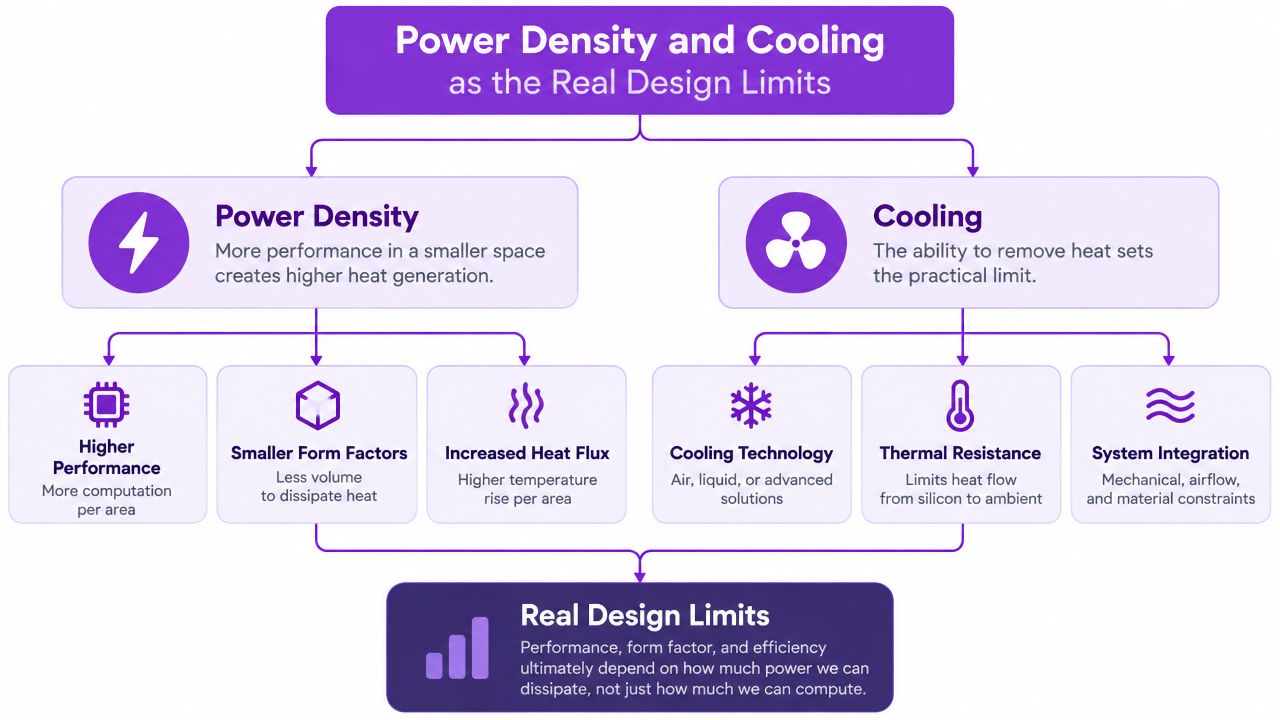
A colocation decision can fail before the floor plan fills up. Each rack draws electricity, and nearly all of that electricity becomes heat. As computing becomes denser, the limiting factor may be the facility's available power or cooling capacity, not its amount of floor space.
Industry guidance places high-density deployment at roughly 15 to 20 kW per rack. Power-dense environments may operate in the 40 to 125 kW per cabinet range, while some extreme AI and high-performance computing racks reach 200 kW or more, as described in industry guidance on high-density deployments.
These figures describe different engineering requirements, not interchangeable labels. A conventional air-cooled rack and an AI cabinet can occupy similar floor area while placing very different demands on busways, breakers, transformers, chillers, heat exchangers, and monitoring systems. For a buyer, queue position for suitable power and the site's density readiness may matter more than geography alone.
What density changes operationally
At lower densities, air cooling and conventional aisle management may be enough. As rack loads rise, the operator needs clear separation between supply and return air, validated airflow paths, and cooling sized for the actual cabinet profile rather than an assumed room average.
Hot and cold aisle containment limits mixing between cooled air and heated exhaust, improving predictability. It does not solve every high-density requirement. Depending on the hardware, the facility may need rear-door heat exchangers, direct-to-chip liquid cooling, immersion systems, or a hybrid design.
Power delivery must also be validated at cabinet level. A contract promising a large facility block does not prove that every position can receive the required load through the intended redundant paths. Request the rack-level design, circuit allocation, maximum sustained load, permitted load swings, and commissioning process for a new cabinet.
Why failure impact increases with density
A high-density cabinet concentrates more computing capacity in one physical position. A power-distribution failure therefore removes more processing at once, while a cooling failure can eliminate thermal margin quickly, particularly when clustered equipment changes load rapidly.
A directory profile such as Green Datacenter ZRH3 can support initial facility research. It cannot replace technical validation with the operator. The procurement team still needs evidence that the selected hall, power path, cooling method, and interconnection plan match the deployment.
Ask specific questions:
- Rack delivery: What continuous and peak kW can each cabinet receive?
- Redundancy: Are both power paths physically available at the intended position?
- Thermal design: Which cooling method supports the proposed hardware?
- Load behavior: Can the system handle rapid GPU load changes?
- Expansion: Is future density supported, or only additional floor space?
Density readiness is a go or no-go condition. Empty cabinets do not represent usable capacity for a high-density workload if the required cooling and power paths are unavailable. In practice, permitting progress, interconnection access, and a place in the power queue can determine deployment timing as much as the building's location.
Uptime Interconnection and Latency That Actually Matters
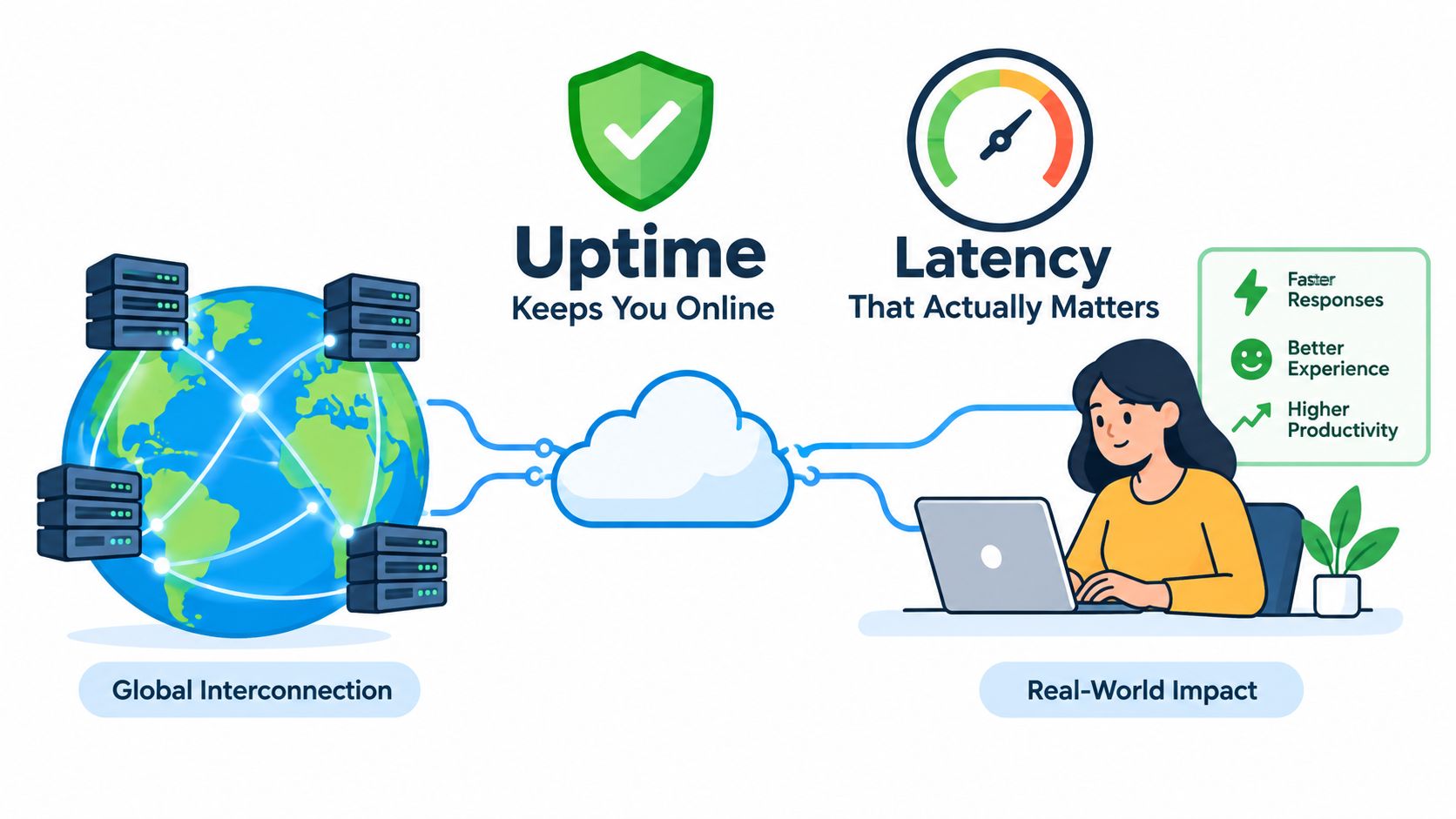
A colocation decision can fail before servers arrive if power delivery and network paths are treated as building features rather than deployment constraints. An industry survey of data center operators places average rack density across surveyed facilities at about 8 kW and identifies power as the leading cause of impactful outages. Redundant power paths, UPS systems, and backup generation therefore protect specific transitions, from utility supply to stored energy and then to generation.
A UPS bridges a short interruption and stabilizes the load while a backup source starts or the distribution path changes. Generators support longer disruptions. Independent distribution paths reduce the chance that one maintenance task or component failure removes both supplies.
The cabinet is the inspection point. A facility may have resilient infrastructure at the building level while a particular rack receives one feed, depends on one panel, or relies on a poorly documented connection. Ask for the actual delivery path, testing records, and cabinet-level redundancy before treating a facility rating as evidence of usable uptime.
Connectivity is an architecture choice
Interconnection determines how many network hops separate colocated equipment from the systems it uses. A private cross-connect can avoid a public-internet route and provide a more controlled connection to a cloud region, carrier, partner, or another tenant.
The same industry survey records cloud on-ramp latency often around 1 to 1.3 milliseconds round trip, while some dedicated links between nearby facilities measure about 1.05 milliseconds. These figures are examples, not guarantees. Distance, route design, equipment, congestion, and the selected service determine actual performance.
Carrier-neutral design preserves options, but physical presence alone is not enough. Confirm:
- Which carriers and exchange points are present?
- How quickly can a cross-connect be ordered and installed?
- Are entrances and routes physically diverse?
- Does the facility provide direct access to the required cloud environments?
- Can the tenant connect to a second site without using a public path?
A profile such as Equinix GV2 in Geneva can support initial facility research. Route maps, service availability, installation timelines, and written operator confirmation must support the final decision.
Latency should match the application. Database replication, interactive financial systems, media workflows, and batch transfers tolerate different delay and interruption patterns. Low latency has value only when the route remains reliable, the connection is available when required, and the commercial terms fit the architecture. Queue position, interconnection access, and density readiness can matter more than geography alone.
Evaluating Operators Markets and Hidden Costs
A facility can be near users and still be a poor choice if its power delivery date is uncertain. Start with a requirements sheet rather than a map. Record the workload's IT load, cabinet density, redundancy requirement, network endpoints, compliance controls, deployment date, and expected expansion. These fields turn a location search into a test of whether a site can support the intended deployment.
Capacity is a delivery claim
Operators should separate total facility capacity, commissioned capacity, contracted capacity, and power that can be delivered immediately. A large development pipeline does not mean the requested load is ready. Utility work, permitting, equipment delivery, and internal construction can each change the schedule.
The procurement question is direct: can the operator deliver power, and when? Recent industry coverage presents that question as central to the 2026 colocation market. Industry brokerage reporting cited in the same analysis states that primary wholesale asking rates for 250 to 500 kW requirements rose 6.6% year over year to USD 196.25 per kW per month in H2 2025. The pressure reflects constrained capacity, not demand for more floor space.
Location therefore means more than proximity to users or network hubs. A viable market needs a credible route through the power queue, planning process, construction schedule, and interconnection workflow. Queue position may matter more than a favorable pin on a map.
Resource impacts belong in the shortlist
A serious review also examines where water use, energy demand, noise, traffic, and permitting burdens will fall. Industry reporting describes AI adoption as changing cooling design and says distributed colocation is being reshaped by power constraints, permitting delays, and data-sovereignty requirements. The same U.S. colocation market analysis values the multi-tenant market at USD 13.85 billion in 2026 and cites expectations that operators will add over 23.2 GW of installed power capacity in the United States from 2025 to 2030.
Those figures show market scale, not local suitability. Planning records, water-stress context, cooling design, energy sourcing, and community consultation reveal the conditions around a specific site. Teams operating in the United Kingdom may also need to navigate environmental regulations early, rather than treating permitting as a final administrative task.
A practical screening method
Use consistent fields across every candidate:
- Power readiness: Separate delivered, reserved, and future capacity.
- Density fit: Record the maximum supported rack profile and cooling method.
- Connectivity: List carriers, cross-connect paths, cloud access, and route diversity.
- Schedule: Capture energization, commissioning, access, and expansion milestones.
- Local context: Review water stress, grid conditions, noise, planning constraints, and community effects.
- Operator evidence: Request outage history, maintenance procedures, SLA language, and pipeline documentation.
A global operator and facility directory can support the first comparison by organizing markets, capacity fields, facility status, and operator portfolios. It does not replace contractual diligence, engineering review, or local permitting research. Its value is a consistent starting dataset before requesting detailed proposals and testing whether each site is ready for the required power, density, and interconnection pattern.
Putting It All Together and Choosing Your Next Step
Colocation is often introduced as a real-estate alternative to an office server room. That description is incomplete. The decisive questions increasingly concern utility access, permitting, rack density, cooling readiness, interconnection, and delivery timing.
The decision sequence can remain simple:
- Define the workload: Separate steady demand from bursts, document hardware needs, and calculate expected cabinet density.
- Set resilience requirements: Specify power-path redundancy, recovery objectives, maintenance tolerance, and geographic diversity.
- Map connectivity: Identify cloud, carrier, partner, user, and secondary-site endpoints.
- Filter markets by readiness: Check grid access, permitting status, commissioned capacity, and delivery queue.
- Compare the full burden: Include energy, water, noise, compliance, network services, expansion, and operational support.
The market data shows why this discipline matters. Forecasts project strong global growth, while capacity constraints and high-density workloads make a generic “available space” label less useful. A buyer needs to know whether the facility can support the exact rack, power path, cooling architecture, and connection pattern required.
A global directory with status labels, capacity-scaled maps, operator views, and local-impact context can narrow the field. The most practical starting point is one market comparison, not an attempt to assess every facility at once. Once the requirements are explicit, the shortlist becomes an infrastructure decision rather than a real-estate browsing exercise.
Data Centers List offers a searchable global directory of active, planned, and under-construction facilities, with operator, status, location, and power-capacity fields for market comparison. Use the Data Centers List directory to compare one target market, check queue and pipeline context, and build a more evidence-based colocation shortlist.