Why Are Data Centers Important: The Digital Backbone Guide
Discover why are data centers important for the global economy. Explore their role in cloud computing, AI growth, jobs, energy, and infrastructure.
13 min read
Data centers are important because they provide the physical infrastructure behind digital services, and they already consumed about 415 TWh of electricity in 2024, roughly 1.5% of global electricity demand. The International Energy Agency projects that share could approach 3% by 2030, making data centers a concern for utilities, communities, investors, and governments, not only technology teams.
A data center is easy to overlook because its output appears on a screen rather than in a factory or shop. Yet every cloud application, digital payment, online meeting, stored file, and AI response depends on buildings filled with servers, storage systems, network equipment, backup power, and cooling infrastructure. The cloud is a delivery model. The data center is the physical system that makes it work.
The deeper answer to why are data centers important therefore reaches beyond website hosting. These facilities connect the digital economy to electricity planning, land use, skilled labor, national resilience, and the limits of high-density computing.
Table of Contents
- The Hidden Infrastructure Running Modern Life
- How Data Centers Power the Digital Economy
- Local Economic Impact and Infrastructure Trade-offs
- Mapping Global Capacity and Market Trends
- Why AI and High-Density Computing Are Reshaping Design
- Resilience, Security, and National Infrastructure Strategy
- What Makes Data Centers Important Beyond Technology
The Hidden Infrastructure Running Modern Life
In 2024, data centers consumed about 415 TWh, or roughly 1.5% of global electricity demand, according to the International Energy Agency's analysis of data-center electricity use. That figure reframes the familiar explanation that data centers “power the internet.” They're no longer a small back-office category hidden behind consumer technology. Their electricity demand is large enough to influence how power systems, transmission investments, and energy policies are planned.
A person streaming a film, checking a bank balance, ordering a product, or posting a message sees an interface. Behind that interface, data centers store information, execute software instructions, route network traffic, and maintain copies of critical data. The same physical layer supports business applications, public services, communications, and increasingly demanding machine-learning workloads.
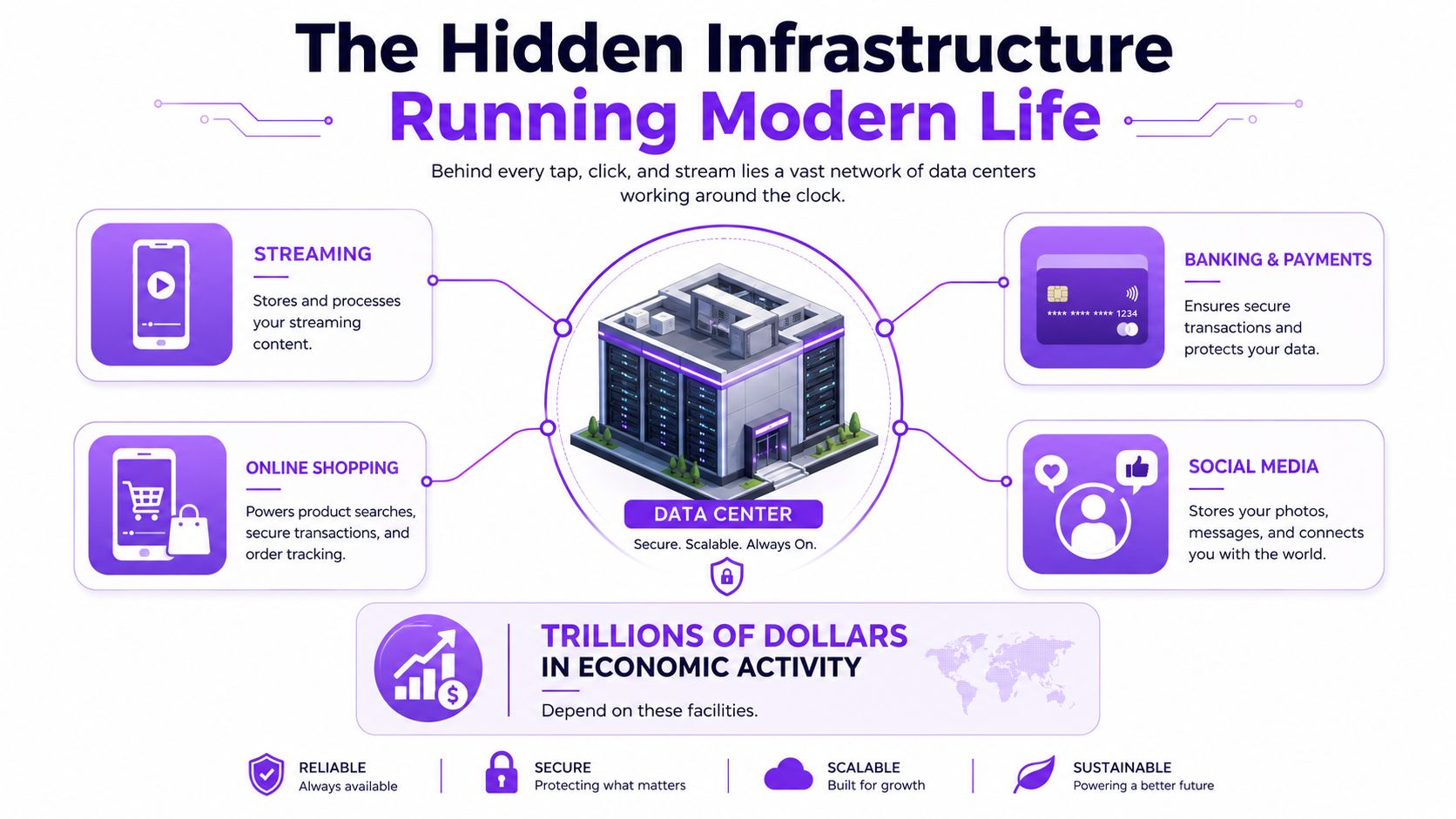
Convenience has a physical cost
The facilities provide speed and continuity, but they also consume resources that local authorities must manage. Operators need suitable sites, dependable power connections, cooling systems, network routes, security controls, and access to construction and technical labor. As demand accelerates, those requirements can collide with housing priorities, water constraints, transmission limitations, and local environmental expectations.
The IEA projects data-center electricity consumption could reach around 945 TWh by 2030, nearly 3% of global electricity demand, in the same energy analysis. The important conclusion isn't that digital services use energy. It's that decisions made by cloud and AI companies can now affect public infrastructure far beyond the facility boundary.
Practical rule: A digital service should be evaluated through both its software function and its physical dependency on power, cooling, connectivity, and operating capacity.
That perspective changes the question from “What does a data center host?” to “What economic and civic systems fail if its infrastructure is unavailable, constrained, or concentrated in the wrong place?” The answer includes far more than websites. It includes the continuity of digital commerce, enterprise operations, communications, and emerging AI services.
How Data Centers Power the Digital Economy
Data centers perform four connected jobs. They provide compute for applications and analysis, storage for files and databases, networking for moving information, and operational continuity for services that users expect to remain available. Cloud providers, colocation operators, and enterprise facilities arrange those resources differently, but all depend on the same physical principles.
A streaming service needs servers to process requests and deliver content. A bank needs secure systems to update records and authorize transactions. A remote-work application needs compute and networking that can respond to users in different locations. AI systems add another layer, requiring facilities that can process large datasets and run computationally intensive models.
Availability and latency solve different problems
Reliability and responsiveness aren't interchangeable. A facility can be highly available yet still be too far from users for latency-sensitive applications. Locating compute closer to users reduces latency and improves application response times, a relationship described in the World Bank's discussion of data-center infrastructure.
Tier IV facilities are designed for 99.99% expected availability, which translates to about 26 minutes of downtime per year, according to the same source. That design target matters for services where interruption can disrupt transactions, operations, or communications, but geographic distribution still matters because distance affects the path data travels.
A useful operating model separates the ecosystem into distinct roles:
| Facility role | Primary function | Strategic value |
|---|---|---|
| Hyperscale campus | Large-scale cloud and computing capacity | Supports broad digital platforms and major workloads |
| Colocation facility | Hosts equipment for multiple organizations | Gives customers shared physical infrastructure |
| Enterprise facility | Serves a specific organization | Provides direct control over business systems |
| Edge location | Places compute nearer to users or devices | Reduces delay for location-sensitive applications |
The global data-center directory helps make this physical ecosystem easier to examine by organizing facilities by location and operational status. That kind of visibility matters because digital capacity isn't evenly distributed. A region with abundant network connectivity but limited power availability may perform differently from a region with strong electricity access but fewer suitable sites.
The strategic shift is clear. Data centers don't merely host websites. They anchor the operating layer of digital economies, and their geography influences resilience, performance, and the services that businesses can deliver.
Local Economic Impact and Infrastructure Trade-offs
A proposed data center often arrives in a community as both an investment opportunity and a planning challenge. Construction can support demand for electricians, engineers, builders, security specialists, and other trades. Long-term operations require technical staff to maintain electrical systems, cooling equipment, networks, servers, and physical security.
The benefits become more durable when operators work with local schools, vocational programs, and workforce agencies. Without that connection, a community may receive construction activity while many specialized roles go to workers recruited from elsewhere. The distinction matters because a facility's economic value depends not only on capital entering a region, but also on whether local residents can build careers around the infrastructure.
Power, water, and land change the local calculation
Electricity is the most visible infrastructure constraint because data centers need continuous service and may request substantial new capacity. The IEA's projected increase in global consumption, described in its data-center electricity outlook, means local grid planning can no longer treat every facility as an isolated commercial load.
Cooling creates another trade-off. Depending on the design and local conditions, facilities may require water, mechanical cooling equipment, or alternative thermal systems. Land use, backup generation, noise, visual impact, and new transmission infrastructure can also shape public acceptance.
A serious community assessment should ask:
- Who pays for grid upgrades? Costs should be allocated transparently rather than transferred to customers without a clear explanation.
- What local benefits are guaranteed? Workforce training, tax arrangements, infrastructure improvements, and community programs should be specific.
- How is water managed? Operators and authorities should disclose the cooling approach and its relationship to local water conditions.
- What happens under stress? Emergency generation, drought, grid congestion, and extreme weather belong in the planning discussion.
A facility profile such as the Amazon Louisiana data center campuses illustrates why location-specific analysis matters. The relevant question isn't whether data centers are good or bad for communities. It's whether the project's resource demands, economic commitments, and infrastructure costs are visible before approval.
Growth is responsible only when a community can see both the value it receives and the infrastructure burden it accepts.
That standard turns data centers into infrastructure stress tests. A strong project aligns power, water, land, labor, and public benefits instead of treating each issue as a separate approval.
Mapping Global Capacity and Market Trends
A map of data centers reveals something that cloud diagrams conceal: digital capacity is geographic. Facilities cluster around power availability, network routes, customers, land, regulatory conditions, and specialized labor. Analysts who ignore those variables can mistake a software market opportunity for a buildable infrastructure opportunity.
A practical assessment starts with facility status. Active sites show current capacity, while planned and under-construction facilities reveal where operators expect demand to develop. The distinction helps investors, consultants, and site-selection teams separate operating reality from future intention.
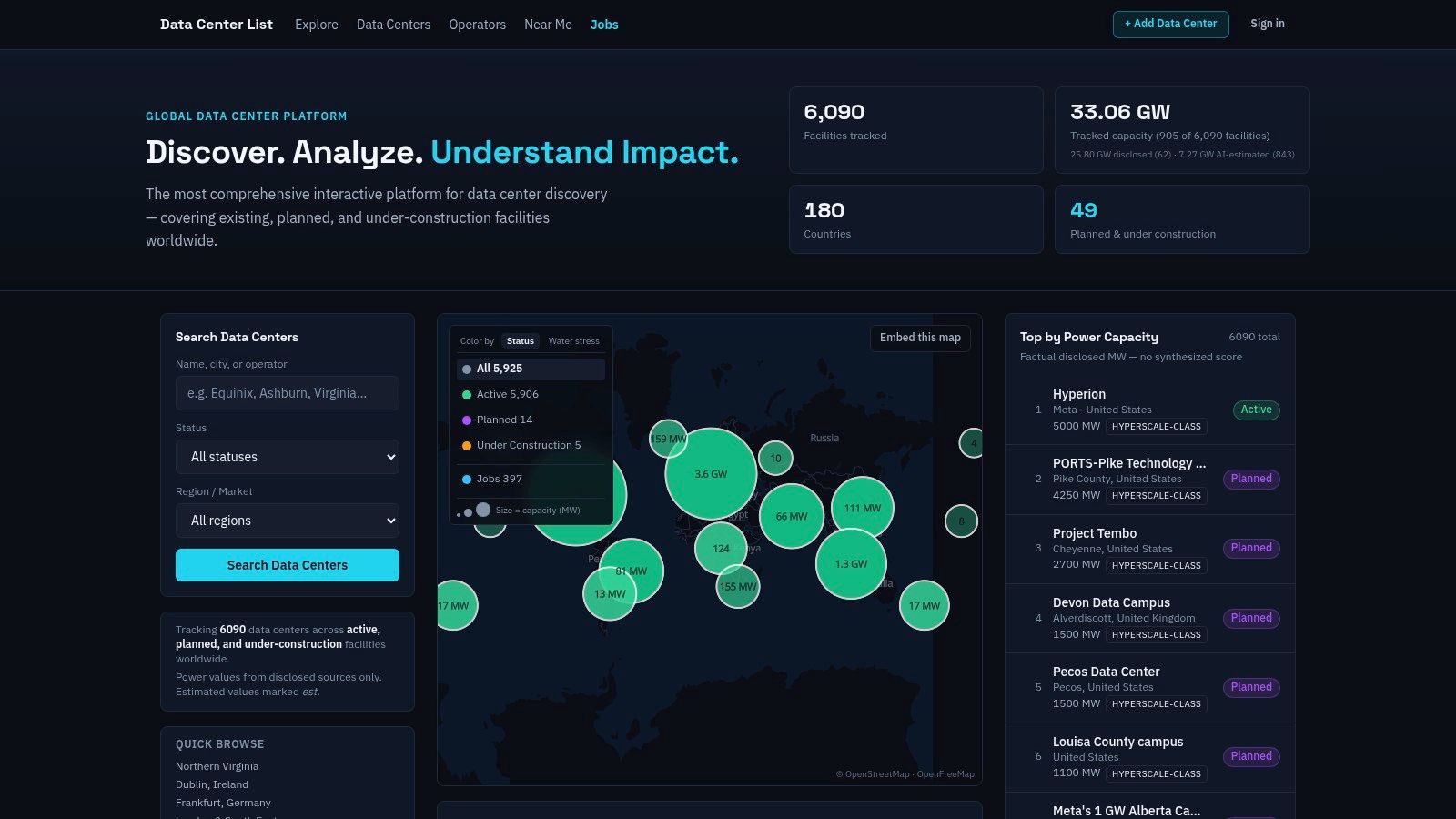
A disciplined way to read the physical market
A structured directory such as Data Centers List can be used as a starting point for four analytical tasks:
- Locate concentration. Searchable maps and regional views show where facilities cluster and where a market may be developing.
- Separate status categories. Active, planned, and under-construction labels help distinguish current supply from pipeline capacity.
- Review capacity quality. IT power figures should be read alongside their disclosure status, because disclosed and AI-estimated values represent different levels of certainty.
- Compare operators and regions. Operator profiles, ranked capacity views, and facility attributes support market benchmarking.
The most useful conclusion doesn't come from counting buildings alone. It comes from comparing capacity, status, geography, and confidence. A region with many announced projects may still face grid delays, permitting friction, or uncertain delivery dates. A smaller market with fewer facilities may offer stronger network access or more practical expansion conditions.
That approach also helps explain why market rankings can change. New campuses, upgrades, and delayed projects alter the balance between current capacity and expected supply. For investors, the pipeline is not a promise. It's a set of signals that must be tested against power access, construction feasibility, operator commitments, and local policy.
Structured facility data turns the question “where is the cloud?” into a decision framework. It gives analysts a way to connect digital demand with the buildings, electrical systems, and sites that must support it.
Why AI and High-Density Computing Are Reshaping Design
AI is changing data-center design because it concentrates computation into denser hardware. Traditional facilities could distribute workloads across server racks using established electrical and air-cooling arrangements. AI and high-performance computing clusters place greater pressure on rack power, thermal transfer, floor layout, and the ability to deliver electricity without interruption.
Conventional perimeter cooling is generally suited to about 20–25 kW per rack, while an industry assessment of AI cooling methods and capacities describes much higher requirements for newer AI and high-performance computing deployments. The result is a design problem, not merely an equipment refresh. Operators must coordinate power delivery and cooling architecture before they can determine how much computing a building can safely contain.
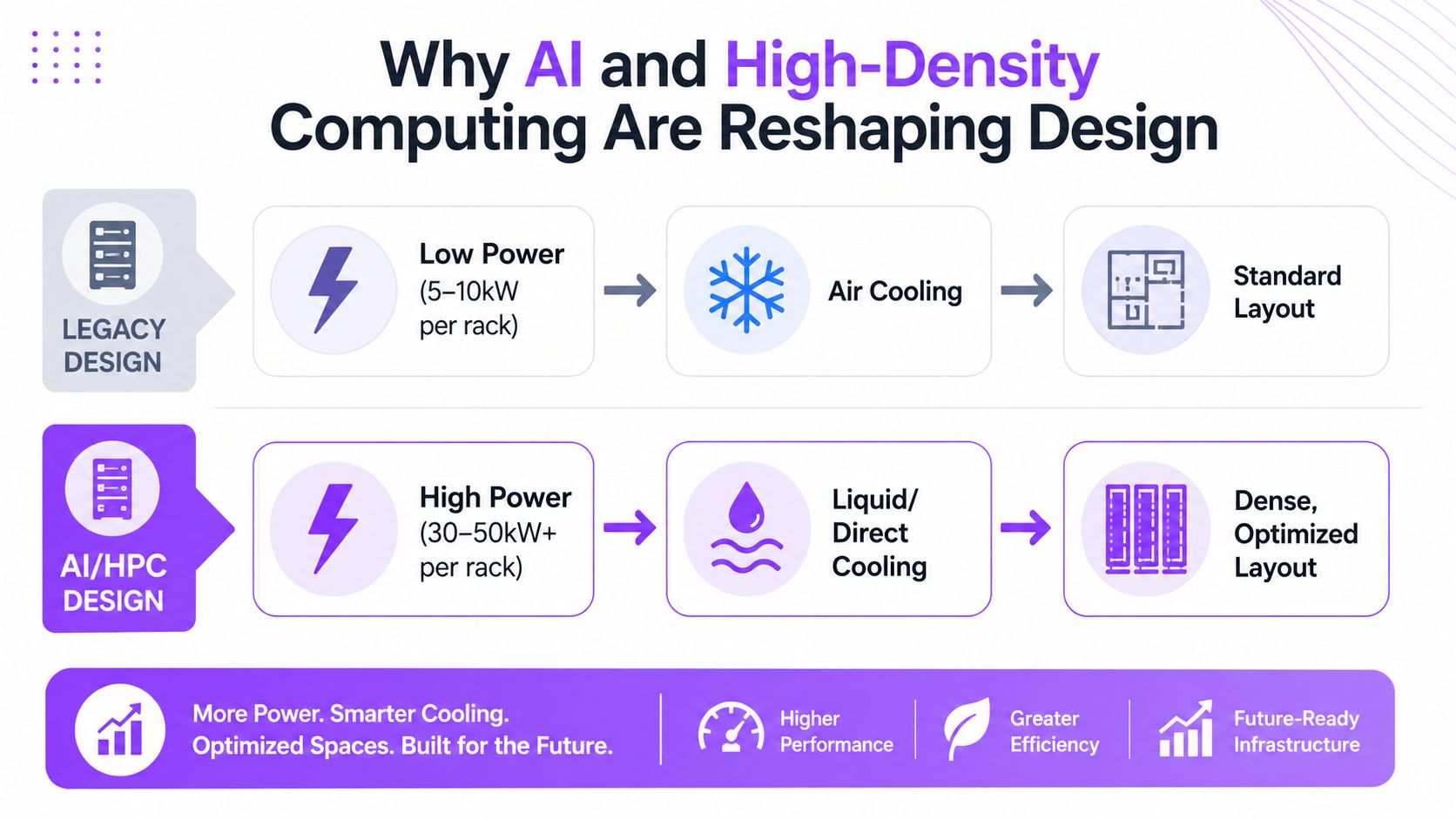
Density becomes a site-selection constraint
The same assessment projects AI power demand could rise from 4.3 GW today to between 13.5 GW and 20 GW by 2028, as reported in the Uptime Institute analysis. That projection makes utility capacity a direct determinant of AI expansion. A site may have land and fiber, but those advantages don't compensate for an electrical connection that cannot support the intended workload.
Cooling choices also affect deployment speed and operating risk. Air systems may remain appropriate for some workloads, while direct or liquid cooling can become necessary as heat concentrates around high-performance processors. Each approach affects plumbing, maintenance, equipment layout, water strategy, and the skills required to operate the facility.
A high-performance site such as the High-Performance Computing Center in Stuttgart is useful as a reference point for understanding that computing infrastructure is designed around workload characteristics. The physical building must match the computational pattern.
The strategic implication is easy to miss. AI doesn't only increase demand for more servers. It changes the definition of a viable data center by making power density and heat removal central conditions of the site. Grid planners, developers, and equipment teams therefore need to coordinate earlier, because a facility designed for conventional loads may not convert easily to dense AI workloads.
Resilience, Security, and National Infrastructure Strategy
A data center becomes national infrastructure when essential services depend on its continuity. Financial systems, emergency communications, public administration, enterprise operations, and digital identity services all require more than software availability. They require buildings with secure access, redundant systems, reliable power, tested recovery procedures, and network routes that can withstand disruption.
The strategic importance is increasing with workload growth. The IEA's 2025 update on data-center electricity demand reports that global data-center electricity demand grew 17% in 2025, while AI-focused data centers rose 50% in the same year. Those figures show why governments and utilities are paying closer attention to facilities that were once treated mainly as private real estate.
Resilience includes more than backup power
A resilient national data-center strategy has several dimensions:
- Energy security: Operators need dependable electricity, while utilities need clear information about the timing and scale of new loads.
- Supply-chain continuity: Servers, networking equipment, cooling systems, and electrical components depend on complex manufacturing relationships.
- Data governance: Cross-border data flows and jurisdictional requirements influence where organizations can place systems.
- Cyber and physical security: Facilities protect hardware, networks, and sensitive information from both digital and physical threats.
- Geographic diversity: Concentrating capacity in one region can create systemic exposure to grid events, disasters, or political disruption.
Regulators therefore face a balancing problem. Faster approvals can support digital competitiveness, but insufficient review can shift environmental, grid, or community costs onto the public. Clear rules help developers plan, utilities prepare, and communities understand what a project will require.
National competitiveness increasingly depends on whether a country can align computing capacity with secure power, trusted governance, and resilient supply chains.
That alignment also changes the role of site selection. The best site isn't just the one with cheap land or a nearby fiber route. It's the site where energy, security, regulation, workforce access, and community legitimacy can support long-term operation.
What Makes Data Centers Important Beyond Technology
Data centers matter because they join systems that are usually planned separately. A cloud platform depends on buildings and networks. Those buildings depend on electricity, cooling, land, equipment, and skilled workers. Their expansion affects utilities, local governments, investors, regulators, and residents.
The answer to why are data centers important has four practical layers:
- Digital continuity: Facilities keep applications, data, and communications available.
- Economic capacity: They support cloud services, enterprise operations, AI development, and digital commerce.
- Infrastructure demand: Their power and cooling requirements influence grid and resource planning.
- Strategic resilience: Their location and security affect national competitiveness and operational independence.
Different audiences should read the market differently. Investors need to distinguish operating assets from uncertain pipelines. Operators must match workload density with electrical and thermal design. Consultants need to compare sites through power, connectivity, regulation, and community conditions. Job seekers can look beyond software roles toward electrical, mechanical, networking, facilities, and operations pathways.
The central lesson is that the digital economy has a physical limit. Better software can improve efficiency, but software still runs on machines inside facilities that require reliable systems and careful planning. AI makes that relationship more visible by pushing power density and cooling design into the center of technology strategy.
A data center directory and map can help decision-makers connect individual facilities to broader market patterns. Data Centers List provides searchable facility information across operational, planned, and under-construction sites, with location, operator, status, and capacity details where available. That context helps readers evaluate digital infrastructure as an economic asset and a potential local constraint.
Data Centers List offers an interactive global directory and map for examining active, planned, and under-construction facilities, including operator, location, status, and available capacity information. Visit Data Centers List to turn the physical layer of cloud and AI growth into practical market, site-selection, and infrastructure intelligence.