What Is Noise Pollution and Why It Harms Health
What is noise pollution? Learn sources, health risks, how it is measured, and how data centers add to community noise with mitigation options.
14 min read
Noise pollution is unwanted or harmful sound that disrupts health and daily life. In Europe, more than 100 million people are exposed to harmful environmental noise, with measurable effects including heart disease, premature death, chronic annoyance, and sleep disturbance.
A sound doesn't need to be deafening to become a public-health concern. A road outside a bedroom, aircraft passing overhead, a train line, construction equipment, or the steady mechanical hum of a large facility can repeatedly interrupt sleep and keep the body alert. The factors include how loud the sound is, how long it continues, when it occurs, and whether people can escape it.
That distinction changes the answer to “what is noise pollution?” Sound is a physical phenomenon. Noise pollution is an exposure that interferes with rest, concentration, communication, health, or quality of life. A sound that feels harmless during the day may become disruptive at night, when the brain and body need uninterrupted recovery.
Table of Contents
- Introduction to What Noise Pollution Really Means
- How Sound Becomes Pollution and How We Measure It
- Common Sources of Noise Pollution in Daily Life
- Health and Community Impacts Beyond Annoyance
- Understanding Noise Standards and Why Low Levels Matter
- Data Centers as an Emerging Source of Local Noise
- Reducing Noise Pollution and What to Do Next
Introduction to What Noise Pollution Really Means
A resident beside a busy road may not fully wake when a vehicle passes at night. The body can still react. Sleep may become fragmented, the nervous system can shift toward alertness, and the next day may feel less restorative, even when the person remembers sleeping through it.
Noise pollution therefore includes more than explosions, concerts, or industrial alarms. Persistent, repeated, or poorly timed sound can become an environmental exposure when each event seems tolerable on its own. Public-health authorities associate environmental noise with sleep disturbance, annoyance, cardiovascular effects, and impaired daily functioning. The WHO's noise fact sheet explains that harmful effects can begin at relatively low sound levels.
The European burden shows why this is more than a nuisance. The European Environment Agency reports that more than 100 million people in Europe are exposed to harmful environmental noise. Its 2025 assessment says over 20% of Europeans experience harmful transport noise under EU reporting thresholds, rising to over 30% when measured against stricter WHO recommendations. The EEA assessment connects long-term exposure with about 48,000 new cases of heart disease and 12,000 premature deaths each year in Europe.
The practical definition: noise pollution is sound that becomes harmful through its intensity, persistence, timing, or effect on people's ability to rest and function.
Transport remains a major source, but communities also encounter neighborhood machinery, construction, industrial systems, and infrastructure such as data centers. These facilities can add a steady, round-the-clock mechanical background to an area, even when no single moment sounds extreme.
The key idea is simple: noise pollution is measured as exposure, not just volume. A low sound repeated through the night can matter like a small interruption that prevents complete recovery, which is why everyday traffic thresholds and newer infrastructure decisions deserve careful attention.
How Sound Becomes Pollution and How We Measure It
A decibel, written as dB, measures sound level on a logarithmic scale. The scale does not behave like an ordinary volume dial. A small numerical change can represent a meaningful change in acoustic energy, while the same scale can describe both quiet background sound and intense noise.
Environmental health assessments therefore look beyond one isolated reading. Monitoring equipment records sound over time, then calculates indicators that describe exposure across daytime, evening, and nighttime periods. The result is closer to a record of repeated conditions than a snapshot.
From individual sounds to average exposure
Lden means day-evening-night level. It summarizes exposure across those periods while giving extra weight to evening and nighttime sound, when disturbance can be more disruptive.
Lnight focuses on outdoor nighttime exposure. Sleep can be affected without a dramatic noise event. Repeated vehicle movement, mechanical cycling, or a low mechanical hum may interrupt quiet conditions and make stable sleep harder to maintain.
Temperature provides a useful comparison. A weekly average can describe the general climate while hiding a short heatwave. In the same way, an environmental noise average describes overall exposure but may conceal sharp peaks, vibration, tonal hum, or repeated nighttime interruptions. A sound assessment should therefore include both the calculated indicator and the pattern of events behind it.
The WHO Environmental Noise Guidelines for the European Region provide source-specific recommendations and health context for interpreting these indicators. The recommendations address outcomes such as sleep disturbance, annoyance, and cardiovascular risk, rather than discomfort alone. The WHO Environmental Noise Guidelines for the European Region explain how exposure from different sources is assessed.
Why the threshold can feel surprisingly low
Many people associate danger with sound that feels painful or makes conversation impossible. Environmental noise assessment asks a different question: what happens when exposure repeats over time, especially while people sleep? That is why a steady background sound can matter even when it never feels extreme.
A site assessment may distinguish average daytime sound, evening exposure, nighttime levels, maximum events, and tonal characteristics. Readers reviewing planning documents or community reports can use Data Centers List's data center terms to clarify unfamiliar infrastructure language, including terms related to facility equipment and operations.
For projects near homes, schools, or workplaces, measurement should follow a suitable monitoring plan rather than rely on casual impressions. Independent environmental hazard testing can help characterize conditions when residents or project teams need documented evidence instead of a single subjective observation. The same approach helps evaluate emerging 24/7 infrastructure noise, where a consistent mechanical background may be more important than one unusually loud moment.
Common Sources of Noise Pollution in Daily Life
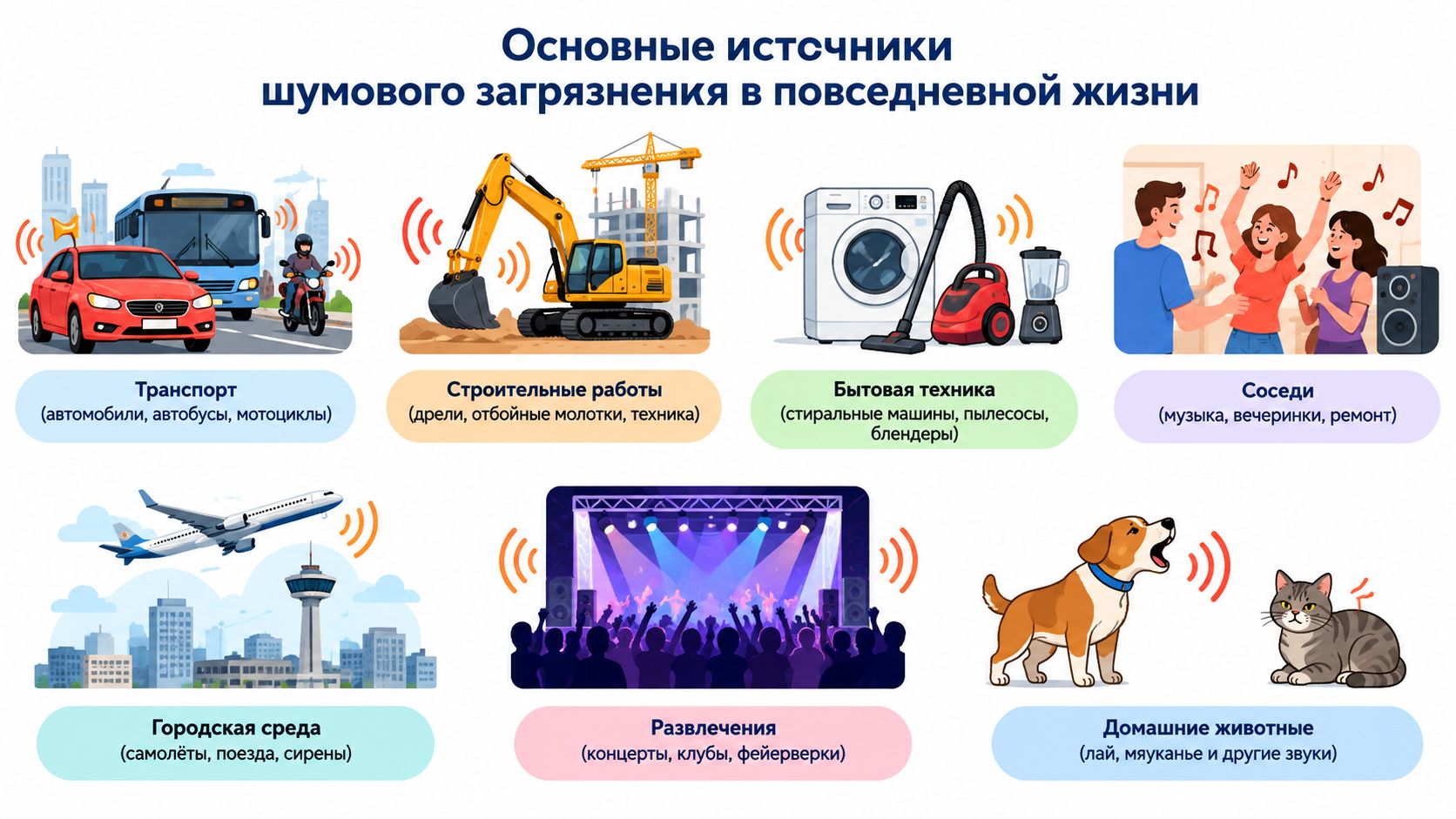
Road traffic is the largest population-wide source in the European evidence base. Earlier WHO-linked assessment estimated 113 million people exposed to daily average road-traffic noise of at least 55 dB(A), and 79 million people exposed to nighttime road-traffic levels of at least 50 dB(A). The underlying WHO material shows why roads matter even when no individual passing vehicle sounds extraordinary.
Traffic produces several sounds at once: tyres rolling, engines, braking, horns, sirens, and acceleration. A home beside a major route may receive sharp fluctuations, while a more distant home may receive a quieter but persistent background layer. Both patterns can matter because exposure depends on repetition, timing, and duration, not only on the loudest moment.
Different sources create different exposure patterns
Railway noise is usually intermittent, with pronounced events as trains pass. Aircraft noise arrives as a moving overhead event, while construction noise may be concentrated during working hours and involve powerful equipment. These patterns do not affect people in exactly the same way, even when their average measurements look similar.
Indoor sources can accumulate:
- Building systems: Ventilation, pumps, lifts, and heating equipment may create a steady mechanical background.
- Household activity: Appliances, music, home renovation, and neighboring apartments can interfere with concentration or rest.
- Animals and community activity: Barking, deliveries, voices, and outdoor gatherings can cause repeated interruptions.
- Industrial equipment: Compressors, generators, fans, and cooling plant may operate for extended periods, sometimes through the night.
An occasional loud event can startle someone. A continuous hum can act more like a recurring interruption, especially during sleep. Low-frequency or tonal noise may feel intrusive because it travels through structures and remains noticeable even when its measured average does not seem extreme.
Newer infrastructure adds another source. Large cooling systems and backup generators near data centers or electrified facilities can produce persistent local noise complaints, even when the buildings are visually discreet. Recent environmental-health evidence describes the shift toward infrastructure-adjacent exposure and the need to assess community impact across the full operating period, including the quieter nighttime hours.
Health and Community Impacts Beyond Annoyance
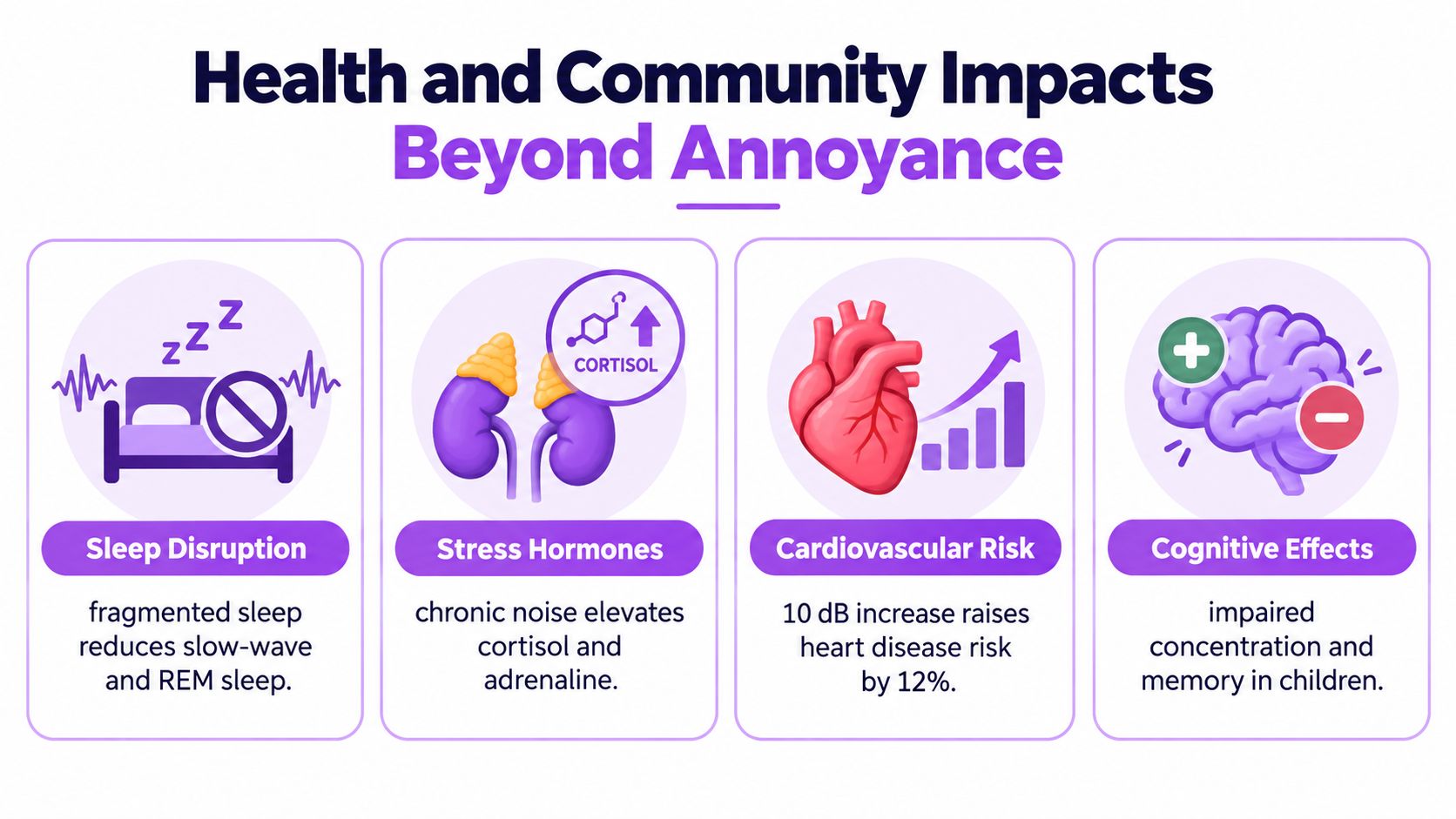
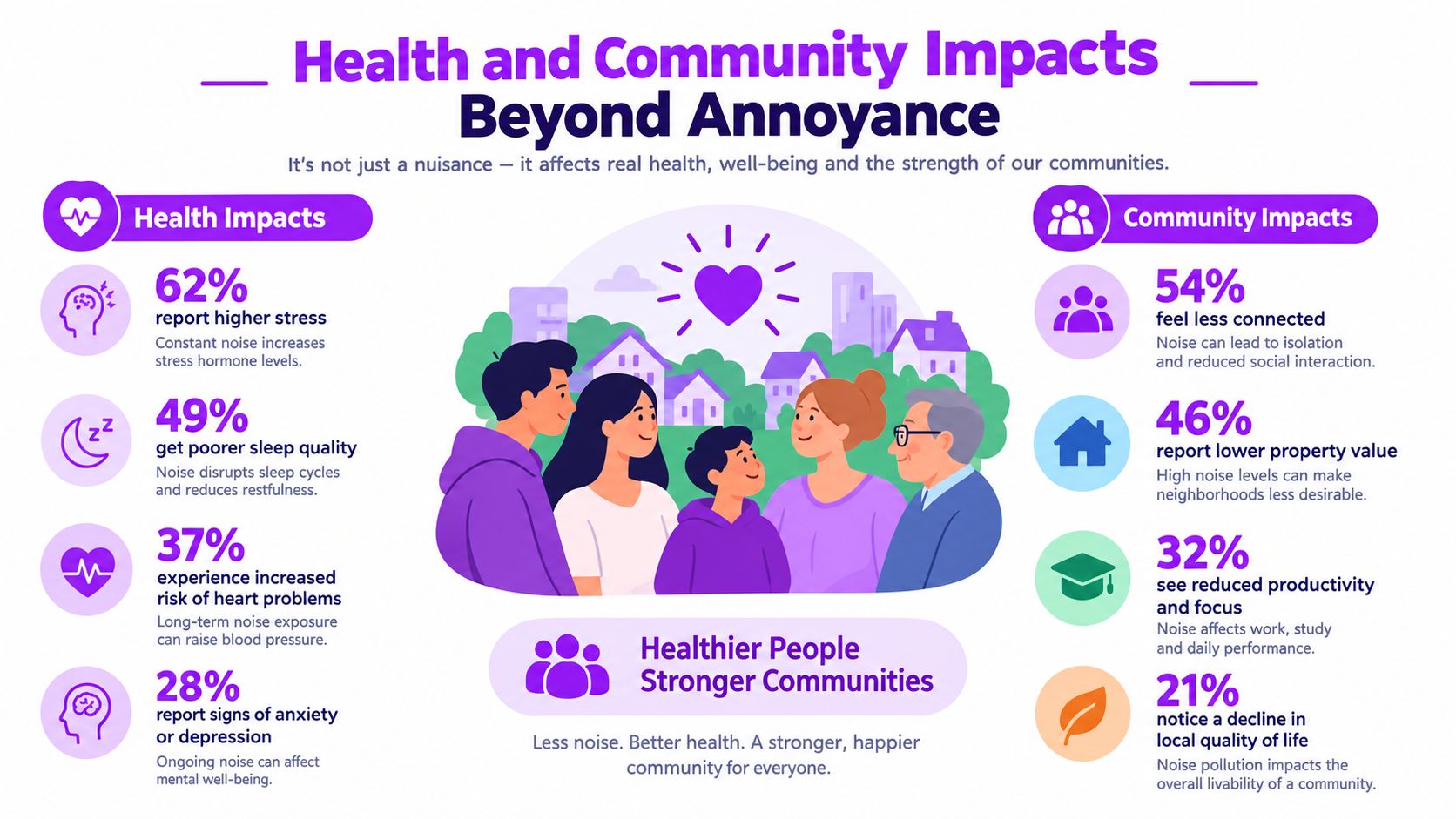
Noise pollution becomes a health concern through repeated exposure, especially during sleep. A person does not need to remember waking up for sound to affect rest. Repeated noise can trigger brief arousals, interrupt sleep continuity, and keep the nervous system alert when the body should be recovering.
That response can extend beyond the bedroom. Environmental noise may affect heart rate and vascular function through physiological systems linked with alertness. Night after night, disrupted sleep and repeated stress responses can add to cardiovascular risk. Noise acts less like a single interruption and more like a background alarm that rarely allows the body to settle fully.
The population burden is measurable
Long-term environmental noise is associated with substantial community-wide effects, including chronic annoyance and chronic sleep disturbance. A recent European health assessment reports 22 million people with chronic high annoyance and 6.5 million with chronic high sleep disturbance. These figures are summarized in the EEA's 2025 health assessment.
These figures describe a population burden, not a prediction that every exposed person will develop a particular condition. Individual risk varies with exposure history, overall health, location, vulnerability, and other environmental factors. The public-health concern is cumulative: repeated exposure across many homes and communities can produce a measurable burden even when no single event appears severe.
Earlier WHO burden-of-disease work estimated that traffic-related environmental noise caused at least 1 million healthy life years to be lost each year in western Europe. The assessment included ischemic heart disease, cognitive impairment in children, sleep disturbance, tinnitus, and annoyance among the relevant outcomes. The WHO publication explains this burden-of-disease framework.
Low-level nighttime sound isn't automatically harmless
A 2026 randomized crossover study involving 74 healthy adults found that low-level nighttime road-traffic noise impaired endothelial function, raised heart rate, and disrupted sleep. The result matters because it points to acute physiological effects in young, otherwise healthy adults, rather than limiting concern to people exposed to extreme workplace sound. The study's full research document provides the relevant evidence.
Noise also affects learning and mental restoration. Children may have greater difficulty concentrating in persistently noisy settings, while adults may experience fatigue, irritability, and reduced focus. Hearing-related harm is a separate but connected concern, particularly where exposure includes loud occupational, recreational, or equipment noise. A focused overview of noise induced hearing loss statistics can help explain that pathway, while environmental assessment must also account for sleep and cardiovascular effects.
Understanding Noise Standards and Why Low Levels Matter
Noise standards become clearer when you separate reporting thresholds from health-protective recommendations. A legal or administrative threshold determines which exposures authorities count, map, or regulate. A health recommendation sets a benchmark intended to reduce harm. The same location can therefore receive different assessments, depending on the benchmark used.
The EEA reports that more than 20% of Europeans experience harmful transport noise under EU reporting thresholds, while the share rises above 30% under stricter WHO recommendations. The EEA comparison shows why the selected standard changes the apparent scale of the problem.
WHO recommended noise limits by source
| Source | Lden limit | Lnight limit | Key health link |
|---|---|---|---|
| Road traffic | Below 53 dB | Ideally below 40 dB outdoors at night | Sleep disturbance and cardiovascular risk |
| Railway | Below 54 dB | Ideally below 40 dB outdoors at night | Sleep disturbance and annoyance |
| Aircraft | Below 45 dB | Ideally below 40 dB outdoors at night | Sleep disturbance and cardiovascular risk |
The table summarizes the recommended road, railway, aircraft, and nighttime values in the WHO's noise guidance for Europe. Use it as a way to interpret exposure patterns, not as a diagnosis based on one reading. A measurement describes sound at a particular place and time, while health risk also depends on duration, timing, frequency, and personal vulnerability.
Why ten decibels matters in research
Research reviews associate road traffic noise with ischemic heart disease, stroke, heart failure, hypertension, diabetes, depression, dementia, and all-cause mortality. One umbrella review found roughly 4.1% higher ischemic heart disease risk, 4.6% higher stroke risk, and 4.4% higher heart failure risk per 10 dB(A) increase in annual average road noise. The published review record provides the underlying analysis.
A ten-decibel change does not produce an identical outcome for every person. It signals a meaningful shift in exposure, much like a small change in a dashboard reading can indicate a different operating condition. Levels below older nuisance assumptions may still matter, especially at night, when recurring sound can interfere with sleep and recovery.
These standards also matter for infrastructure decisions. A project can comply with a reporting rule yet remain relevant to nearby residents if sound is continuous, tonal, or concentrated during sleeping hours. Health-based guidance keeps that difference visible.
Data Centers as an Emerging Source of Local Noise
A data center can look quiet from a distance, yet operate as a continuous industrial sound source. Behind a windowless exterior, cooling fans, pumps, transformers, and backup generators may run, cycle, or stand ready around the clock. The building's appearance therefore reveals little about its acoustic footprint.
Cooling equipment can create a steady hum or tonal sound, while generator testing, maintenance, and power interruptions produce shorter, louder events. Vibration may travel through structures or the ground. For a nearby resident, the exposure resembles a background appliance that never fully switches off, interrupted by occasional changes in pitch or intensity.
Why local context matters
Noise at a data center boundary should be assessed with measurements, operating schedules, and modeled conditions rather than building size alone. A single daytime reading can miss nighttime cooling, tonal fan noise, or generator tests. The relevant question is how the source behaves over time where people sleep, work, and study.
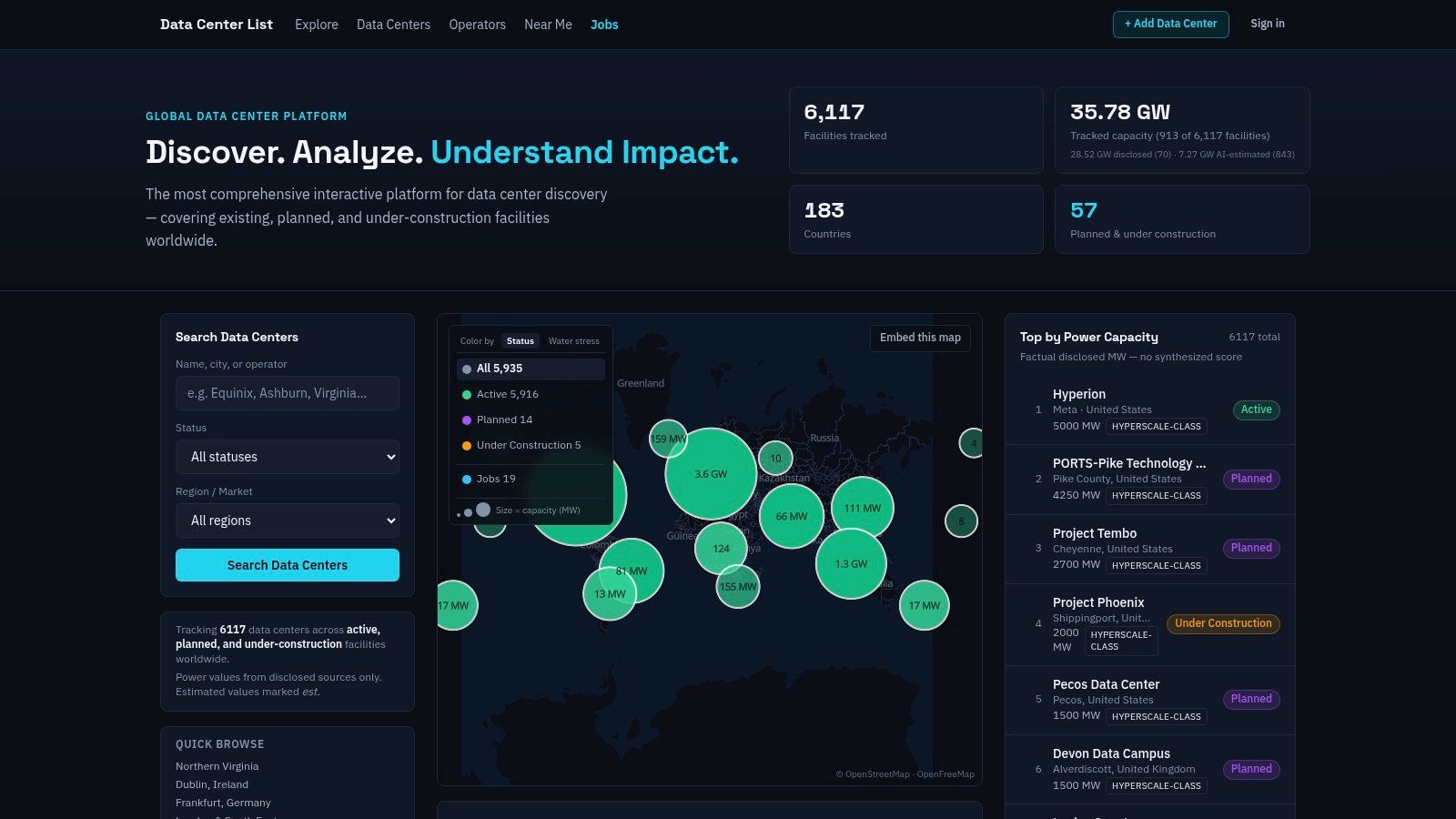
A facility directory cannot replace an acoustic survey, planning record, or community consultation. It can establish the geographic context for those checks. Data Centers List's global data center directory organizes facility locations, operating status, operator information, and capacity fields, including disclosed or estimated values where available.
That context supports practical questions:
- Location: How close is the facility to homes, schools, and other sensitive uses?
- Status: Is the site active, planned, or under construction?
- Operations: Which cooling and backup-power systems may operate outside daytime hours?
- Cumulative exposure: Are roads, rail lines, industrial sites, or other persistent sources nearby?
- Evidence quality: Has the project published baseline measurements, modeled contours, monitoring plans, and nighttime assumptions?
A data center's local impact depends on equipment, schedules, acoustic design, terrain, and existing sound. Treating it as a measurable environmental exposure makes infrastructure review more useful than judging the site by visibility or apparent quiet.
Reducing Noise Pollution and What to Do Next
Noise reduction works best when it starts at the source. Project teams can select quieter equipment, specify acoustic performance, isolate vibration, and design cooling and power systems so that tonal or impulsive noise doesn't dominate nearby environments.
The next layer controls the path between source and receiver. Enclosures, barriers, building orientation, distance, and façade design can reduce transmission. For homes and other occupied buildings, properly designed glazing and seals may improve indoor conditions. A practical overview of double glazing noise reduction can help explain how window design fits within a broader acoustic strategy, although windows can't solve an outdoor source by themselves.
A practical review checklist
- Ask for baseline data: Look for measurements taken before construction or operation, including nighttime conditions.
- Check the operating schedule: Confirm whether cooling, testing, deliveries, and generator activity can occur during sleep hours.
- Review the metric: Identify whether documents report Lden, Lnight, maximum events, tonal noise, or another indicator.
- Compare cumulative sources: Assess traffic, rail, aircraft, industrial equipment, and the proposed facility together.
- Require verification: Independent monitoring and transparent complaint procedures are more useful than unsupported assurances.
- Track the operator: Facility owners and operators can be researched through Data Centers List's operator directory, then matched against planning documents and public disclosures.
Residents can also reduce personal exposure by improving bedroom placement, closing gaps around windows and doors, using quieter appliances, and protecting hearing during loud work or recreation. Those steps help individuals, but lasting improvement usually depends on planning decisions, source controls, enforcement, and meaningful community participation.
Noise pollution becomes manageable when communities measure it carefully and ask specific questions about timing, persistence, and health. Data Centers List offers facility locations, status, operator information, capacity context, and research-oriented local impact fields to support that process. Visit Data Centers List to investigate data center projects in a chosen area and use the available context to prepare better questions about noise, infrastructure, and community health.