What Is Data Verification? a 2026 Guide
Learn what is data verification, how it differs from validation, and why it is essential for accurate datasets in data center directories and quality controls.
19 min read
Data verification is the process of confirming that data accurately matches its original source, while validation checks whether data meets predefined rules before use. In a data center directory, that difference shows up the moment one submission says a facility runs on 150 MW of IT capacity and the operator's own material points to 80 MW, because the question is no longer whether the number looks formatted correctly, but whether it can be trusted.
If that sounds familiar, the issue is probably already sitting in a spreadsheet, a CMS, or a reporting dashboard. A field can look clean, yet still be wrong in a way that changes a market ranking, a site comparison, or a public directory entry. That's why data verification is a recurring quality-control practice, not a one-time check at entry, and why it matters whenever records are copied, transformed, or integrated across systems, as noted in the practitioner guidance on verification and the EPA's QA framework for source reconciliation and acceptance criteria. Data verification practitioner guide, EPA data quality guidance
Table of Contents
- What Data Verification Means in Practice
- How Verification Differs from Validation
- Core Methods Used to Verify Data
- The Four Dimensions of Verification
- Verifying Data Center Directories in the Real World
- The Cost of Skipping Verification
- Making Verification an Ongoing Practice
- Key Takeaways and Common Misconceptions
What Data Verification Means in Practice
A new facility submission lands in the queue. The form says a site has 150 MW of IT capacity, but the operator's public material says 80 MW. The analyst's job is not to decide which number sounds more plausible. The job is to check which number matches the original source records, then document what was confirmed and what still needs follow-up.
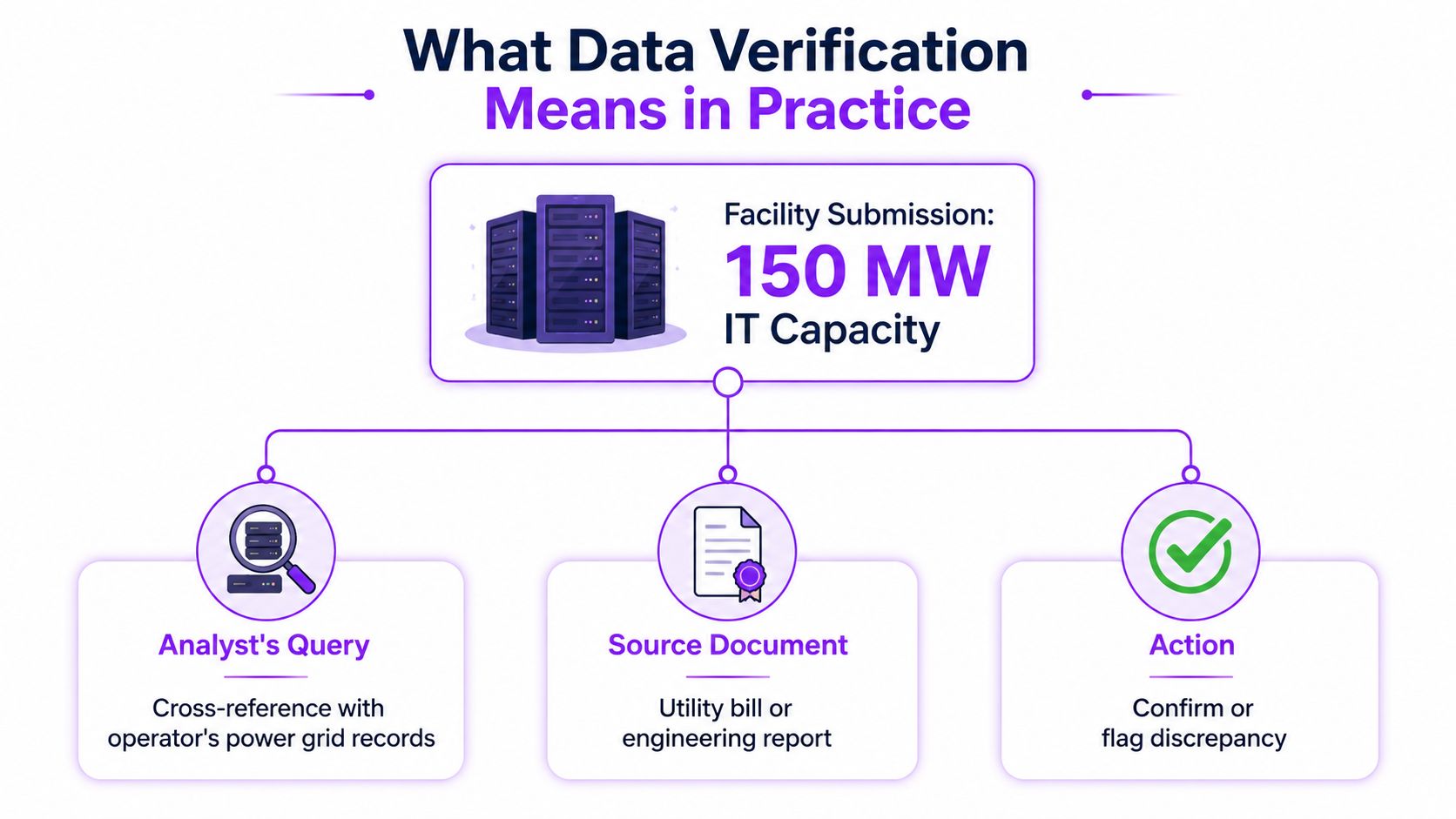
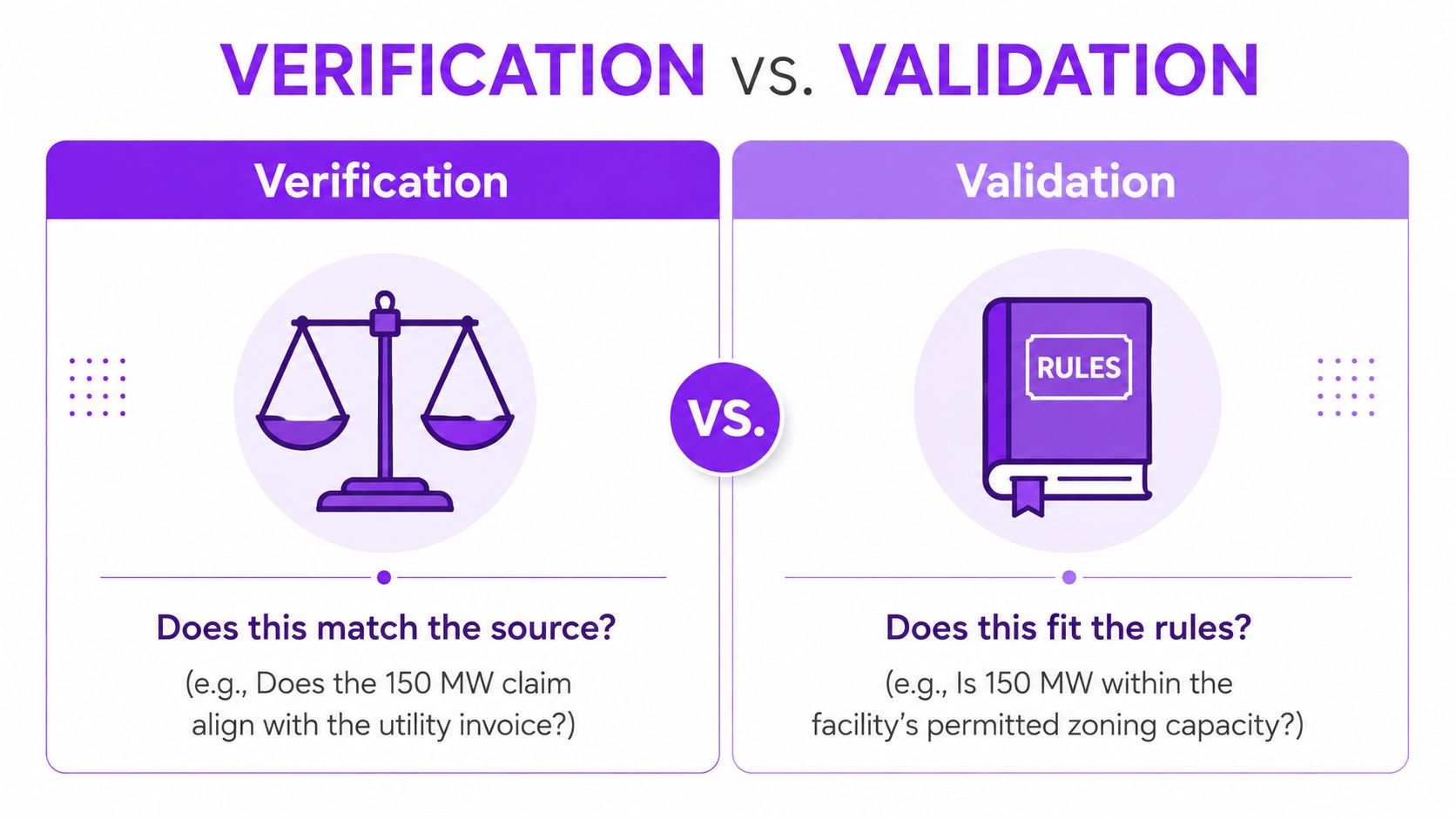
Data verification asks a simple question, does this data match its source? That is different from validation, which asks whether the value fits predefined rules before use. In practice, verification is about checking a record against the original disclosure, filing, operator page, or other source that produced it. Validation can tell you that a field is present and formatted correctly. Verification tells you whether the field is trustworthy enough to publish or reuse.
That distinction matters because facility data often moves through several hands. A capacity figure may start in a disclosure, get copied into an internal spreadsheet, then appear in a public directory. Each transfer creates room for transcription errors, stale updates, or values that were estimated instead of disclosed. A record can look clean and still be wrong.
Why the distinction matters in a directory workflow
A data center directory entry can pass a quick sanity check and still be wrong. The country can be set to United States, the status can be active, and the capacity field can be numeric, yet the capacity might still be copied from the wrong source document. A record like that is formatted correctly, but it is not confirmed.
The difference shows up most clearly in a directory workflow. Analysts working through a directory need to separate disclosed figures from estimates, then separate estimates from confirmed disclosures. If a facility profile includes an AI-estimated capacity, that value should be handled as a different kind of signal from a disclosed figure, not treated as if both carry the same level of certainty.
Practical rule: a clean form is not the same thing as a confirmed record.
The analyst should think in layers. First, the record should clear rule-based validation. Then it should be reconciled against an original disclosure, an operator page, a filing, or another authoritative record. Only after that should the record be treated as verified enough for public use. In a directory context, that also means noting where the value came from, whether it is direct or inferred, and whether a later update changed the meaning of the number.
What a beginner should look for first
Three questions usually catch the confusion early.
- Source match: Does the value line up with the original document?
- Update trail: Has the number been copied, transformed, or summarized anywhere else?
- Audit record: Can the reviewer show how the decision was made?
That sequence keeps verification from turning into a vague “looks right” exercise. It also prepares a directory team to handle live updates, because facilities change over time and their records need fresh confirmation. A public directory such as Data Centers List shows why source clarity, status labels, and consistent fields matter when readers need to tell a disclosed MW figure from an inferred one.
How Verification Differs from Validation
A facility profile can look clean and still be wrong. The country is set to United States, the status is active, and the MW capacity field contains a number. Validation accepts that record because the fields are present and the values fit the expected format. Verification asks a different question, whether that capacity matches an original filing, operator disclosure, engineering note, or utility record for the same site.
That gap matters in a data center directory. A record can move through the pipeline without errors and still publish a figure that was copied from a draft, tied to the wrong campus, or lifted from the wrong reporting period. A record can also be source-accurate and still be hard to use if the fields are malformed, inconsistent, or impossible to sort. The two checks solve different failures, and a directory needs both.
How the two checks work together
A good workflow starts with structure, then moves to source review for the fields that shape decisions. Validation catches obvious problems first, such as a missing status or a capacity field that is not numeric. Verification follows by checking whether the figure in the profile matches the evidence behind it, especially when a number can be disclosed in one place and estimated in another.
In a directory setting, that second step is where the analyst separates a direct disclosure from an inferred value. A campus listing may show an AI-estimated capacity beside a reported MW figure, but those entries should not be treated as equal signals. The reviewer needs to note where the number came from, whether it was copied or transformed, and whether a later update changed its meaning.
The sequence matters because a record can remain structurally valid after its meaning changes. A facility profile may pass validation on the day it is entered, then become outdated after an expansion, a reclassification, or a public correction. Verification has to be repeated when the source record changes, not only when the form looks complete.
How to tell which check comes first
Use validation when the question is whether the record can be processed at all. Use verification when the question is whether the number is reliable enough for publication, reporting, or analysis. A data quality lead looks at both, because one protects the pipeline and the other protects what readers will take from the directory.
That is why a clean field is only the starting point. In a data center directory, the analyst still needs to compare the value against the source, keep track of provenance, and confirm that any inferred figure is labeled as such. The comparison chart explaining the difference between verification and validation in data analysis processes shows the same split in simple terms, rule checking on one side, source checking on the other.
Core Methods Used to Verify Data
Verification usually works through three methods that stack on top of one another. Each method catches a different kind of error, and none of them should be treated as a full substitute for the others.
Validation rules as the first pass
Validation rules are the simplest layer. They check whether a record fits the expected shape, such as a capacity field being positive or a status field belonging to an allowed list. In a facility directory, this keeps obviously broken records from moving forward, especially when submissions arrive in bulk or through community forms.
That layer is useful, but narrow. It does not tell anyone whether the capacity figure is true, only whether it behaves like a capacity figure. If a site is marked active and the MW field contains a plausible-looking number, the record can still be wrong in the world.
Reconciliation against source records
Reconciliation compares the directory entry with authoritative source material. That might include an operator disclosure, a regulatory filing, a utility document, or another accepted record of the site. In the data center context, reconciliation is where the analyst checks whether the reported figure aligns with the original source and whether differences are explainable by timing, methodology, or scope.
This is the most direct way to catch copied errors. It also surfaces subtle mismatches, like a capacity value that belongs to a campus rather than a single building, or a status label that reflects one asset while the record describes another. The check is especially important when records move between systems and a detail gets altered along the way.
Provenance checks that explain where the number came from
Provenance checks trace the origin of the value itself. Who reported it. When was it reported. Under what methodology. That context matters because the same number can mean different things depending on whether it came from disclosed utility data, an estimate, or a secondary summary.
Provenance is the difference between a number and a number you can defend.
In a directory workflow, provenance keeps AI-estimated values separate from disclosed figures and makes the status of each field visible. It also helps reviewers decide whether a discrepancy is a true error or just a difference in source scope. Together, these methods create a layered defense, which is much stronger than relying on one check alone.
The Four Dimensions of Verification
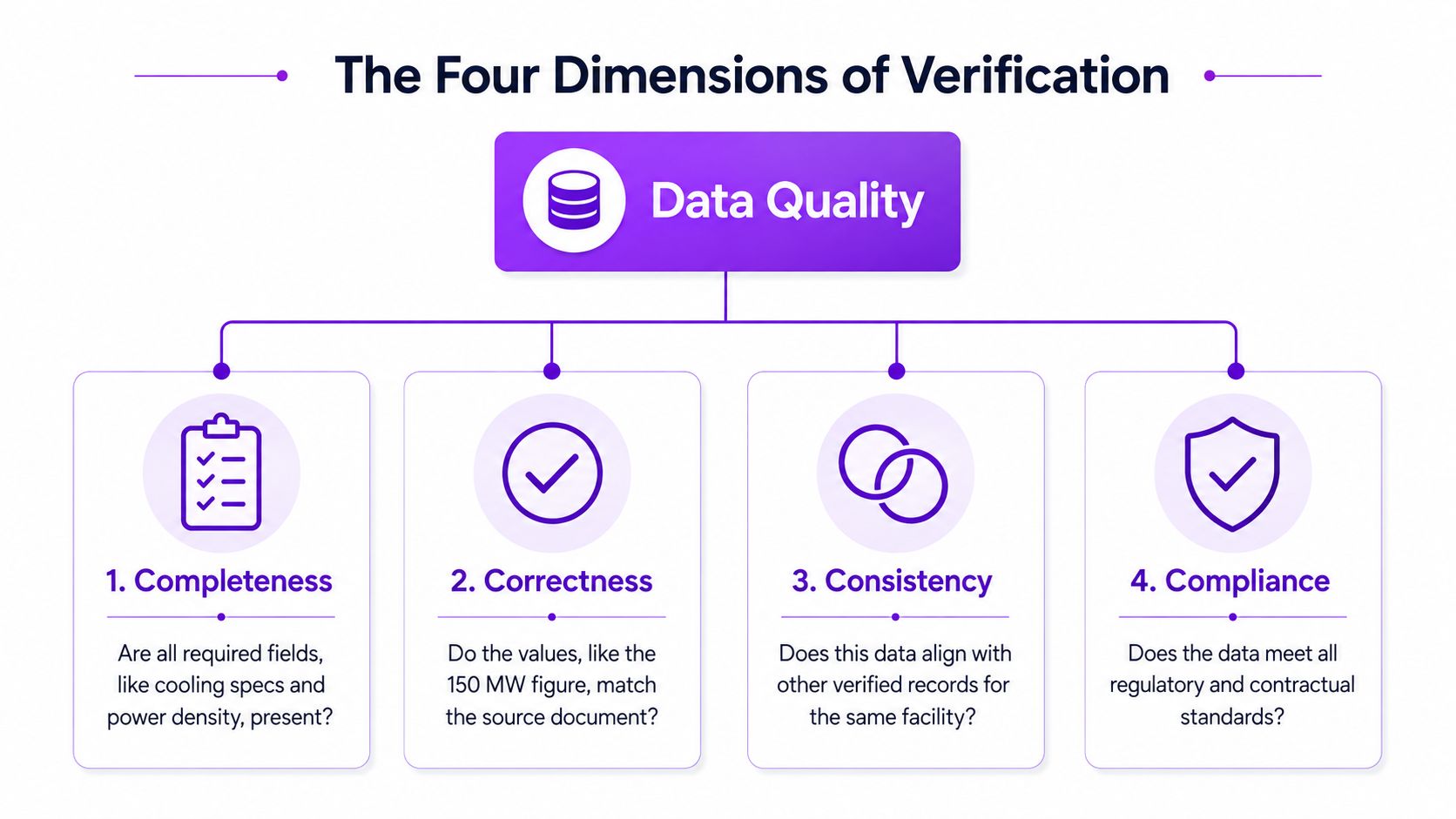
The EPA frames verification as an objective check against required source, procedural, or contractual conditions, especially completeness, correctness, consistency, and compliance. That structure is useful because it turns a vague quality task into a set of questions a reviewer can answer.
Completeness and correctness
Completeness asks whether all required fields are present. In a data center directory, that means the facility has the core identifiers needed for use, such as operator name, city, and MW capacity. Missing one of those fields can make a record hard to compare or easy to misread.
Correctness asks whether the values match the source. A site can be complete and still be wrong if the capacity figure, address, or operator attribution does not align with the document it came from. Correctness is where the reviewer compares the entry line by line with the original record.
Consistency and compliance
Consistency checks whether the same facility appears identically across related tables, exports, or profile views. If one part of the directory says a site is under construction and another says active, the dataset is no longer internally reliable. That kind of mismatch often shows up after updates are made in one system but not another.
Compliance asks whether the data meets contractual or regulatory requirements. In a directory context, that can mean labeling AI-estimated MW figures separately from disclosed figures, or preserving the distinction between confirmed and inferred values. Compliance is where verification protects both the publisher and the user from misunderstanding what a field means.
How to use the four dimensions as a checklist
A reviewer can move through the four dimensions in order:
- Is every required field present?
- Do the values match the source?
- Do related records agree with one another?
- Does the record meet the labeling and disclosure rules?
The value of this checklist is that it exposes where a dataset is weak. A record can be complete but not correct. It can be correct in one table and inconsistent in another. It can be both correct and inconsistent, yet still fail compliance if the label is wrong. That's why the EPA's framework works well for operational directories, not just for regulated technical packages.
Verifying Data Center Directories in the Real World
A global directory does not get trustworthy by accident. It gets there by separating what is disclosed, what is estimated, and what is still under review, then applying verification at each stage of the record lifecycle. The point is not to force every field into the same certainty level. The point is to label each field.
How mixed-source records stay usable
A facility directory often combines operator disclosures, public records, community submissions, and inferred values. That creates a useful but messy dataset. The cleanest operational practice is to keep disclosed figures distinct from AI-estimated ones, never blend them without stating the split, and preserve the source path that led to each value.
Community-submitted facilities need extra care. A reviewer has to compare the submission with public material, reconcile differences, and decide whether the record is ready, needs editing, or should stay flagged. Internal consistency matters too, because a site listed as planned in one view should not appear as active in another.
The directory's facility listings and market views show why this matters at scale. A global map, ranked lists, and searchable tables are only useful when the underlying labels stay disciplined across hundreds or thousands of records.
Why workflow sequencing matters more than one perfect source
No single source solves every field. An operator disclosure may be strong on capacity, but weaker on current status. A planning record may confirm development intent, but not operational timing. Public context sources may help triangulate a site, but they rarely replace the operator's own record.
That means verification has to be sequenced, not improvised. Start with the most authoritative source available for the field, compare against at least one supporting reference where appropriate, then record why differences exist. A discrepancy is not automatically a failure. It becomes a failure only when the dataset cannot explain it.
What trust looks like in production
A trustworthy directory gives users enough context to judge the record themselves. It shows whether a figure is disclosed or estimated, where the site status came from, and whether a field is still open to correction. That kind of clarity turns verification into a user-facing quality feature, not just an internal checklist.
If users can't tell what was confirmed and what was inferred, the dataset is already harder to trust.
The Cost of Skipping Verification
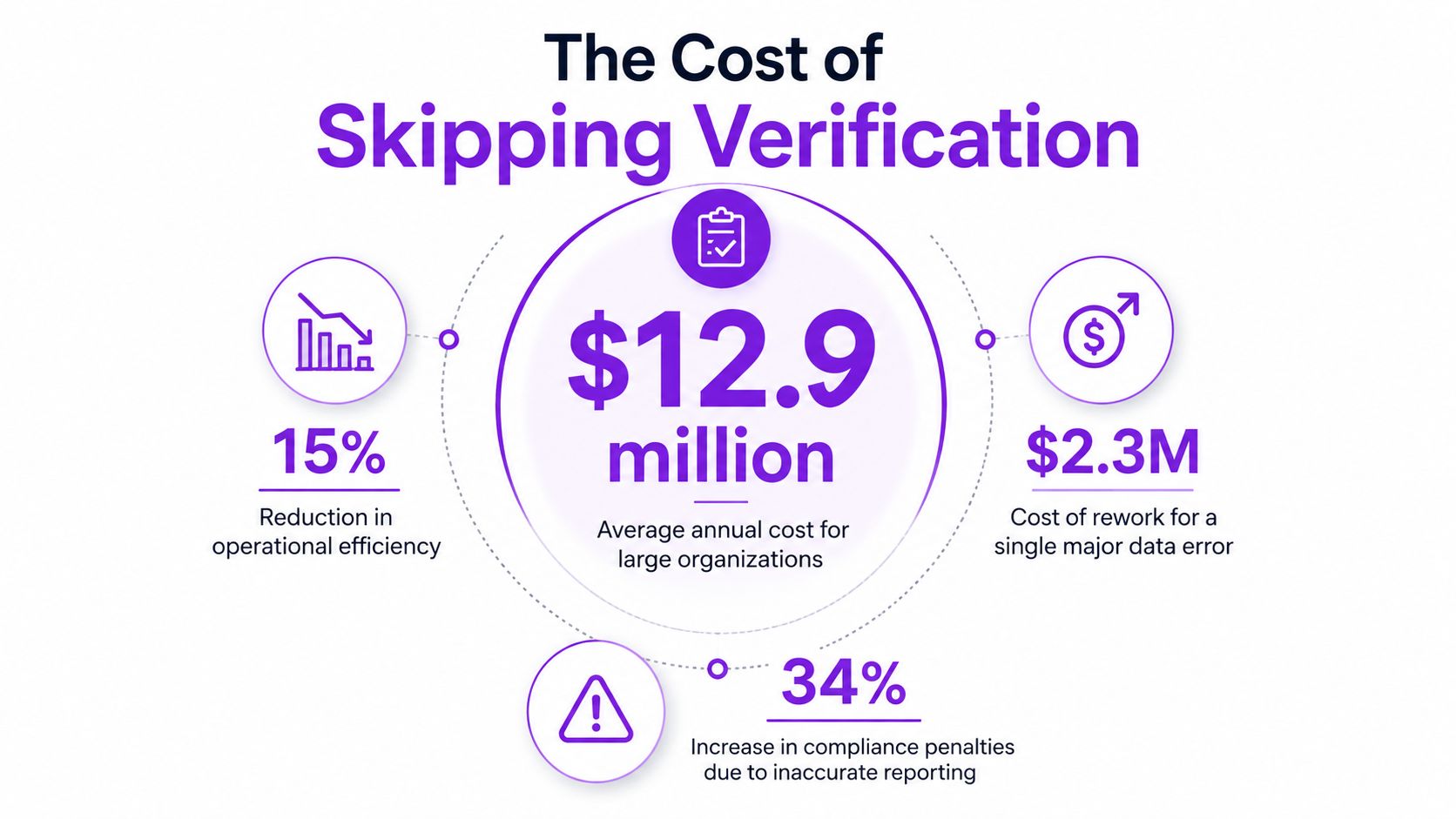
A record can look harmless in isolation, yet still send a directory in the wrong direction. A capacity field that was copied without checking, a status label that is one refresh behind, or a site name that was matched to the wrong facility all create decisions that seem reasonable until someone relies on them. Poor data accuracy has been tied to large annual business costs in industry summaries, which is why verification belongs in the control layer, not at the end of cleanup. Poor data accuracy cost summary
What bad records do to analysis
A directory analyst can check a number and still not trust it. That gap matters because a field may be syntactically correct, while the underlying meaning is still off. One industry summary says many enterprise records conflict across systems, and another says many fail validation rules. Those findings point to the same problem, records drift as they move from one system to another, and the drift is easy to miss if no one compares sources carefully.
In a data center directory, that drift can change the story of a market. An operator disclosure may show one figure, while an AI-estimated value fills a missing field in a different record, and the two need to coexist with clear labeling. If the disclosed MW value is not reconciled against the supporting source, a site can look larger or smaller than it really is. If the status field is copied from an older feed, a planned campus may appear active, or an active one may still look speculative.
Why the Verification Factor helps
A practical way to track this work is the Verification Factor, or VF. It is the ratio of verified records to reported records, so a team can see how much of the directory has been checked rather than just collected. Verification Factor definition
VF is useful because it makes coverage visible. A directory team can review one batch of records, compare the verified share with the reported share, and see where manual review is still needed. In a facility directory, that might mean checking operator disclosures against a market note, then recording whether the MW field was confirmed, estimated, or still open.
The point is not to report a perfect number. It is to show what has been checked and what still depends on judgment. That turns verification into a working control for a growing dataset, especially when new rows keep arriving and each one can introduce a mismatch in status, location, or capacity.
What the numbers mean for operational teams
Weak verification can still produce a polished directory page. The problem appears later, when a planner, investor, or analyst uses a field that was never confirmed and treats it as settled fact. A market overview may look clean on the surface, but a single unverified capacity value can ripple into ranking logic, shortlist decisions, or a planning model.
That is why the cost shows up after publication. The correction work arrives when a user questions the record, when an internal review finds a mismatch, or when the dataset has to be rebuilt around a better source. In a live operator directory view, that delay matters because one unchecked label can affect many related records, and each correction asks the team to revisit work that should have been settled earlier.
Making Verification an Ongoing Practice
Verification works best when it lives inside the data lifecycle. A facility can expand, a status can change, and a figure that was correct last quarter can drift out of date. For that reason, live records need periodic re-verification, not a single approval stamp.
Keep a traceable audit trail
Each verification step should be documented. That means noting what was checked, which source was used, what matched, what didn't, and why the discrepancy was resolved the way it was. Good documentation keeps later reviewers from repeating the same work and gives the dataset auditability when someone asks how a value was approved.
A practical review loop usually includes two habits. First, compare figures across two or three independent databases when the field matters enough to justify it. Second, write down why the sources differ, whether the cause is period, methodology, or definition. Those notes turn disagreement into an explainable record instead of a hidden problem.
Recheck live data before it becomes stale
Verification should be scheduled around change, not just around intake. A facility that adds capacity, changes ownership, or moves from planned to active needs a fresh pass. That is especially important in directory workflows, where stale status labels can make a market look more mature or more constrained than it really is.
The operator directory view is a reminder that one brand can manage assets across markets, and each asset can move on a different timeline. That makes ongoing review more valuable than a one-time batch clean-up.
Use the right error signals
Statistics Canada recommends examining the proportions of valid, invalid, missing, and outlier values, then comparing those figures with related information to detect errors. That approach works because it doesn't rely on a single suspicious field. It looks at the shape of the dataset and asks whether the pattern makes sense.
When sources conflict, record the reason instead of flattening the difference.
That habit preserves trust. It also makes it easier to revisit older decisions when a facility record changes or when a stronger source appears later.
Key Takeaways and Common Misconceptions
A data center directory can look correct at a glance and still carry a wrong capacity figure, an outdated status label, or a source note that no longer matches the record. That is why data verification matters in practice. It is the step that checks whether the published value still matches the source document, the disclosed filing, or the latest operational record before anyone treats it as dependable.
Three misunderstandings create most of the confusion. One is treating verification as a one-time cleanup job at the point of entry. Another is assuming a record is trustworthy once it passes a rule check. A third is assuming that a single review can cover every field in a directory that mixes disclosed MW figures with AI-estimated values and records that change over time. In a live directory workflow, analysts need validation, reconciliation, and provenance checks to work together, then they need to repeat those checks when a facility changes ownership, expands, or moves from planned to active.
A simple way to keep the process straight is to ask three separate questions. Does the record follow the rule set. Does it match the source. Can the team explain where the value came from and why it was chosen. Those questions serve different jobs, and a directory needs all three answers before a record deserves confidence. A disclosed MW figure may satisfy the disclosure rule, while an AI-estimated value may still need a source note and a later review before it is trusted for analysis.
A directory team that skips verification may publish a facility as active even though the source still shows planned, or it may carry an estimated value without marking it as inferred. The record still exists, but the meaning of the record shifts. That is the difference analysts need to watch for, because users do not only read numbers, they rely on the story those numbers tell about a site.
The practical takeaway is to keep verification visible. Record what was checked, what was inferred, and what still needs confirmation. Revisit the record when the source changes, not only when the spreadsheet is built. In a data center directory, that habit protects the quality of the directory itself and makes mixed-source records easier to trust.
Data Centers List applies that source-aware approach in a public directory for operators, analysts, and site selection teams. The platform separates disclosed and AI-estimated capacity, keeps facility records searchable, and provides market context that helps verification work in real workflows. Visit Data Centers List to see how a verified directory supports cleaner analysis and better decisions.