What Is a Hyperscale Data Center and Why It Matters
Learn what is a hyperscale data center, how scale and architecture differ from enterprise sites, and why operators build them in massive campuses.
12 min read
A hyperscale data center is a single facility or campus built for massive, repeatable expansion, usually at 5,000+ servers, 10,000+ square feet, and 40 MW to 100+ MW of IT load. The useful way to think about it is not as a bigger server room, but as an operating model used by cloud, AI, and platform companies at global scale.
By the end of 2024, Synergy Research Group said there were 1,136 large hyperscale data centers worldwide, and that count had doubled over the previous five years. That growth pattern matters more than the label itself, because hyperscale is really about how capacity is added, powered, cooled, and managed over time, not just how large one building happens to be.
Table of Contents
- Defining Hyperscale in Plain Language
- The Conventional Thresholds That Define Hyperscale
- How Hyperscale Architecture Differs From Enterprise Sites
- Who Actually Builds Hyperscale Sites
- Pipeline Versus Operational Capacity
- Market and Community Implications
- Common Misconceptions and What to Watch Next
Defining Hyperscale in Plain Language
Synergy Research Group's count of 1,136 large hyperscale data centers worldwide at the end of 2024 gives the category real-world scale, not just marketing gloss. The same report says the count doubled over the previous five years, which is why hyperscale should be read as an infrastructure growth pattern and operating model, not just a size label Synergy Research Group.
The simplest answer
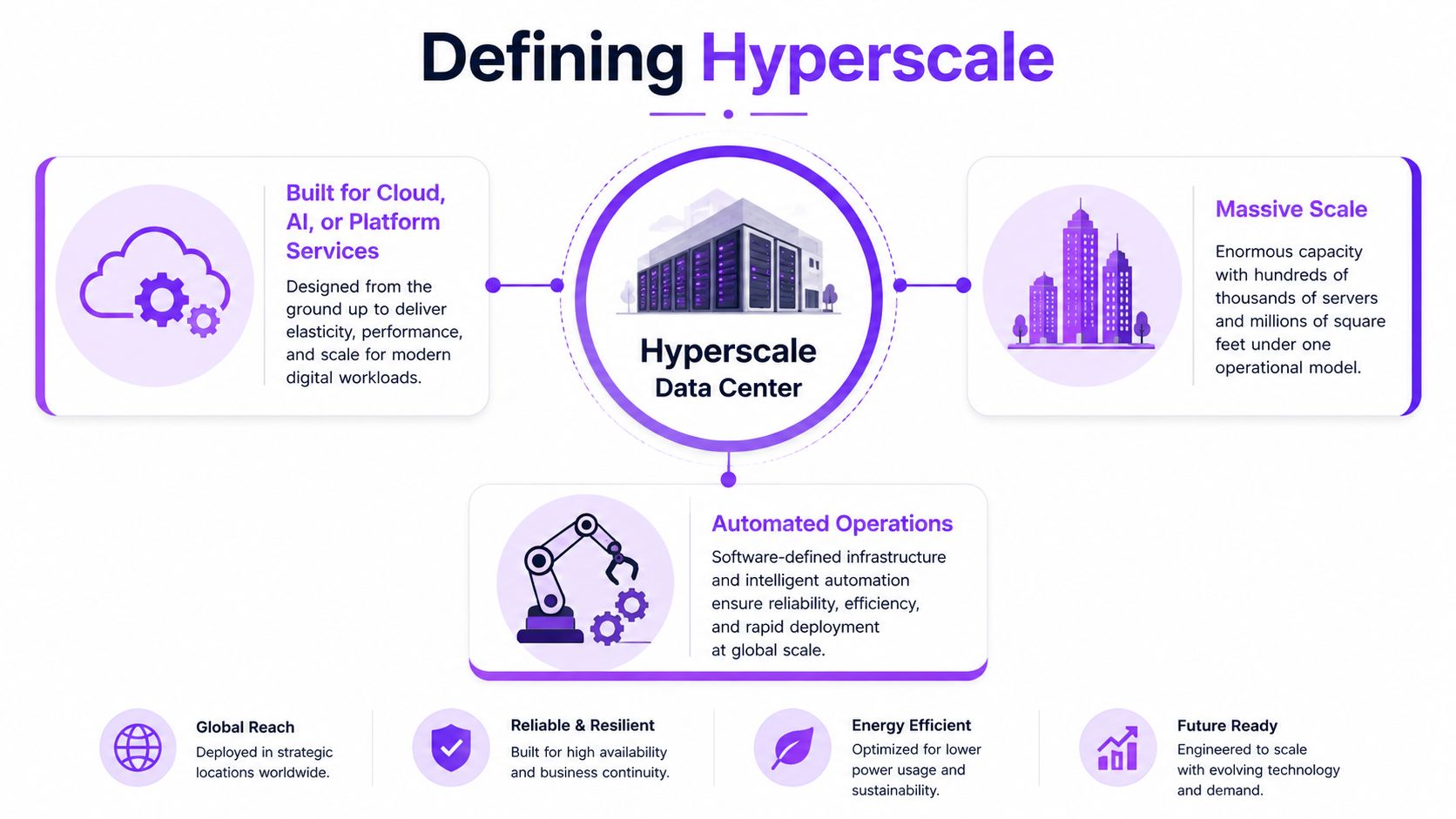
A hyperscale data center is a campus built for cloud, AI, or platform services that is designed to grow in large, repeatable blocks. The defining feature is not a single building footprint. It is the ability to add capacity again and again without changing the underlying operating model.
For a non-technical investor, the practical distinction is straightforward. An enterprise site usually supports one company's internal applications. A hyperscale site supports a platform that can absorb large swings in demand and then expand again as workload grows.
Practical rule: If the site is planned around recurring megawatt blocks, dense racks, and automated operations, it behaves like hyperscale even when the marketing language is looser.
The five lenses that matter
The cleanest way to evaluate the label is to ask five questions.
- Thresholds: Does the facility meet conventional scale markers such as server count, floor area, and power draw?
- Architecture: Is the electrical and cooling design built for block loads rather than small incremental growth?
- Operators: Is the site owned or operated by a platform company at scale?
- Capacity mix: Is the market looking at live capacity only, or also the pipeline?
- Community impact: Does the project concentrate grid, water, and land-use demands in a way that changes the local market?
That framing is more useful than asking whether a building is “large.” A large warehouse full of servers is not automatically hyperscale. A hyperscale campus is a system designed to scale repeatedly, with power, cooling, and operations all aligned to that purpose.
The Conventional Thresholds That Define Hyperscale
IBM summarizes the IDC definition as requiring at least 5,000 servers, at least 10,000 square feet of physical space, and an energy draw over 100 MW IBM. Those markers are widely used because each one captures a different part of operational scale, even though none of them is a legal definition.
Why each benchmark exists
Server count is a proxy for compute density. It tells analysts the site is no longer a small corporate environment, but a large compute platform with enough scale to support standardized systems and central orchestration.
Floor space is a proxy for operating complexity. At hyperscale, there has to be room for large electrical rooms, cooling plants, staging, maintenance, and future expansion, which is why the footprint usually looks more like a campus than a single commercial suite.
Power draw is the clearest metric. A site can be branded creatively, but utility planning, substation design, and cooling all scale with megawatts. That is why analysts focus on MW before almost anything else.
| Metric | Conventional Threshold | Why It Matters |
|---|---|---|
| Servers | 5,000+ | Signals platform-scale compute density |
| Floor space | 10,000+ square feet | Reflects operational and expansion complexity |
| Energy draw | 40 MW to 100+ MW | Best indicator of utility, cooling, and campus design |
These thresholds are useful, but they are also partly arbitrary. Market practice keeps moving upward as AI workloads and larger campuses push the lower boundary higher, so the more important question is whether the facility behaves like a hyperscale asset.
That is why capacity share matters more than a simple building count. A market can add a modest number of very large campuses and still absorb a huge share of new digital infrastructure. For a working glossary of facility terms, the data center terminology guide is a useful reference point.
A single number rarely settles the question. A site should be tested against server scale, floor area, and megawatt load together, not in isolation.
How Hyperscale Architecture Differs From Enterprise Sites
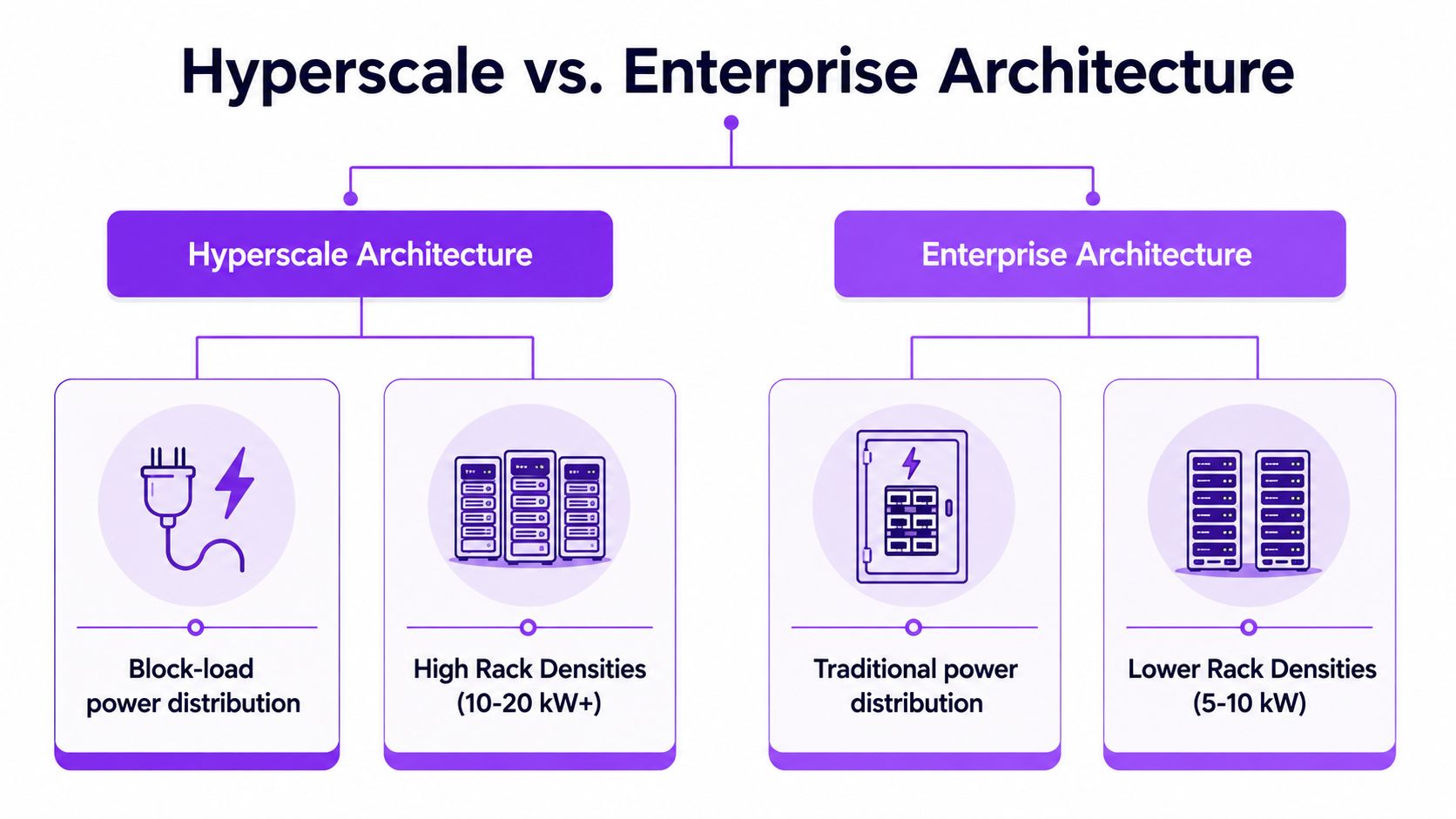
Rack density is where the difference becomes visible. Hyperscale sites are built to carry dense compute blocks, while enterprise rooms are usually designed around lighter, more distributed loads. In practical terms, that means the hyperscale facility has to treat power and cooling as one coordinated system, not as separate building services.
Power is organized in blocks
Hyperscale facilities are usually built around block-load power distribution, so substations, busways, and backup generation are sized for large increments rather than piecemeal additions. That design choice is not cosmetic. It follows from the amount of electricity a campus has to move reliably, minute after minute, without creating bottlenecks.
A useful comparison is a power plant and a building backup system. Enterprise spaces are closer to a generator supporting a building, while hyperscale campuses behave more like industrial energy systems that must carry steady megawatt blocks at high utilization.
Cooling follows the same logic. When rack densities rise, air alone stops being enough, and operators move toward liquid cooling or advanced chilled-water systems because heat removal becomes the binding constraint.
Efficiency becomes a design target
State-of-the-art hyperscale designs are often cited at PUE 1.1 to 1.2, or roughly 1.1 to 1.25, which signals aggressive optimization of cooling and power conversion PBC zoning white paper. That matters because PUE shows how much overhead electricity the site needs beyond the IT load itself.
The practical implication is simple. As compute density rises, the operator has to reduce non-IT energy losses or the facility becomes too expensive and too hard to run. That is why hyperscale campuses tend to cluster near grid nodes and low-cost power, not because that sounds strategic, but because the physics and economics force that location choice.
- High rack density: More compute in less space means higher heat rejection requirements.
- Liquid-ready cooling: Air cooling alone cannot keep up indefinitely.
- Grid adjacency: Utility access becomes a first-order siting criterion.
Operational takeaway: Hyperscale design is not about making a building look advanced. It is about moving power and heat with enough discipline that a much larger workload can run predictably.
Who Actually Builds Hyperscale Sites
In practice, hyperscale is defined by the operator as much as by the structure. The category is dominated by large platform companies, especially the major cloud and internet operators, and that's why the same campus design can look different depending on who owns it and how it's used.
The operator identity matters most
The clearest hyperscale operators are the global cloud and platform firms that run capacity at scale across multiple regions. Their footprint extends across the U.S., Europe, and China, which is consistent with Synergy's observation that the United States accounts for well over half of worldwide hyperscale capacity, while Europe and China each account for about a third of the rest Synergy Research Group.
That geographic concentration tells investors two things. First, hyperscale sites are tied to markets with strong grid access and deep demand. Second, the operator's business model matters more than the shell around the building.
A campus can sit inside a third-party colocation structure or a leased asset and still function as hyperscale capacity if the operator is using it like a platform-scale resource. For that reason, site ownership and operator identity are usually cleaner indicators than marketing language on the front gate.
For a structured view of operator footprints, the operator directory is the most useful place to start.
Why the market is concentrated
The same set of operators keeps appearing because hyperscale requires constant capital spending, long power lead times, and a repeatable operating playbook. That is a narrow club by design, not a broad category anyone can enter casually.
Operator identity is the fastest shortcut to understanding whether a facility is truly hyperscale, because the asset has to support platform-scale demand, not just general hosting.
The second-tier ecosystem also matters. Large platform builders outside the most famous cloud names can still operate hyperscale-class capacity if their workloads, network design, and expansion plans are similar. The point isn't the logo. The point is whether the operator is assembling and managing infrastructure as a repeated growth engine.
Pipeline Versus Operational Capacity
The current market picture is easy to misread if only live sites are counted. Synergy reported 1,189 hyperscale facilities by Q1 2025, while also noting that hyperscalers accounted for 41% of worldwide data center capacity in an earlier measurement and were forecast to rise above 60% of global capacity by 2029 DataCenterKnowledge. That is a capacity story, not just a building-count story.
Why the split matters
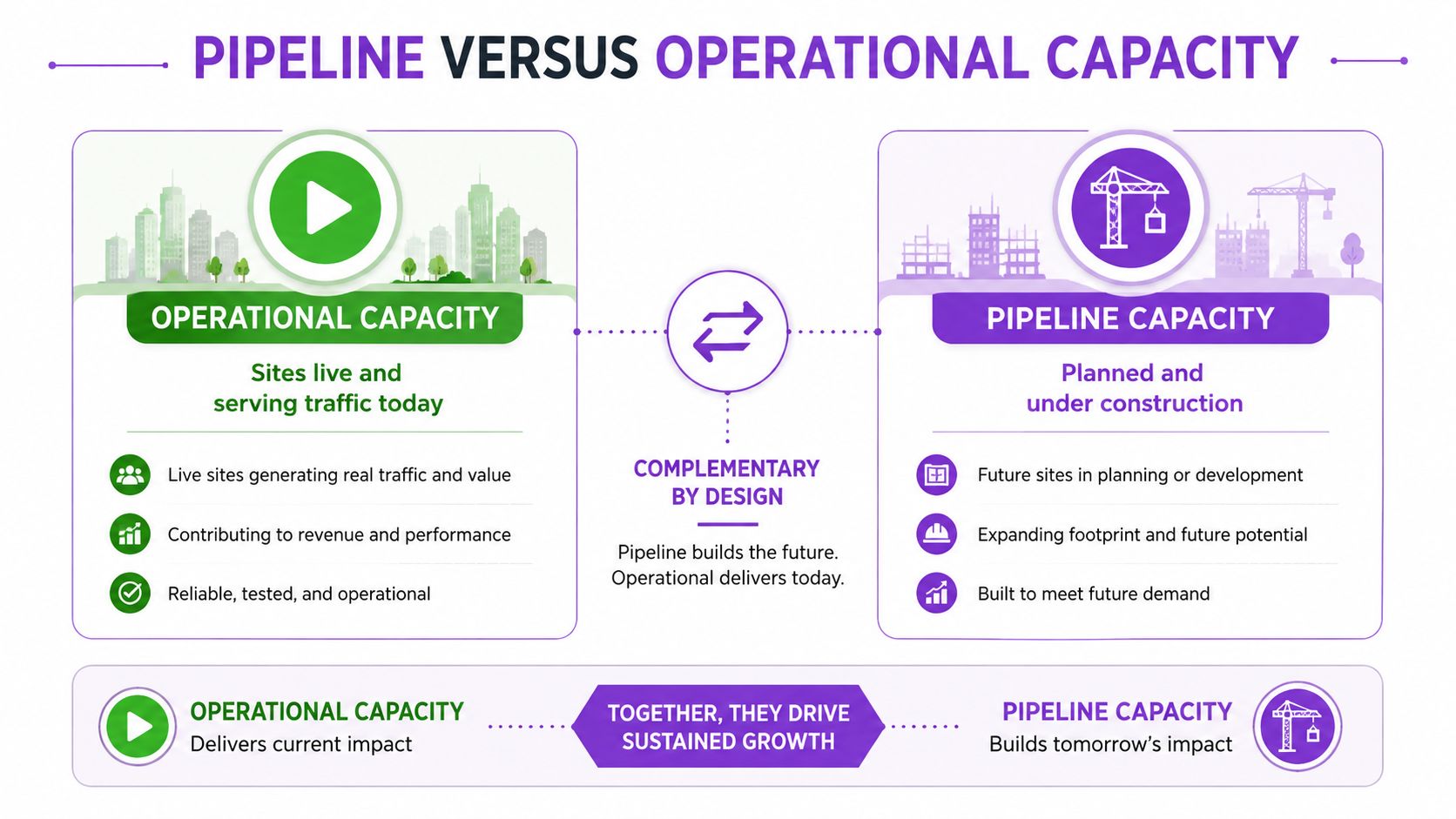
Operational capacity is the footprint already live and serving traffic. Pipeline capacity is the set of projects planned or under construction. The gap between the two is where future pressure shows up first, on substations, transmission lines, water planning, labor availability, and municipal permitting.
That distinction matters because a region can look stable if only operating sites are counted, while the stress is still in the pipeline. Analysts watch that split to understand how much capacity is already committed before the next wave goes live.
The directory framing makes this visible. Facilities labeled active, planned, or under construction tell a much clearer story than a static list of addresses. For a concrete example, the Amazon Louisiana data center campus listing shows why development context matters as much as the existing footprint.
What investors should read into it
A large pipeline usually signals demand pressure two to four years out, depending on permitting and utility coordination. It can also reveal where grid planning is already being pulled forward by committed projects, even if the final buildings have not opened yet.
Capacity disclosures are uneven, though, so comparisons have to separate disclosed figures from estimated ones. That distinction matters because a region's apparent scale can look smaller or larger depending on whether the source is reporting confirmed IT load or inferred load.
The right question is not how many facilities exist. It is how much capacity is live, how much is queued, and how much of that queue is already tied to power, water, and land-use constraints.
Market and Community Implications
Hyperscale campuses change local markets because they concentrate infrastructure demand in one place. That creates visible upside, but it also creates planning pressure that smaller enterprise or colocation footprints usually don't generate at the same intensity.
What the host region actually experiences
Grid load is the first obvious effect. A hyperscale campus can concentrate demand on a handful of substations and utility corridors, so planners have to think in terms of interconnection, not just zoning approval.
Water is the next issue, especially where cooling-heavy designs are involved. Even when the site is engineered efficiently, the cooling system can still become a central part of local debate because water stress is visible to nearby residents and policymakers.
Construction and operations jobs are part of the story too. A hyperscale build-out can bring skilled labor demand into markets that don't normally see this level of industrial construction, then leave a smaller but still meaningful operations footprint once the campus is live.
Why communities push back
Noise, traffic, and land-use changes are the issues that usually reach residents first. Those concerns are not abstract, and they are not unique to hyperscale, but the scale of the campus makes them harder to ignore than in a smaller server site.
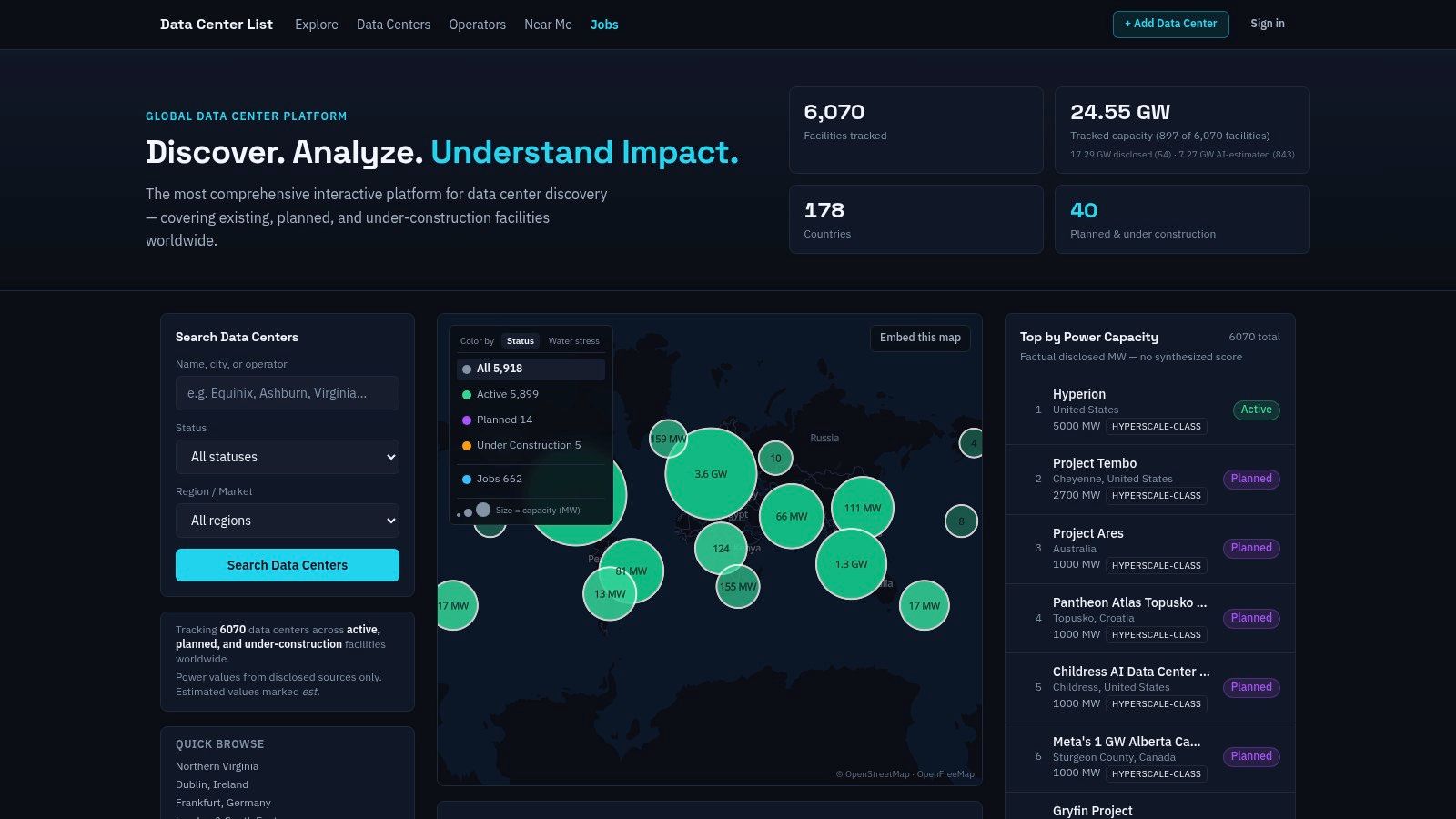
The most useful planning tools are the ones that make those impacts visible on a map, alongside capacity and local stress overlays. That's where facility-level context matters, because a project that looks isolated on paper can sit on top of a constrained utility or water system in practice.
Communities do not react to server counts. They react to trucks, substations, cooling equipment, and the way a campus changes the feel of a place.
For analysts, the lesson is to treat hyperscale as a regional infrastructure event, not just a real estate project. The upside may be stronger tax base and job demand, but the trade-offs land on utilities, housing, roads, and public meetings.
Common Misconceptions and What to Watch Next
Three misconceptions keep causing confusion. First, not every large facility is hyperscale. Second, hyperscale is not just a synonym for cloud. Third, a single megawatt figure or square-foot number is never enough by itself.
The cleaner way to think about it
Hyperscale is best understood as a growth pattern, an operator identity, and a facility design envelope working together. That is a more precise test than treating the label like a size badge.
Large facilities can still be ordinary enterprise buildings at scale. Cloud facilities can also be modest in size if they're regional nodes or specialized sites. And one number alone can mislead, because server count, floor area, and power load need to line up before the label really fits.
What to watch next is the continued rise of AI-heavy infrastructure, which pushes rack density upward and keeps favoring campuses that can absorb much larger power blocks. The market is also likely to keep hearing more about 1 GW campus proposals, which are campus-level concepts rather than single-building specifications.
The investor takeaway is straightforward. Operators should track power access and cooling strategy. Analysts should track disclosed versus estimated capacity and the live-versus-pipeline split. Job seekers should focus on markets where new capacity is being built, because that is where demand for skilled labor tends to cluster.
Data Centers List compiles facility-level capacity, status, operator, and local context in one searchable directory, which makes it easier to compare hyperscale markets without relying on marketing language. For a closer look at live, planned, and under-construction sites, visit Data Centers List and use the map to assess how hyperscale capacity is distributed across operators and regions.