7 Switch Data Centers Migration Strategies
Compare 7 switch data centers migration strategies, from big-bang cutovers to hybrid deployments, with risks, tactics, and practical selection guidance.
17 min read
The fastest migration isn't automatically the safest, cheapest, or most suitable. A short maintenance window can conceal a long preparation cycle, tightly coupled applications can make a simple cutover risky, and physical hardware may rule out approaches that work well for virtual machines. The right choice depends on workload criticality, application architecture, virtualization, compliance requirements, power and cooling constraints, and the budget available for operating two environments.
This comparison evaluates seven switch data centers migration strategies using the same decision lens: operating model, transition mechanics, outage tolerance, synchronization demands, rollback flexibility, infrastructure prerequisites, and modernization effort. The aim isn't to produce another relocation checklist. It's to show why a regulated enterprise, a legacy hardware estate, and a cloud-native platform should make different decisions. Organizations reviewing the wider planning process can also consult this cloud migration guide from Continuum Solutions for broader migration context.
Table of Contents
- 1. Big Bang Migration Cutover
- 2. Phased Migration Staged Cutover
- 3. Parallel Run Migration
- 4. P2P Physical-to-Physical Cold Migration
- 5. V2V Virtual-to-Virtual Live Migration
- 6. Cloud-Native Redeployment
- 7. Hybrid On-Premise Cloud Bursting
- 7 Data Center Migration Strategies Compared
- Turn the Migration Shortlist Into a Decision
1. Big Bang Migration Cutover
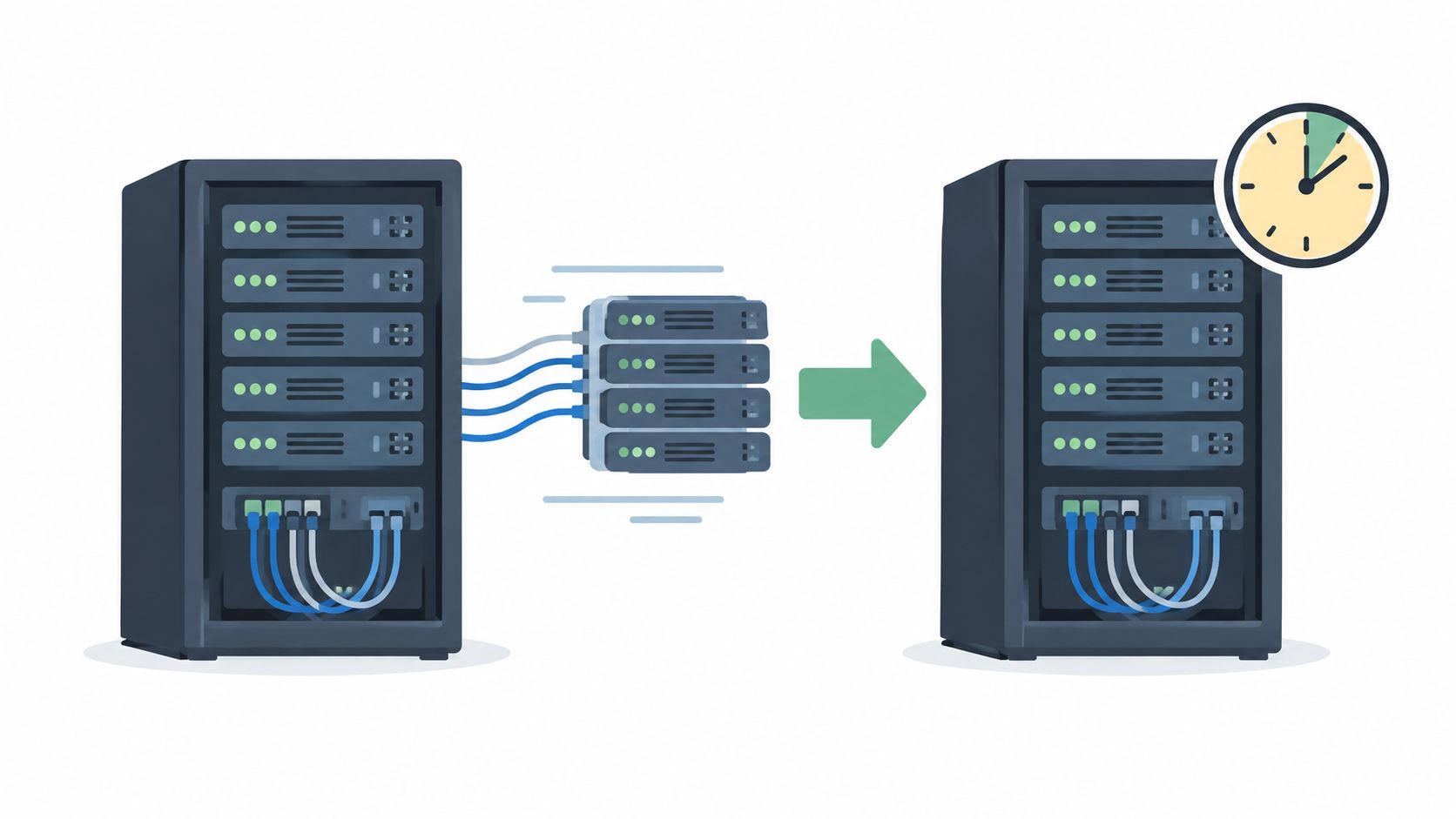
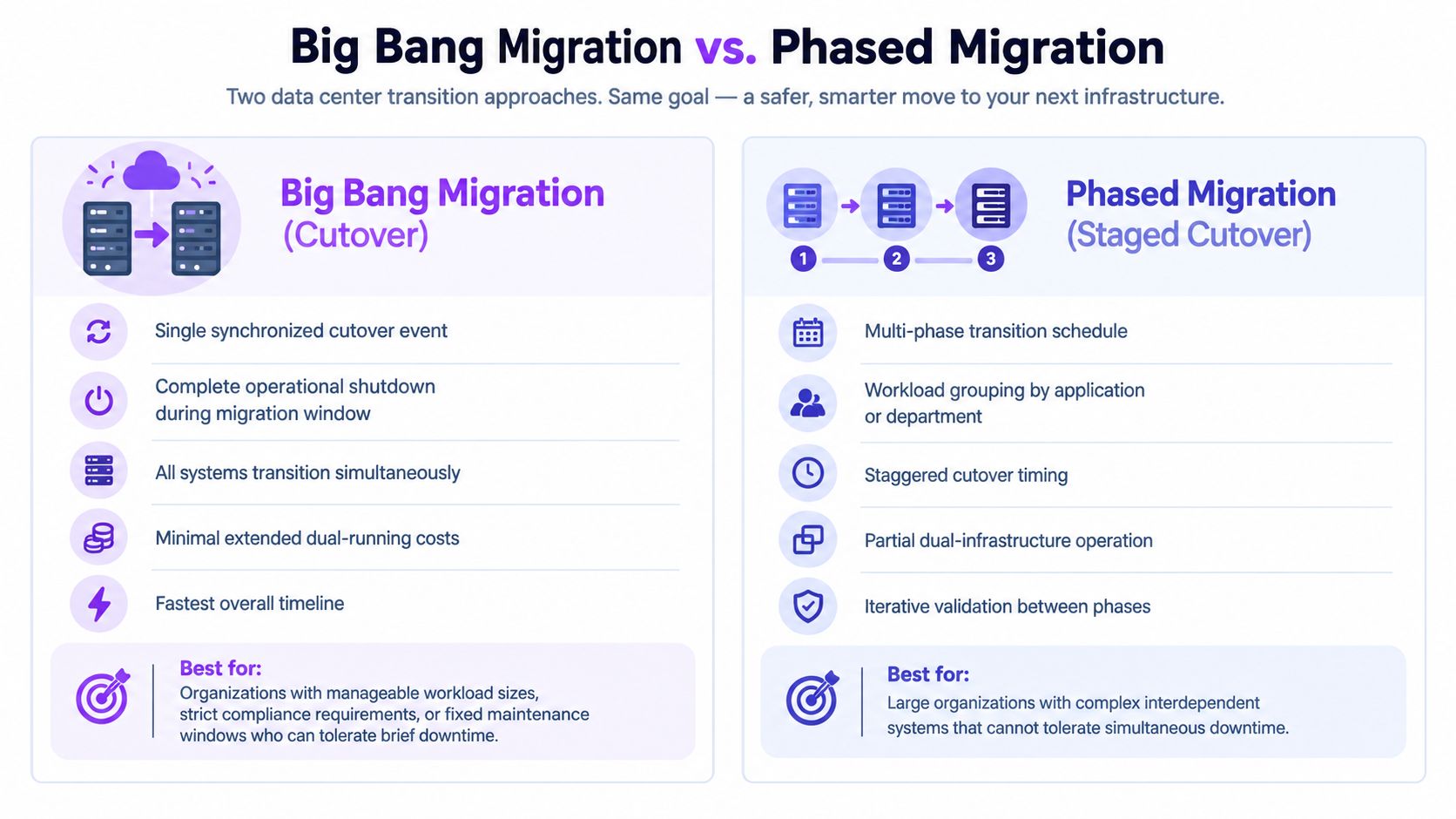
A big bang migration moves the complete service estate during one coordinated event. The source facility shuts down, equipment or workloads transition, and the destination becomes the production environment within a defined maintenance window. Its attraction is straightforward governance: one approved event, one change record, one final state.
That simplicity makes the method unforgiving. A database, identity service, storage platform, network fabric, monitoring stack, and application tier must reach compatible states together. If one dependency is missed, the destination can appear operational while critical transactions fail. The approach therefore fits organizations that can tolerate a planned outage and have a relatively well-understood dependency graph, not environments where teams are still discovering undocumented integrations.
What makes the compressed window acceptable
Preparation determines whether the cutover is controlled or improvised. Teams should build a detailed runbook, assign named owners for each system, define go and no-go gates, and establish rollback triggers before the maintenance window begins. A full dress rehearsal should test shutdown order, destination startup, routing changes, application validation, backup restoration, and communications.
The physical coordination model matters too. Technical leads should remain available at both facilities, with an incident commander authorized to stop the sequence. A relocation involving a specific market or facility should also include destination research, such as the Switch Las Vegas facility record, rather than relying only on an internal asset list.
Practical rule: A big bang plan needs a rollback decision based on observable service tests, not optimism about the remaining maintenance window.
Schedule the event during the lowest-risk traffic period, but don't treat a weekend as protection against failure. Teams should confirm customer communications, validate failover and recovery procedures beforehand, and preserve the source environment until post-cutover testing proves that production is stable.
2. Phased Migration Staged Cutover
Phased migration reduces blast radius by moving systems in groups. A team might transfer shared services first, then applications with limited dependencies, and finally the workloads that carry the greatest operational or regulatory risk. Regional enterprises can also sequence operations by geography, maintaining a coexistence period while each location proves its readiness.
The method trades a single dramatic outage for a longer transition. During coexistence, teams must support source and destination environments, maintain accurate service ownership, and prevent configuration drift. Dependency mapping becomes a living operational artifact, because every completed phase can expose a relationship that wasn't visible in the original inventory.
Phase gates create the control system
Each phase needs explicit entry and exit criteria. A useful gate can require successful data validation, application owner approval, monitoring coverage, tested rollback, and confirmation that the destination has sufficient network, compute, storage, power, and cooling capacity. A canary workload should precede a business-critical group where the architecture allows it.
The strongest advantage is the learning loop. Teams can document defects after each phase, update the runbook, refine automation, and adjust the next workload group. That makes staged cutover suitable for financial institutions with strict service commitments, distributed enterprises, and organizations whose dependency documentation is incomplete but can improve over time.
A phased plan isn't automatically low risk. Shared identity, DNS, storage, security controls, and network services can become cross-site dependencies, and a poorly designed sequence can leave applications split across facilities without reliable synchronization. Teams should define which services may span both sites, which must remain together, and who owns every phase decision.
Best-fit conditions
- Limited outage tolerance: Short, controlled interruptions are acceptable, but a single estate-wide outage isn't.
- Mixed criticality: Systems can be ranked from low-dependency workloads to tightly coupled production services.
- Operational maturity: Teams can maintain monitoring, documentation, change control, and rollback for an extended coexistence period.
3. Parallel Run Migration
Parallel run keeps the source and destination active simultaneously. Applications, traffic, and data operate across both environments, so teams can compare production behavior before transferring operational responsibility. It offers the strongest validation of the seven approaches because testing occurs under live conditions, not only in a rehearsal.
That validation requires duplicated operations. The organization must fund and staff both environments, maintain replication, compare performance, reconcile discrepancies, and define the point at which the source can be retired. The approach fits healthcare, financial services, and high-volume software platforms that have low outage tolerance and require strong rollback flexibility, even when transition costs rise.
Synchronization is the central risk
The two environments must agree on application state and data. Replication design therefore needs rules for write ordering, conflict handling, recovery points, storage behavior, and each application's consistency requirements. Automated comparison can expose mismatched records, configuration drift, response differences, and missing dependencies before production traffic moves permanently.
Traffic-management controls support gradual shifts rather than a single handoff. At each checkpoint, teams should compare error rates and latency, validate complete transactions from the user's perspective, and record discrepancies with an owner and resolution status. The rollback plan must specify how to reverse traffic without split-brain behavior or lost writes.
Parallel run is most suitable when the destination uses compatible infrastructure and the organization can sustain synchronization for an extended coexistence period. It is less suitable when applications cannot share state safely, replication bandwidth is limited, or the migration budget cannot support duplicate capacity. Cloud-native redeployment may offer greater modernization, while parallel run prioritizes operational proof and reversibility.
The switch reliability study illustrates why infrastructure validation belongs in the retirement decision. Its operational evidence on switch continuity, hardware faults, and power interruptions does not measure migration success directly, but it supports testing destination hardware and power behavior before the source site is decommissioned.
Both environments should have a defined retirement test. “The new site is live” isn't the same as “the old site is no longer needed.”
4. P2P Physical-to-Physical Cold Migration
P2P cold migration relocates the equipment itself. Servers, storage arrays, appliances, and network devices are powered down, removed, transported, reinstalled, cabled, and restarted at the destination. It suits dedicated hardware, legacy platforms, and specialized systems that lack a practical replication or live-migration path.
The dominant risk is physical execution rather than software synchronization. An incomplete inventory, undocumented cable, wrong rack position, damaged component, or missing replacement can extend the outage beyond its approved window. The move also tests assumptions about floor loading, rack dimensions, power connectors, cooling, grounding, security access, and network handoff.
Asset control determines the outcome
Before shutdown, record serial numbers, firmware, configurations, port mappings, cable labels, storage relationships, and equipment photographs. Barcodes or RFID tracking can maintain accountability during removal, transport, receiving, staging, and installation. A relocation provider with suitable insurance may reduce handling exposure, but the organization still needs one authoritative inventory and a documented acceptance process.
Destination readiness must be proven before equipment leaves the source. Assign owners and collect evidence for power circuits, network services, rack layouts, physical access, fire suppression, and security procedures. Specialized systems also require application-level checks after power-up. A successful hardware boot does not confirm that dependencies, data paths, or business functions work.
When cold relocation makes sense
A colocation customer moving within the same metro area may accept a maintenance window to retain ownership of dedicated equipment. Scientific computing or trading operations may make the same choice when appliances have no workable live-migration route. Legacy systems can also favor cold relocation over forcing an unsupported modernization project into the move schedule.
This approach has low synchronization demand because workloads are stopped, but high outage exposure and limited rollback flexibility. It fits organizations with a defined maintenance window, transportable assets, verified destination capacity, and staff able to test each system after restart. It is a poor fit when downtime is expensive or equipment cannot be safely transported.
Independent relocation guidance estimates unplanned downtime at $5,600 to $9,000 per minute and describes a two-hour outage as roughly $1.1 million in added project cost. Those figures appear in the data center relocation cost estimate, reinforcing that physical planning is a financial control as well as a logistics task.
5. V2V Virtual-to-Virtual Live Migration
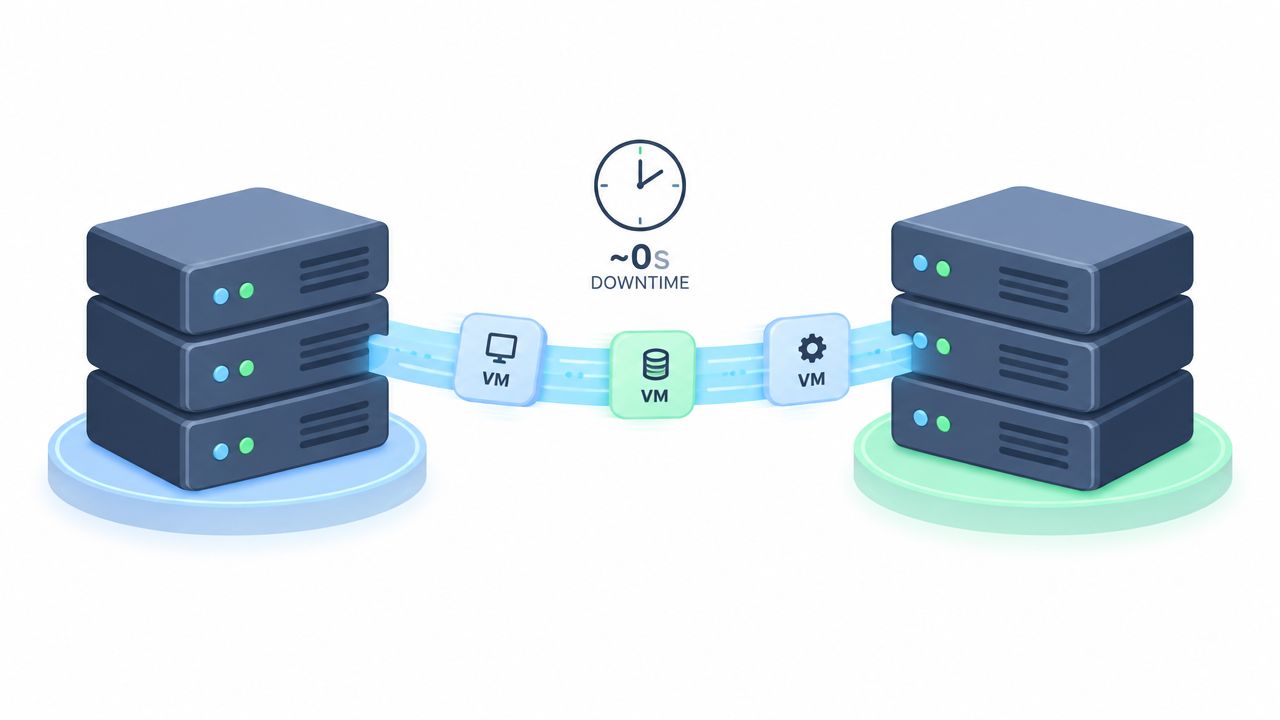
V2V live migration reduces outage exposure by moving virtual machines between compatible hosts, storage systems, or data centers while services remain active. Its feasibility depends on whether hypervisor platforms align across network, storage, CPU, licensing, and orchestration conditions. The method is therefore less interchangeable than it appears. It suits virtualized estates with low outage tolerance, but demands stronger synchronization and operational control than a cold move.
A successful VM transfer does not prove that the service works at the destination. Identity dependencies, firewall rules, monitoring agents, backup policies, licensing controls, and latency-sensitive connections may change behavior. Validation must cover application transactions and dependencies, not only the migration task.
Prerequisites that decide feasibility
Source and destination hosts require compatible virtualization capabilities and sufficient capacity. The inter-site path must provide adequate bandwidth and latency without allowing migration traffic to crowd out production flows. Storage architecture also determines risk. Shared storage, replicated storage, and copied virtual disks create different consistency, performance, and rollback conditions.
Migration should proceed in stages. Move non-production machines first, then workloads with clear rollback paths and observable health checks. Automation can enforce ordering, capacity checks, tagging, network assignment, and post-migration tests. Operators still need dashboards that expose transfer failures, application errors, and performance changes quickly.
Rollback is usually more flexible than with physical relocation, but it depends on data synchronization and destination integrity. Teams should define the reversal point before starting, confirm which writes can be reconciled, and test DNS, routing, security policy, backup, observability, and application transactions at the destination. A facility profile for Equinix SV17 can support early location research, while infrastructure teams still need direct technical validation from the facility operator.
Best-fit conditions
- Virtualized workloads: Compatible hypervisor platforms support coordinated network and storage movement.
- Low outage tolerance: Services require continued operation, and the organization can fund prerequisite testing.
- Strong automation: Infrastructure teams can schedule, observe, validate, and reverse migrations consistently.
- Synchronization capacity: The inter-site link and storage design can maintain acceptable consistency without impairing production traffic.
6. Cloud-Native Redeployment
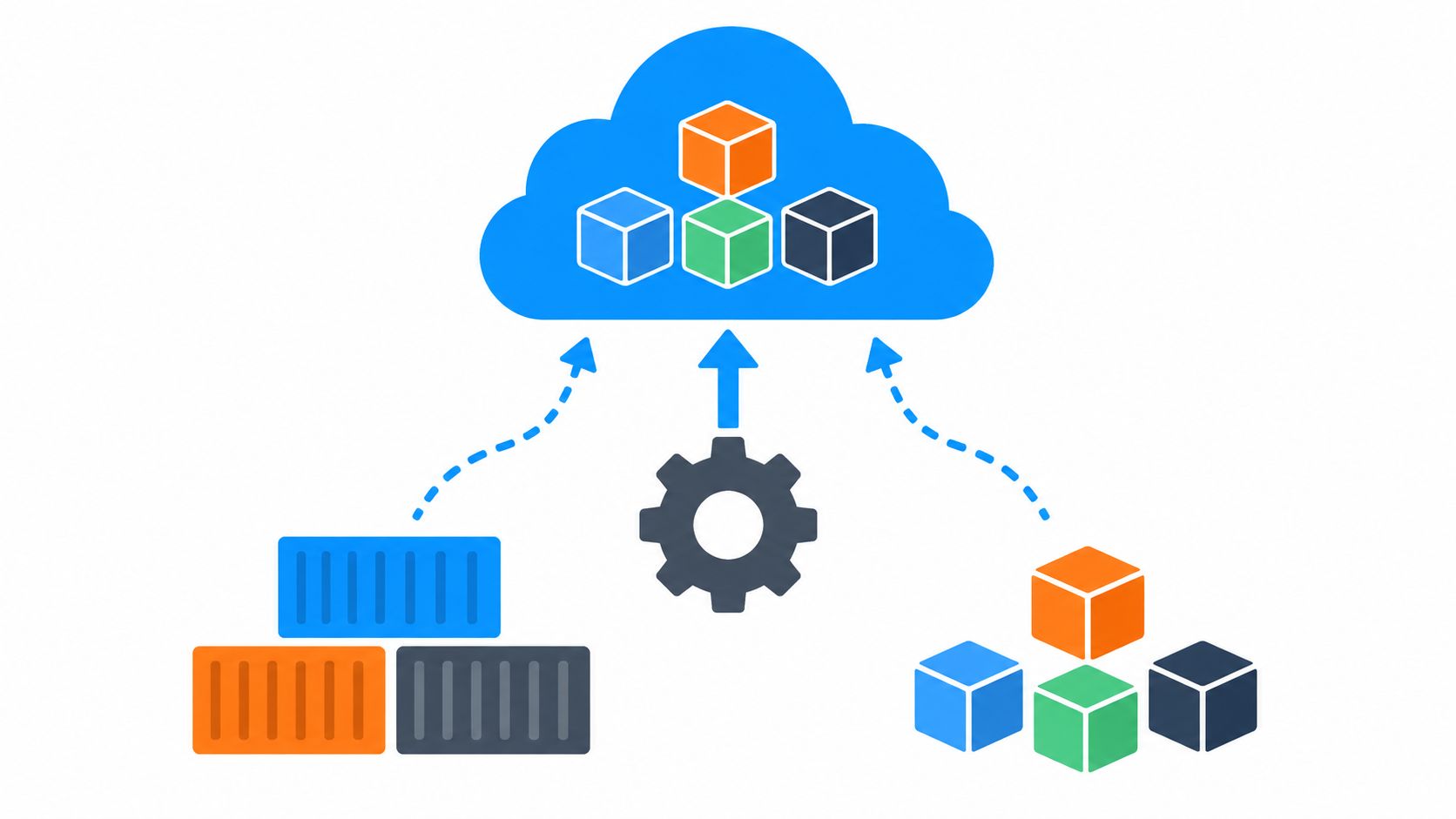
Cloud-native redeployment changes the application, not merely its address. Teams rebuild or re-platform services with containers, managed services, infrastructure-as-code tools, and automated delivery pipelines. This can improve portability and repeatability, but it demands engineering work that a physical relocation avoids.
A lift-and-shift preserves much of the existing architecture. Redeployment changes how applications package state, discover services, store data, scale, recover, and release changes. Containers may simplify deployment, while stateful databases, licensing systems, latency-sensitive integrations, and compliance controls still require deliberate redesign.
Modernization needs a controlled boundary
Teams should map dependencies before choosing pilot workloads. A less-critical service can test container images, orchestration, delivery pipelines, secrets management, logging, monitoring, backup, and disaster recovery without exposing the most sensitive transaction path to immediate risk. Infrastructure-as-code tools can make destination environments repeatable, while automated tests offer evidence that redeployment preserved application behavior.
The approach suits organizations that can absorb engineering effort before migration completion. It offers greater flexibility across locations and reduces dependence on fixed hardware, but it also introduces platform skills, operational complexity, new security boundaries, and possible changes to licensing or service economics. Select it when long-term architectural flexibility justifies near-term modernization work, not because a facility move creates an opportunity to redesign.
The infrastructure model also affects site selection. A CloudHQ MCC2 Manassas data center profile can support early facility research, but teams still need direct validation of connectivity, power, compliance, and operational requirements from the operator.
AI workloads make that evaluation more consequential. The global data center switch market was estimated at USD 14.97 billion in 2025 and projected to reach USD 34.24 billion by 2033, with a projected 11.1% CAGR from 2026 to 2033, according to market analysis of the data center switch sector. The direction indicates that network and facility decisions increasingly need to support data-intensive infrastructure, not only traditional application relocation.
7. Hybrid On-Premise Cloud Bursting
Hybrid placement keeps selected infrastructure on premises while moving other workloads to a cloud or alternate facility. Cloud bursting adds capacity during demand spikes, while policy-based placement can retain regulated data or latency-sensitive services in a controlled environment. The result is an operating model for distributing workloads, not a one-time migration.
Its suitability depends on outage tolerance, infrastructure ownership, synchronization needs, rollback options, and modernization effort. Organizations that require gradual cloud adoption may accept the added operational burden. Teams seeking a simple facility move should choose a narrower migration method.
Placement rules must be explicit
Workload placement should follow documented criteria, including data residency, compliance, latency, hardware acceleration, available capacity, recovery objectives, and cost visibility. Orchestration and infrastructure policy should enforce those rules, rather than leaving placement to manual decisions during an incident.
Synchronization requires a defined source of truth, replication behavior, recovery process, and failure mode. Teams should test degraded private connectivity, unavailable cloud capacity, and return of a workload to its original facility. Consistent access controls, logging, backup, and incident procedures must apply across environments.
The architecture also needs shared operating controls. Private connectivity, identity, security policy, observability, and support processes must cover every location. Without them, the organization creates separate operational islands, weakens rollback confidence, and makes cost attribution difficult.
This strategy fits regulated organizations retaining selected systems on premises, enterprises adopting cloud gradually, and platforms with variable demand. It does not remove migration planning. It creates a permanent distributed estate, requiring budget for governance, platform engineering, monitoring, support, and cost management.
Market conditions make connectivity and capacity planning more consequential. In 1Q26, worldwide Ethernet switch revenue reached USD 15.4 billion, up 39.8% year over year, while the data center segment rose 61.0% to USD 10.0 billion, according to IDC's Ethernet switching market analysis. That demand supports evaluating network paths, power, and capacity before treating hybrid bursting as a simple cloud extension.
7 Data Center Migration Strategies Compared
| Strategy | Implementation complexity | Resource requirements | Expected outcomes | Ideal use cases | Key advantages |
|---|---|---|---|---|---|
| Big Bang Migration (Cutover) | High, synchronized dependencies, rehearsals, tight rollback windows | Moderate-to-high short-term staffing and on-site coordination | Complete, fast migration with a single, short downtime window | Small–mid workloads or operations with fixed maintenance windows and tolerable brief downtime | Fastest timeline, minimal prolonged dual-running costs, clear milestone |
| Phased Migration (Staged Cutover) | Medium–high, phase gates, dependency mapping, coordination across teams | Higher ongoing resources for dual-infrastructure and management tools | Incremental moves with validation between phases and reduced single-event risk | Large enterprises, complex interdependencies, multi-region transitions | Lower risk per move, iterative learning, reduced business impact |
| Parallel Run Migration | Very high, real-time sync, observability, complex decommission criteria | Very high, dual operations, replication, bandwidth, monitoring tools | Extended validation with gradual traffic shifting and near-zero downtime | Mission-critical systems, massive user bases, zero-downtime requirements | Strongest validation and rollback capability, minimal disruption |
| P2P Cold Migration (Physical-to-Physical) | Medium, logistics, chain-of-custody, cabling, environment readiness | Moderate, transport, handling teams, insurance, reinstallation effort | Physical assets relocated with downtime during transport and post-install validation | Legacy or specialized hardware, same-metro colocation moves, dedicated appliances | Direct asset transfer, clear custody, avoids virtualization/licensing issues |
| V2V Live Migration (Virtual-to-Virtual) | Medium, hypervisor compatibility, orchestration, storage sync | Moderate-to-high, network bandwidth, hypervisor expertise, orchestration tools | Minimal or zero user-facing downtime with running VMs moved live | Homogeneous virtualized environments requiring low disruption | Near-zero downtime, scalable live transfers, no application code changes |
| Cloud-Native Redeployment | High, re-architecture, CI/CD, IaC, microservices decomposition | High, developer effort, tooling, training, refactoring and testing | Rebuilt cloud-optimized applications with improved scalability and portability | Organizations investing in modernization or multi-cloud strategies | Improved scalability/resilience, easier future migrations, optimized resource use |
| Hybrid On-Premise / Cloud Bursting | High, multi-environment orchestration, placement rules, consistent security | High, integration platforms, private connectivity, monitoring, multi-skill teams | Flexible workload placement, cost/performance optimization, gradual transformation | Large enterprises with compliance needs, variable workloads, gradual cloud adoption | Flexibility to optimize cost/performance, compliance control, incremental migration |
Turn the Migration Shortlist Into a Decision
The correct strategy emerges from constraints, not preference. The first decision is the acceptable outage for each workload, expressed in operational terms that application owners can approve. A service that can pause during a scheduled window belongs in a different migration category from a transaction platform that must remain available while data changes continuously.
Next, classify dependencies. Teams should map databases, identity, DNS, storage, network paths, security controls, monitoring, backups, external integrations, and hardware appliances. The map should distinguish hard dependencies from convenient integrations, because a dependency that cannot move independently may determine the strategy for an entire application group.
Physical and hypervisor constraints narrow the shortlist further. Dedicated appliances and unsupported legacy systems point toward P2P cold migration. Compatible virtual machines may support V2V live migration. Container-ready applications can justify cloud-native redeployment, while compliance or latency requirements may require hybrid placement even after modernization.
The financial model must include more than transport and engineering. A parallel run carries dual operating costs, a phased move prolongs coexistence, and a cold move concentrates outage exposure. The cloud migration strategies guide for SMBs provides additional planning context, but each organization still needs its own downtime, staffing, connectivity, licensing, and rollback assumptions.
Destination validation should happen before the final method is approved. Teams need evidence for power, cooling, rack compatibility, network services, security access, recovery capability, and operational support. Switch Datacenters' modular build and heat-recovery design was reported to achieve a PUE of 1.19, reach market in under 18 months, and be at least 50% less carbon-intensive than conventional approaches, according to the published case study. Those results describe a specific project, so they should inform questions rather than replace site-specific due diligence.
A compact decision sequence looks like this:
- Cold move: Choose P2P when physical equipment must travel and a controlled outage is acceptable.
- Single cutover: Choose big bang when dependencies are well understood and the organization can enforce a tested maintenance window.
- Staged transition: Choose phased migration when workloads can be grouped and teams can manage coexistence.
- Maximum validation: Choose parallel run when rollback confidence and continuous comparison outweigh duplicated operating cost.
- Virtual mobility: Choose V2V when hypervisor, storage, bandwidth, latency, and licensing prerequisites are satisfied.
- Modernization: Choose cloud-native redeployment when long-term portability and repeatability justify engineering effort.
- Distributed placement: Choose hybrid bursting when compliance, capacity, latency, or demand variability requires multiple operating locations.
Data Centers List can support destination-market research by comparing facility locations, operator information, operational status, and disclosed or AI-estimated IT power capacity. Its directory and map also provide context for existing, planned, and under-construction sites, helping infrastructure teams examine the market before committing to a migration path.
Data Centers List provides an interactive global directory and map for comparing data center locations, operators, status, and disclosed or AI-estimated IT power capacity. Visit Data Centers List to evaluate destination-market context before selecting a switch data centers migration strategy.