10 Data Centers in Canada to Watch in 2026
Explore 10 data centers in Canada by market, status, capacity, operators, sustainability focus, and practical site-selection considerations.
21 min read
Canada's data center map is smaller than its development narrative suggests. The Boston Consulting Group's Canadian market snapshot places live Canadian capacity at about 1.4 GW in September 2025, compared with 40.6 GW in the United States in early 2026, while 3.5–4 GW of Canadian AI data center capacity is already planned. The contrast points to a market shaped less by a lack of digital demand than by power availability, utility queue timing, and the ability to secure large-scale grid access.
That tension matters when evaluating data centers in Canada. The national footprint includes mature metropolitan hubs, specialized regional markets, legacy facilities, and sustainable development pipelines. A facility directory alone can obscure the operational questions behind a location: Is the site active, planned, or under construction? Is its IT power disclosed or AI-estimated? Which operator controls the asset, which carriers serve it, and what constraints affect expansion?
This map-first guide organizes ten Canadian market roles rather than presenting a simple facility directory. Each entry considers status, operator context, IT power, connectivity, electricity, resilience, and community impact. Buyers, developers, investors, and policymakers can use the data center guidance for CIOs alongside the embeddable Canadian data center map to move from a national view to facility-level research without treating estimates as disclosed capacity.
Table of Contents
- 1. Toronto Tier III and Tier IV Hyperscale Facilities
- 2. Montreal Bilingual Colocation and Enterprise Data Centers
- 3. Vancouver West Coast Cloud and Content Delivery Hubs
- 4. Calgary Energy-Intensive and Hyperscale Development Corridor
- 5. Ottawa Government and Secure Federal Data Centers
- 6. Waterloo Technology Innovation and Research Data Centers
- 7. Halifax Maritime and East Coast Resilience Hubs
- 8. Winnipeg Midwest Data Center and Content Routing Hub
- 9. Tier I Legacy Data Center Modernization and Right-Sizing
- 10. Green and Sustainable Data Center Development Pipeline
- Top 10 Canadian Data Centers Comparison
- Turn the Roundup Into a Market Shortlist
1. Toronto Tier III and Tier IV Hyperscale Facilities
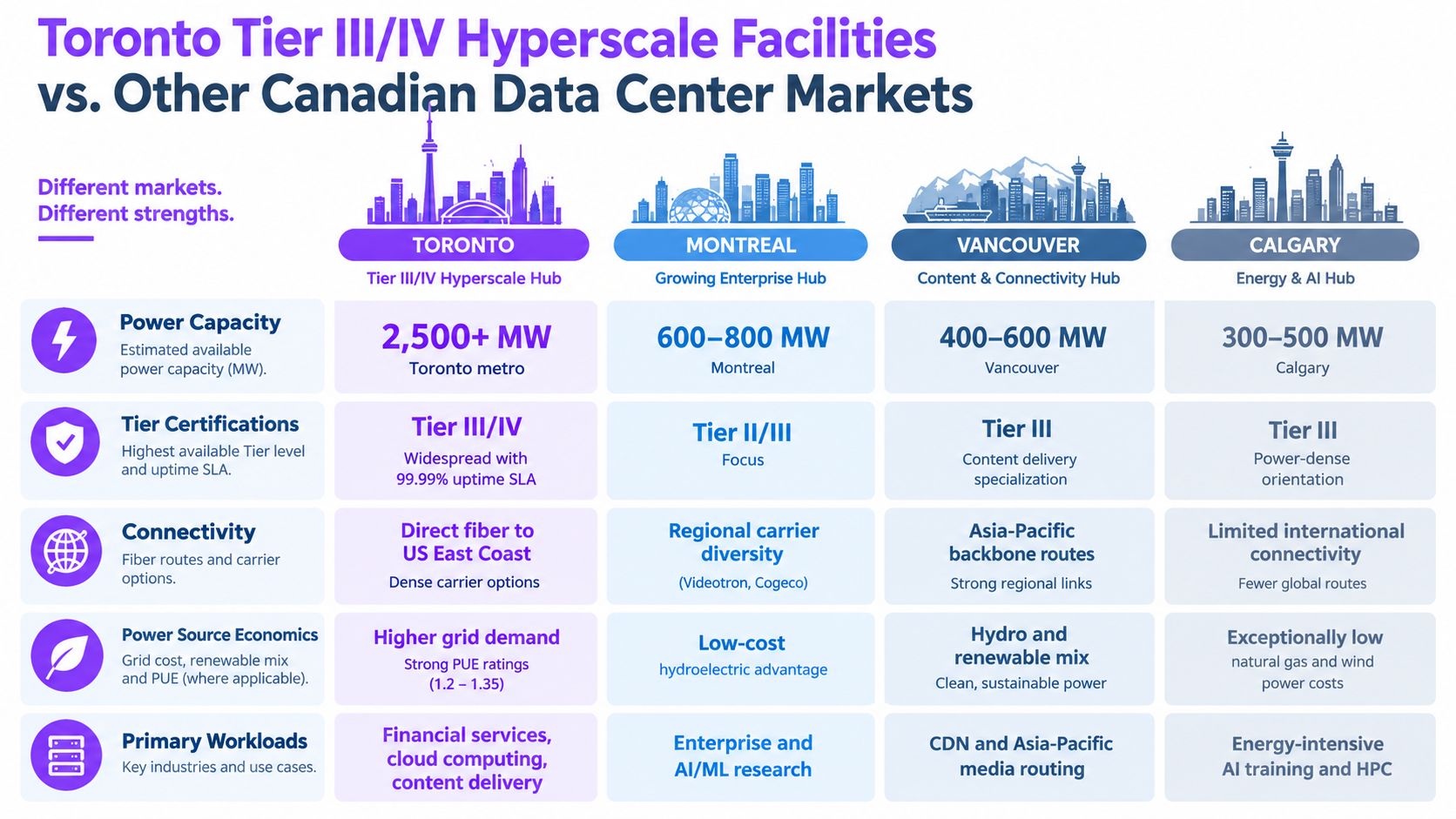
Toronto remains the clearest established hub for hyperscale, cloud, financial-services, and colocation workloads. Its role rests on a mature metropolitan ecosystem, dense carrier access, established enterprise demand, and proximity to major United States markets. The Canada Energy Regulator market snapshot identifies Ontario as the country's leading province by operating data center sites, with 105 locations. That provincial concentration makes Toronto an important starting point for national capacity research, but it also means buyers should distinguish broad market presence from available rack or campus capacity.
Operators and platforms associated with the Toronto market include AWS Canada's Central Region, Microsoft Azure Canadian regions, Equinix TR facilities, PEER 1, and Zenlayer. A profile such as Digital Realty YYZ10 in Markham can help analysts examine a specific asset rather than infer availability from a city label.
What buyers should verify
Toronto's strongest advantage is ecosystem depth, but mature markets can create procurement friction. A buyer should request:
- Carrier diversity: Confirm physically diverse entrances, cross-connect options, and service-level commitments from more than one carrier.
- Power allocation: Separate contracted building capacity from the IT power available to the buyer. Oversubscription and phased delivery can change the practical answer.
- Expansion timing: Secure future capacity commitments early, especially for workloads with predictable growth.
- Commercial exposure: Model Canadian-dollar costs, contract escalation, and power pass-through terms rather than comparing headline rates alone.
- Municipal fit: Review zoning, permitting, noise, and local infrastructure requirements with advisers familiar with the specific municipality.
Toronto is therefore best read as an established operating market, not an automatic guarantee of immediate hyperscale capacity. Modular construction can also affect delivery strategy, as discussed in this guide to building data centers with modular construction.
2. Montreal Bilingual Colocation and Enterprise Data Centers
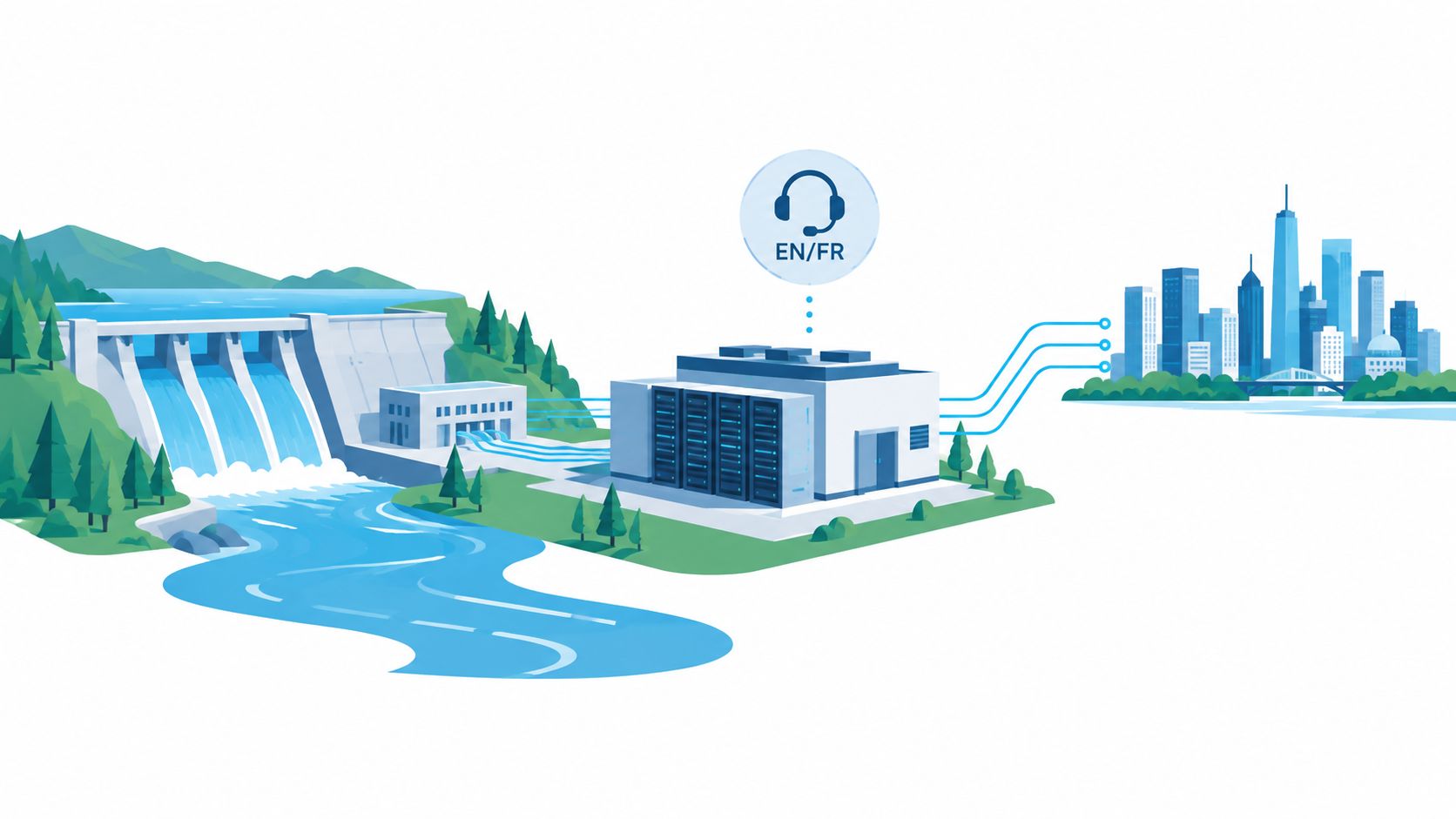
Montreal plays a different role from Toronto. It combines enterprise colocation, media workloads, cloud support, research activity, and bilingual service requirements within a province known for substantial hydroelectric generation. The Canada Energy Regulator snapshot places Quebec at 57 operating sites, making it one of the country's most significant provincial markets without equating site count with available IT power.
The commercial case depends on workload and operating model. Power-sensitive users may find Quebec's electricity profile attractive, while enterprises serving French-speaking customers may value local support, contractual fluency, and provincial operating context. Montreal also supports regional cloud and colocation providers, media companies, insurance workloads, and research-linked computing. A facility such as Vantage Data Centers QC1 in Montreal provides a useful reference point for facility-level comparisons.
The trade-off is cost against proximity
Montreal may suit cost-sensitive or power-intensive workloads, but the right decision depends on application architecture. A Toronto-connected workload may tolerate the regional distance, while latency-sensitive services may need careful testing rather than assumptions based on city-to-city labels.
- Language support: Confirm that operations, incident response, and service-level documentation meet French-language requirements where relevant.
- Power contracting: Examine contract duration, rate structure, and curtailment provisions before treating hydroelectric availability as a fixed cost advantage.
- Connectivity: Validate routes to Toronto, customer locations, and cloud on-ramps through carrier documentation.
- Research workloads: Confirm whether the facility supports GPU clusters, high-density cooling, and the technical support required by research or media users.
- Incentives: Have legal and tax advisers verify eligibility for provincial programs instead of assuming that every project qualifies.
Montreal's market role is specialized efficiency. It can be a strong alternative to Toronto for the right workload, but location economics should be tested against latency, language, contract terms, and expansion certainty.
3. Vancouver West Coast Cloud and Content Delivery Hubs
Vancouver is best understood as a west-facing connectivity and content market. Cloud platforms, content delivery networks, gaming services, media companies, and international businesses can use the region as a Canadian gateway toward Pacific routes. Its value isn't geographic proximity to Asia. Buyers also need to examine submarine cable access, carrier redundancy, disaster recovery architecture, and the ability to route traffic without creating a single regional dependency.
The Canada Energy Regulator data center overview lists 35 operating sites in British Columbia. That figure describes the provincial operating footprint, not the amount of capacity available in Vancouver or the suitability of each facility for high-density workloads. Digital Realty facilities, Telus Cloud infrastructure, and colocation assets form part of the market context, while gaming and media providers create demand for edge and delivery-oriented services.
A facility profile such as Cologix VAN3 in Vancouver helps anchor research at the asset level, where power, operator, status, and connectivity details can be evaluated together.
Connectivity needs a resilience test
A Vancouver deployment should be assessed as a network design, not merely a real estate choice. Pacific connectivity can improve routing for some users, but international paths require documented service levels and failure scenarios.
Practical rule: Treat every international route as a dependency that needs a backup path, not as a permanent geographic advantage.
Operators should confirm seismic design, backup power, cooling performance, and carrier entrance diversity. Cooler ambient conditions may support efficient thermal management, but the buyer still needs facility-specific evidence about cooling topology and operating limits. Disaster recovery teams should also test whether a Vancouver site is independent from primary infrastructure in Central Canada, including shared cloud, carrier, and management dependencies.
Vancouver's role is strongest when the workload benefits from west-coast routing, content distribution, or regional resilience. It is less compelling when a buyer evaluates only rack price and ignores international connectivity, seismic exposure, or the practical separation between primary and recovery environments.
4. Calgary Energy-Intensive and Hyperscale Development Corridor
Calgary's importance comes from its potential role in high-density computing and large-scale development. The region offers industrial land, energy-sector expertise, and access to a power system that developers may consider for AI, high-performance computing, rendering, and other energy-intensive workloads. The market also carries a distinctive operational question: whether new demand can be connected to the grid without shifting pressure to transmission, generation, water, or local infrastructure.
The Canada Energy Regulator market source lists 22 operating sites in Alberta. That is a footprint indicator, not proof that every proposed campus has firm interconnection or that operating sites can accommodate modern AI density. Alberta's market should therefore be separated into active facilities, expansion projects, and development narratives.
National Observer's reporting on Alberta data center demand identified 21,085 MW of requested electricity from the grid. That disclosed request is not the same as connected load or delivered IT power. The distinction is central. Development interest can be large while utility approvals, transmission construction, generation plans, and municipal services remain unresolved.
Economics can hide infrastructure risk
Calgary may suit workloads that value power economics more than central-market proximity. Cryptocurrency operations, AI training, rendering, and HPC can place different demands on electricity, cooling, and network design than ordinary enterprise colocation.
- Power pathway: Confirm whether a project has an executed interconnection plan, not only a utility discussion or land option.
- Generation model: Assess grid supply, backup generation, fuel availability, emissions exposure, and permitting as one system.
- Cooling design: Prairie temperature swings require equipment and controls designed for the operating envelope, especially at high density.
- Network architecture: Measure latency to customers, cloud regions, and research partners before accepting a power-led site decision.
- Community impact: Examine water service, noise, land use, and road requirements alongside the project's energy case.
Calgary is a specialized development corridor, not a universal Toronto replacement. Its opportunity depends on converting energy access into dependable, permitted, and socially workable capacity.
5. Ottawa Government and Secure Federal Data Centers
Ottawa's market role is defined by trust and jurisdiction rather than scale alone. Federal agencies, Crown corporations, defense organizations, and security-sensitive enterprises require environments that support strict controls, documented accountability, physical protection, and procurement processes. A site can be technically capable yet unsuitable if the customer cannot satisfy clearance, data handling, audit, or contractual requirements.
The market includes Shared Services Canada facilities, federal operations, secure computing environments, and service providers supporting government workloads. IBM Global Services has also been associated with secure Ottawa operations. Buyers evaluating these facilities should ask how the operator maps physical access, tenant separation, incident response, evidence retention, and government security directives to the specific workload.
Compliance is an operating capability
Security claims need to be tied to a service boundary. A facility's certification or control framework doesn't automatically make every tenant deployment compliant. The customer must understand which controls the operator owns, which controls remain the customer's responsibility, and how audits are handled.
- Security eligibility: Confirm organizational clearances and personnel requirements before procurement begins.
- Protected workloads: Map data classification to the facility's approved services and technical controls.
- Procurement route: Identify applicable federal buying channels and contract obligations early.
- Audit readiness: Request evidence procedures, access logs, incident notifications, and continuity documentation.
- Talent: Verify that support teams understand government security protocols rather than relying on generic colocation experience.
Ottawa's advantage is proximity to federal institutions and a concentrated security ecosystem. Its constraint is that commercial speed may be secondary to authorization, procurement, and governance. For government and defense workloads, those constraints are part of the product, not administrative overhead.
6. Waterloo Technology Innovation and Research Data Centers
Waterloo occupies a specialized position between academic research, startup infrastructure, and enterprise software. The surrounding technology corridor connects the University of Waterloo, Wilfrid Laurier University, technology companies, research laboratories, and early-stage ventures. That ecosystem creates demand for flexible compute, GPU infrastructure, development environments, and research-grade support rather than only conventional enterprise racks.
The most relevant facilities may sit inside universities, research programs, technology organizations, or colocation environments serving local companies. Their market value depends on technical flexibility and ecosystem access. A research team may need scheduling support for HPC or GPU clusters, while a startup may need an economical path from development capacity to production deployment.
The buyer is often part of the ecosystem
Waterloo facilities can compete through partnerships as much as through physical specifications. Operators that work with universities, accelerators, and talent programs may build stronger demand channels, but those relationships should be evaluated for practical value.
- Research fit: Check GPU availability, interconnect design, storage performance, and support for research software stacks.
- Commercial flexibility: Seek contracts that accommodate startup growth, grant cycles, and changing workloads.
- Talent access: Explore internship, co-op, and university partnerships for operations and technical staffing.
- Support model: Distinguish research-grade assistance from standard remote-hands service.
- Expansion path: Confirm whether a successful pilot can move into production without a disruptive relocation.
Waterloo isn't primarily a scale story. It is an innovation and capability story. Its strongest use cases involve organizations that value proximity to researchers, technical talent, and software communities alongside infrastructure.
7. Halifax Maritime and East Coast Resilience Hubs
Halifax gives Canada an Atlantic option for geographic diversification, disaster recovery, and regional enterprise service. Maritime industries, telecom providers, public-sector organizations, and companies with Central Canadian primary sites may use the region to reduce concentration risk. The market's appeal grows when a buyer needs a recovery location that is operationally and geographically distinct from Toronto or Montreal.
MARK2 and regional colocation providers form part of Halifax's data center context. Subsea cable development and Atlantic connectivity also matter, although a cable landing point alone doesn't guarantee diverse routes, resilient backhaul, or low-cost international service. Buyers should verify the full path from facility entrance to carrier network and cloud exchange.
Resilience requires independence
A backup facility is only useful if it can operate during the same incident that affects the primary site. Shared carriers, cloud dependencies, management systems, fuel providers, and staffing arrangements can undermine geographic separation.
- Recovery architecture: Test replication, failover, and restoration procedures under realistic bandwidth constraints.
- Carrier diversity: Confirm separate physical paths and providers, not multiple service names.
- Regional demand: Assess local enterprise and maritime workloads that can support the facility between recovery events.
- Climate readiness: Review cooling, flood exposure, storm planning, fuel storage, and access procedures.
- Cable strategy: Monitor planned connectivity, but treat future infrastructure as pipeline until it is delivered and tested.
Halifax's role is not to replace Central Canada for every workload. It is to give organizations a credible Atlantic operating point, provided the facility's resilience claims survive dependency mapping and disaster-recovery testing.
8. Winnipeg Midwest Data Center and Content Routing Hub
Winnipeg's value comes from position. It can support regional cloud services, content routing, enterprise backup, and load distribution across Central Canada and the Northern United States. The city may also appeal to organizations seeking secondary capacity away from saturated metropolitan markets, particularly where the workload doesn't require the ecosystem density of Toronto or the international orientation of Vancouver.
Regional colocation, telecom, and CDN operations shape the market. The relevant question is not whether Winnipeg has a large national footprint, but whether a particular facility can provide the carrier access, power, support, and geographic separation required by the workload. Content providers should measure routes directly rather than infer latency from a map.
A secondary site needs a clear job
Winnipeg can be useful when the architecture assigns it a specific function. It might host backup data, regional delivery nodes, failover services, or workloads that benefit from central routing. It becomes harder to justify when a buyer expects it to provide the same carrier density, cloud adjacency, or specialized support as a mature hub.
- Routing role: Define which users and regions the facility will serve before selecting capacity.
- Carrier relationships: Review local ISP and carrier redundancy at the building level.
- Backup economics: Compare reserved space, power, and recovery obligations rather than buying capacity without an activation plan.
- Operational staffing: Confirm remote-hands coverage, escalation procedures, and replacement-parts logistics.
- Growth plan: Verify that additional power and cabinets can be delivered if the secondary site becomes a production environment.
Winnipeg's market role is geographic load balancing. Its best case is a deliberate architecture that values distribution and economics, not an assumption that every lower-cost site is interchangeable with a major hub.
9. Tier I Legacy Data Center Modernization and Right-Sizing
Canada's existing footprint includes older enterprise and telecom facilities that still support important workloads. Many were designed for lower-density servers, earlier cooling requirements, and a different model of distributed IT. Their current challenge isn't age. Operators must decide whether to modernize the building, consolidate workloads, migrate customers, repurpose the property, or close the site with proper environmental and compliance controls.
Legacy Toronto office-park conversions, telecom facilities, IBM Global Services consolidations, and enterprise-operated sites illustrate the range of possible paths. The facility's label matters less than its actual condition. A lower-tier site with reliable customers and a feasible upgrade path may remain useful, while a higher-profile building can become stranded if power density, cooling, or connectivity cannot support current demand.
Modernization needs a workload-led business case
The decision should start with customer requirements, not equipment replacement. Some workloads need higher density and better redundancy. Others may remain economical in a right-sized legacy environment, particularly when migration introduces application, compliance, or operational risk.
- Capacity audit: Measure usable power, cooling headroom, floor loading, network diversity, and maintenance condition.
- Migration economics: Compare upgrade costs with relocation, application remediation, downtime, and contract obligations.
- Customer segmentation: Identify workloads that require modern density versus customers that value locality or continuity.
- Repurposing options: Examine mixed-use, office conversion, energy storage, or limited colocation where technically and legally feasible.
- Closure governance: Plan data destruction, equipment reuse, environmental handling, records retention, and customer communication.
Legacy modernization is a market role because it determines how much apparent capacity is usable. A national directory that shows operating sites still needs facility-level status and technical context before analysts treat those sites as substitutes for new Tier III or Tier IV environments.
10. Green and Sustainable Data Center Development Pipeline
Sustainable development is now a pipeline question, not just a facility marketing claim. Canada's hydropower resources in Quebec and British Columbia, renewable development in the Prairie provinces, and interest in advanced cooling create a strong basis for lower-carbon infrastructure. Yet the next wave of AI campuses tests that advantage against transmission limits, water availability, land use, emissions, and local permitting.
The CBC reporting on Canadian data center proposals counted 159 proposed or under-construction facilities as of July, including 116 expected to exceed 100 MW. Those figures describe project activity and anticipated scale, not commissioned IT power. The same reporting highlights developers considering on-site gas generation and water-intensive cooling strategies, which complicates any simple claim that Canadian expansion automatically means clean or low-impact expansion.
Clean power isn't the whole sustainability case
A project can secure renewable procurement while still creating local pressure through transmission construction, land conversion, noise, water demand, backup generation, and municipal services. The Canada Energy Regulator's global electricity context reports that data centers and data transmission networks consumed about 460 TWh worldwide in 2022, equal to roughly 1.4%–1.7% of global electricity use. That benchmark shows why infrastructure planning matters, but it shouldn't be used to infer the performance of an individual Canadian project.
- Power contract: Confirm the source, matching method, firmness, curtailment terms, and delivery timeline.
- Cooling system: Ask whether the design uses air, liquid, immersion, closed-loop, or hybrid systems and how each affects water.
- Water context: Review municipal supply, watershed stress, wastewater, fire protection, and seasonal constraints.
- Grid delivery: Separate renewable certificates from physical interconnection and transmission readiness.
- Community evidence: Publish noise, land, jobs, infrastructure, and emissions information in a form residents can assess.
The sustainable pipeline is therefore an opportunity under conditions. Canada's clean-power advantage will remain meaningful only when developers can pair it with credible transmission, water stewardship, permitting, and community-impact plans.
Top 10 Canadian Data Centers Comparison
| Item | Implementation complexity | Resource requirements | Expected outcomes | Ideal use cases | Key advantages |
|---|---|---|---|---|---|
| Toronto Tier III/IV Hyperscale Facilities | High, Tier III/IV design, strict redundancy | Very high power, dense fiber, skilled ops, large capital | 99.99% uptime, scalable hyperscale capacity, low US latency | Financial services, cloud regions, large CDNs | Established ecosystem, carrier density, strong PUE |
| Montreal Bilingual Colocation and Enterprise Data Centers | Moderate, Tier II/III builds, bilingual operations | Moderate power (hydro), bilingual staff, regional carriers | Cost-efficient compute, competitive operating costs | AI/ML research, enterprise colo, media companies | Low electricity costs, lower rents, provincial incentives |
| Vancouver West Coast Cloud and CDN Hubs | Moderate, Tier III, seismic resilience measures | Moderate power mix, international fiber to Asia | Lower latency to Asia, efficient cooling, CDN performance | Streaming, gaming, Asia‑Pacific routing, edge services | Strategic Pacific geography, natural cooling advantages |
| Calgary Energy‑Intensive and Hyperscale Corridor | Moderate–High, power‑dense facility design | Very high power availability (natural gas, wind), land for greenfield | Cost-effective, high-density compute for energy‑intensive workloads | AI training, HPC, crypto mining, rendering farms | Exceptionally low power costs, expansion land availability |
| Ottawa Government and Secure Federal Data Centers | High, stringent security and compliance engineering | Specialized security staff, certifications, audited infrastructure | Certified secure environments, predictable government demand | Federal agencies, defense, regulated enterprise workloads | Compliance pre-validation, government proximity, premium contracts |
| Waterloo Technology Innovation and Research Data Centers | Low–Moderate, flexible, research‑grade setups | Moderate power, close academic partnerships, flexible configs | Rapid prototyping, research compute, grant‑friendly pricing | University HPC, startup R&D, academic collaborations | Strong academic links, flexible terms, innovation ecosystem |
| Halifax Maritime and East Coast Resilience Hubs | Low–Moderate, DR‑focused, emerging facilities | Moderate power, growing subsea fiber, lower real estate costs | Geographic diversification, backup capacity, improved Europe links | Disaster recovery, backup sites, Atlantic market presence | Lower operating costs, maritime cooling, strategic diversification |
| Winnipeg Midwest Data Center and Routing Hub | Low–Moderate, regional routing emphasis | Moderate power, central fiber routes, cost‑efficient builds | Low latency to Central Canada/Northern US, underutilized capacity | Content routing, regional CDN, backup and load balancing | Central geography, competitive pricing, good latency profile |
| Tier I Legacy Data Center Modernization and Right‑Sizing | High, complex upgrades or staged migrations | Capital for modernization, migration teams, phased workstreams | Extended facility life or migration to modern sites, reduced obsolescence | SMB consolidation, enterprise migration planning, niche colo | Potential lower acquisition/refurb costs, existing customer base |
| Green and Sustainable Data Center Development Pipeline | High, renewable sourcing and advanced cooling integration | Long‑term PPAs, advanced cooling tech, higher upfront capital | Lower carbon footprint, long‑term OPEX reduction, ESG alignment | Cloud providers, sustainability‑focused enterprises, net‑zero goals | Access to renewables, policy incentives, market differentiation |
Turn the Roundup Into a Market Shortlist
A national list becomes useful when it supports a repeatable research workflow. Start with the interactive map to compare Toronto, Montreal, Vancouver, Calgary, Ottawa, Waterloo, Halifax, Winnipeg, and other Canadian regions by market role rather than by reputation. Then filter facilities by active, planned, or under-construction status. This separates operating supply from development narratives, which is essential in a market where proposed AI capacity can materially exceed live capacity.
The sortable table provides the next layer of screening. Analysts can sort by location and IT power, then open facility profiles to inspect the operator, operational status, and whether the capacity is disclosed or AI-estimated. Those labels should remain visible in every investment or site-selection model. A disclosed figure may still require verification of availability, phasing, and tenant allocation, while an estimate can help with market mapping without serving as a final procurement commitment.
A practical shortlist should compare at least two regions against the same workload requirements:
- Latency: Test application routes to users, cloud regions, exchanges, and recovery sites.
- Power: Verify available IT power, interconnection status, expansion timing, and contract structure.
- Connectivity: Review carrier diversity, physical route separation, and international paths where relevant.
- Security: Match facility controls and jurisdiction to data classification and customer obligations.
- Water context: Examine cooling design, municipal supply, wastewater, and local water stress.
- Resilience: Map hazards, backup generation, fuel, staffing, and shared service dependencies.
- Expansion: Confirm whether additional cabinets, halls, power, and cooling can arrive within the workload's schedule.
Data Centers List provides a searchable facility directory at Data Centers List, including Canadian market browsing, operator views, facility profiles, community-sourced updates, jobs, and alerts. Its broader directory covers 6,052 sites across 175 countries, while Canadian research can remain focused on local status, operator, power, and development context. The platform also distinguishes disclosed from AI-estimated capacity, uses public sources and planning records for verification, and includes map layers for status and water stress where data is available.
That distinction is particularly important for sustainable development. A proposed facility may have a compelling renewable-power narrative but lack a firm grid connection, water plan, or construction schedule. A legacy facility may appear active yet offer little high-density expansion room. A regional hub may look smaller than Toronto but provide the geographic separation a recovery design needs. The shortlist should therefore treat capacity as one input among several, not as a substitute for engineering, commercial, and community diligence.
The most defensible decision combines map-level comparison with facility-level validation. Buyers should request current power availability, carrier documentation, cooling specifications, security evidence, expansion commitments, and local-impact information before signing. Analysts should record the source and status of each figure, especially when comparing operating sites with projects still moving through planning or interconnection.
Data Centers List gives infrastructure teams a searchable map, facility profiles, operator views, status filters, disclosed and AI-estimated IT power fields, community updates, jobs, and alerts for researching data centers in Canada. Visit Data Centers List to compare Canadian markets and investigate facilities before making a site-selection, investment, or capacity decision.