Data Center Regulations: A Global Compliance Guide
Navigate complex data center regulations across global markets. Learn about energy efficiency mandates, local permitting, and compliance strategies for 2026.
13 min read

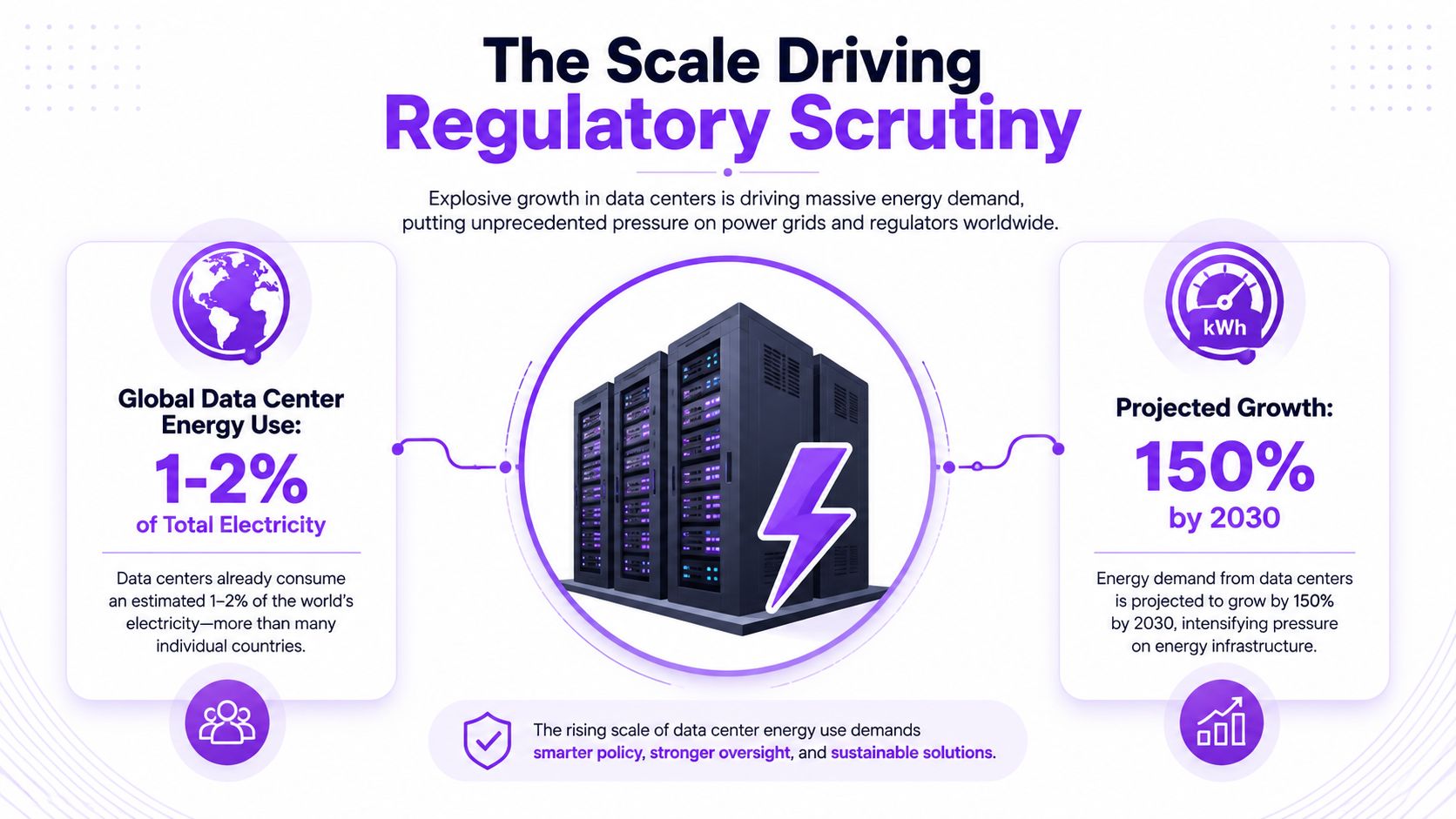
U.S. data center annual energy use reached about 176 TWh in 2023, equal to roughly 4.4% of total U.S. electricity consumption that year, excluding cryptocurrency mining, according to the Congressional Research Service R48646. That scale explains why data center regulations have moved from peripheral permitting issues into the center of utility, environmental, and land-use policy. Regulators are no longer asking whether these facilities belong in a market. They're asking how much grid capacity, water, and disclosure burden each site will impose.
Table of Contents
- The Scale Driving Regulatory Scrutiny
- Divergent Global Regulatory Frameworks
- Operational Thresholds and Design Mandates
- The Hidden Costs of Grid Interconnection
- Evolution of Local Zoning and Land Use
- Building a Compliance and Reporting Strategy
- Future Trends in Infrastructure Policy
The Scale Driving Regulatory Scrutiny
Load growth is the clearest reason data center regulations have tightened. When a single asset class absorbs a visible share of a national power system, lawmakers stop treating it as routine industrial development and start treating it as infrastructure with public obligations. The Congressional Research Service figure above is the strongest signal that the sector's footprint has crossed that line R48646.
That shift now shows up in legislative behavior. In 2025, lawmakers across all 50 states considered 238 data-center-related bills and enacted more than 40 in 21 states Congressional Research Service R48646. The point is not the tally itself. It is the direction of travel. Policy attention has moved from attracting projects to managing their externalities, especially where grid capacity, water demand, and community impacts intersect.
Why scale changes the compliance conversation
The practical consequence is straightforward. Site selection teams now face harder questions at the front end, because a parcel that clears zoning can still fail on grid readiness, water availability, or rate design. The most expensive mistakes often happen before the first building permit is issued, when the utility position is still uncertain and the project has already narrowed its land options.
Practical rule: if the utility conversation starts after land control is signed, the project team has already accepted avoidable risk.
The broader pattern also matters for multinational portfolios. EU-style disclosure expectations are shaping procurement and investor diligence, while U.S. states are using different combinations of energy, water, and community-impact rules HWG Law on global data-center regulation. Development teams need to assume that one operating model will not satisfy every jurisdiction. The sector is moving toward proof, not promise.
Divergent Global Regulatory Frameworks
The regulatory split in data center regulations is widening. The European Union has moved toward standardized disclosure that turns operating performance into a formal obligation, while the United States still relies on state-by-state measures that can reach rates, water use, and community protections HWG Law on global data-center regulation, Congressional Research Service R48646. For developers, that difference affects more than filing deadlines. It changes how designs are documented, how assets are benchmarked, and how quickly a portfolio can be compared across markets.
The European Union's reporting model
The EU's 2024 framework requires operators to report PD IT, the installed IT power demand in kW, and if that value changes during the reporting period, they must use a weighted average EU Delegated Regulation 2024/1364. That is a technical rule because it is meant to standardize capacity accounting instead of relying on loose annual snapshots. The result is more defensible benchmarking across sites.
The same regime also requires energy and sustainability KPIs to be communicated to the European database on data centres. Operators should treat that as a governance requirement. If the data cannot be reconstructed with a clean audit trail, the filing process becomes a design problem.
The United States' state-by-state approach
The U.S. path is messier. State lawmakers are targeting ratepayer protection, energy costs, and water use, and some proposals now reach facilities as small as 10 MW, while federal rules referenced in 2026 discussions focus on much larger sites above 100 MW Congressional Research Service R48646. That split means one market may treat a project as a local utility issue, while another frames it as a large-load policy issue.
| Regulatory theme | European Union | United States |
|---|---|---|
| Core mechanism | Centralized reporting and disclosure | Fragmented state-level legislation |
| Primary compliance object | Operational performance data | Rates, water, and community impacts |
| Design implication | Standardized metering and KPI governance | Market-specific legal review and utility strategy |
The implication for investors is straightforward. EU assets are increasingly compared on a common disclosure baseline, while U.S. assets can be forced into highly localized negotiations. A portfolio strategy that ignores that divide will misread both risk and timing.
Operational Thresholds and Design Mandates
Germany's Energy Efficiency Act shows how quickly broad sustainability policy becomes a design brief. New data centers starting operations from July 2026 must achieve PUE of 1.2 or better, waste-heat systems must be technically ready to reuse at least 10% of waste heat from 2026 and 20% from 2028, and operators consuming more than 7.5 GWh/year must implement ISO 50001 or EMAS-certified energy management PowerUp compliance overview.
What those thresholds force in practice
A PUE ceiling of 1.2 is a hard engineering requirement. It pushes developers toward efficient cooling architectures, tighter airflow management, and lower auxiliary loads because total facility energy is being measured against IT energy. The effect reaches the mechanical floor plan, the electrical chain, and the room layout before procurement begins.
Waste-heat obligations add a second design constraint. They require teams to treat heat as a recoverable byproduct, not just a thermal nuisance. That changes the conversation with local utilities, adjacent landowners, and district energy planners, because the building has to be designed around future reuse paths rather than only around immediate uptime.
A design lens for development teams
Design choice, not compliance afterthought: if the thermal plan cannot support the reporting plan, the project is already out of alignment with the law.
Compliance has to be embedded at concept stage. Teams should treat metering architecture, energy management certification, and waste-heat readiness as part of site feasibility, not as a post-entitlement checklist. In Europe, the line between engineering and regulation is getting thinner, and the design package has to reflect that reality.
For developers, this also creates a procurement filter. A design that looks efficient on paper but cannot support consistent KPI disclosure will be expensive to defend later. The cheapest path is the one that allows the facility to prove performance from day one.
The Hidden Costs of Grid Interconnection
The biggest regulatory risk is often the post-approval dispute over grid upgrade costs. Once utilities, regulators, and large-load customers start arguing over who should pay for the transmission, substation, or service work needed to connect the site, the project's cost base can shift after the permit looks settled. That long-tail exposure is why rate design has become a front-line issue in data center regulations Bipartisan Policy Center report on development considerations.
Why ratepayer protection changes project economics
Policy guidance in the U.S. increasingly emphasizes protecting residential customers from rate impacts and making sure large-load customers pay their fair share Bipartisan Policy Center report on development considerations. That point can seem abstract until a project is pulled into tariff disputes, infrastructure cost allocation, or utility rulemaking. At that stage, the delay is no longer about a building, it is about grid economics and who absorbs the upgrade burden.
Development teams should treat interconnection approval as one step in a longer negotiation. A project can clear siting and engineering review and still face a separate financial fight over transmission, substation, or service upgrades. In constrained power markets, that post-approval dispute can become a major schedule risk, because the utility conversation often continues after the permit conversation has ended.
How to model the exposure
The right question is not only whether the site can be powered. It is whether the commercial model can absorb a utility dispute that surfaces late in the process. Legal, land, and electrical teams need the same view of upgrade risk, tariff exposure, and which public bodies can reopen the terms.
A clean permit does not guarantee a clean power path.
Many project models are too optimistic. They treat interconnection as a technical milestone, then underweight the regulatory follow-through that can reshape capital needs and operating cost. The tighter the grid, the more likely it is that the utility negotiation will outlast the permit review, and the more carefully the team should assess whether the site can still support the project if those costs shift. A practical benchmark is the interconnection discipline visible in major campus projects such as the Google data center at Elmina Business Park, where access, upgrades, and timing all affect the final development profile.
Evolution of Local Zoning and Land Use
Municipalities are increasingly writing rules specifically for data centers rather than folding them into generic industrial zoning. Local ordinances now often address setbacks, noise buffers, water performance, generator operating limits, and in some cases closed-loop cooling or limits on potable water use Smart Growth America on zoning and data centers. That matters because local governments are turning community concerns into enforceable design criteria, not just leaving them as mitigation promises.
Why generic industrial zoning is breaking down
Data centers present a different public profile than warehouses or light manufacturing. They may operate without drawing much attention most of the time, then draw scrutiny over backup generation, cooling water, heat rejection, and utility load. Cities are responding with conditional permits, special-use permits, and overlay districts so they can attach site-specific conditions instead of relying on older industrial zoning language.
That shift changes site selection. A parcel that looks attractive on a map can fail once noise setbacks, utility access, and emergency-system rules are applied to it. Development teams need to treat local ordinance review as a design constraint, not a later entitlement step.
What the local rulebook now covers
The newer local framework tends to focus on three pressure points. Noise is one, because neighborhoods want enforceable limits on generator and cooling-system impacts. Water is another, because some jurisdictions are moving toward closed-loop or recycled-water requirements. The third is layout, since setbacks and screening can shape the actual building envelope.
The practical implication is clear. Local approval is becoming a design exercise. If the project team cannot show how the facility will meet district-specific standards on water, noise, and emergency systems, public review gets harder and timelines stretch. Entitlement strategy belongs in the earliest rounds of site feasibility.
The project pages for Google's Elmina Business Park facility and Project Eagle in Wharton County show how local context shapes development risk. Geography is only the starting point. The ordinance overlay is where compliance cost and schedule exposure start to appear.
Building a Compliance and Reporting Strategy
A workable compliance plan begins with data governance; legal review follows that foundation. The reporting burden is not just a filing problem, it is a recordkeeping problem that starts with clean inputs, consistent ownership, and a clear audit trail. If a facility cannot trace load changes, utility data, and operational assumptions back to the source, the rest of the compliance workflow becomes unstable.
What operators need in place
The first requirement is metering that supports time-based reporting, not just summary estimates at the end of a period. The second is a data model that preserves source records for utility inputs, load changes, and sustainability KPIs. The third is a review process that connects filings to engineering and operations, so reported values do not drift as teams rotate or expand.
That workflow also needs a defined reporting cadence. Monthly internal checks, filing calendars, and assigned reviewers reduce the risk that one missing input cascades into a missed deadline or a disputed submission. For larger portfolios, it helps to centralize this workflow through our operator listings, since multi-site teams often need a consistent view of ownership, contact points, and disclosure responsibility.
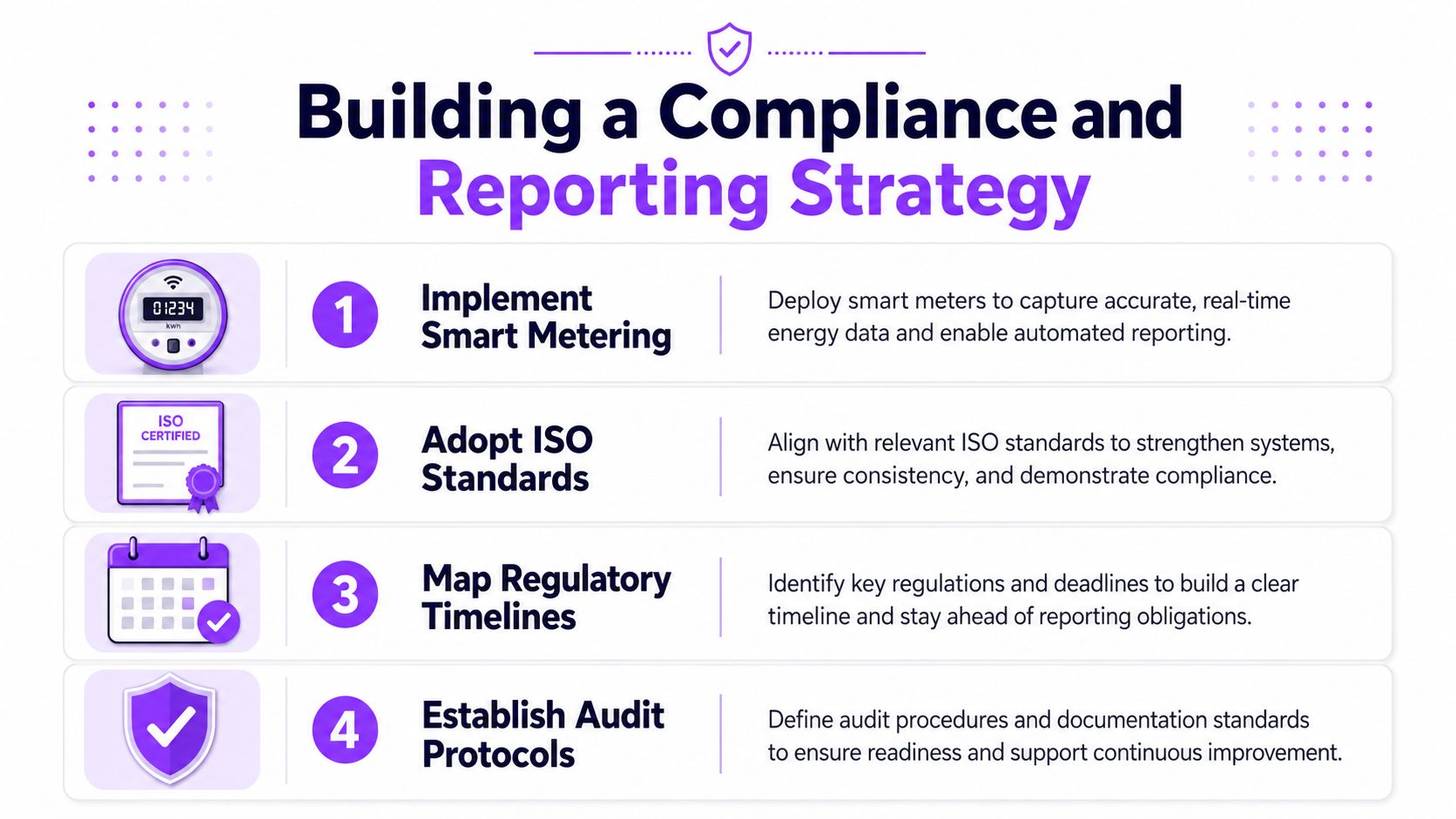
- Implement Smart Metering: Capture facility and IT load data in a format that supports reporting across the full period, not only at year-end.
- Adopt ISO Standards: Align energy management with ISO 50001 or the relevant certified system where the law requires it, especially for higher-consumption sites.
- Map Regulatory Timelines: Track filing windows, permitting milestones, and local review triggers in one calendar so deadlines do not conflict.
- Establish Audit Protocols: Keep source documents, design revisions, and KPI calculations together so filings can be defended if regulators ask questions.
Why stakeholder engagement belongs in the same plan
The public side of compliance can create as much friction as the internal side. Local officials and affected communities often want clear answers on noise, water, grid load, and emergency-system design before they support a project. Early engagement does not remove opposition, but it does reduce the number of surprises that turn into schedule risk or costly redesigns.
Best practice: the team should prepare one core narrative for engineers, lawyers, utilities, and community stakeholders, then tailor the evidence for each audience.
The strongest operators treat compliance as an operating discipline. They design for proof, preserve records in a form that can be audited, and make sure reporting matches the physical plant rather than sitting beside it as an afterthought. That approach lowers the odds of last-minute corrections, repeated filings, and avoidable disputes with reviewers.
Future Trends in Infrastructure Policy
The next phase of data center regulations is likely to move beyond energy use alone and fold in a wider set of community-impact tests. Recent legislative guidance points in that direction, with agencies being asked to weigh noise, heat, traffic, air quality, water quality, wildlife, and related local effects alongside infrastructure questions. The practical result is a harder approval path, because project teams now have to defend both the electrical load and the site's effect on the surrounding area.
Transparency will also gain more weight as regulators ask for data they can compare across facilities and markets. The EU model shows the direction of travel, where reporting is part of the operating expectation rather than a side exercise, and disclosure becomes part of compliance review EU Delegated Regulation 2024/1364. For investors and procurement teams, that means reported performance will shape diligence as much as engineering specs or lease terms.
The harder issue for developers is not just disclosure, it is the growing expectation that the site story matches the physical design. Regulators are beginning to examine whether noise control, heat rejection, and water management are handled as integrated project risks instead of separate technical matters. That shift rewards teams that can explain their footprint before questions surface, because their applications look more credible and less reactive.
Site selection will feel this shift first. A parcel that clears utility and zoning checks may still face delay if the surrounding community views the project as a source of unresolved heat, water, or traffic burden. That is why future approvals are likely to favor proposals with clearer mitigation plans, tighter engineering documentation, and a stronger link between facility design and local impact, while projects that cannot show that alignment will spend more time in review than in construction.
Regulators are beginning to treat noise, heat, and water quality as co-equal with energy load in project reviews, signaling a shift from utility-focused permitting to community-impact assessment.