Data Center Locations in the US: A Decision Framework
Discover how to evaluate data center locations in the US with this decision framework for colocation and cloud needs.
16 min read
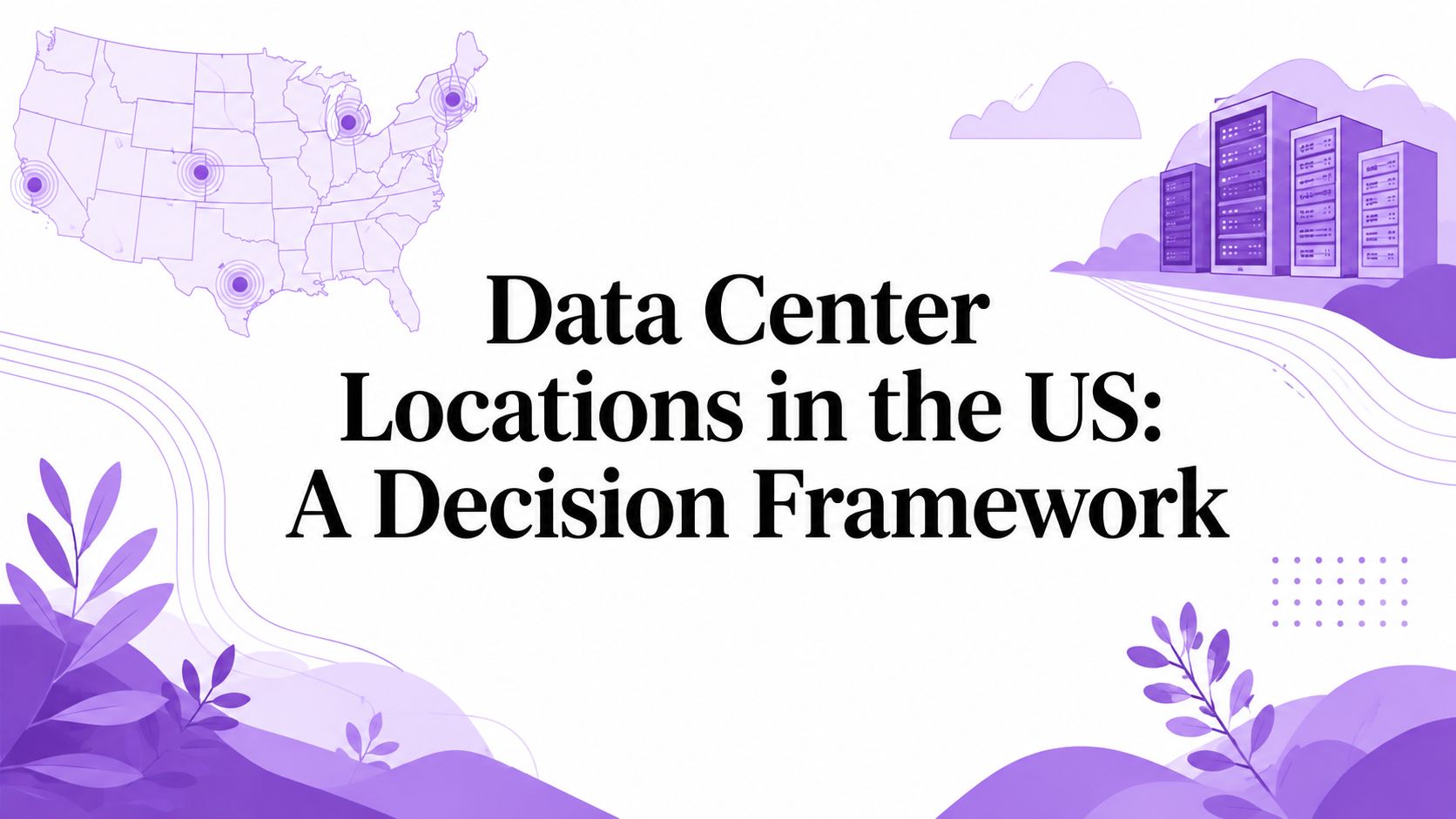
A company that needs latency to the East Coast, a cloud team balancing power and land costs, or a consultant comparing new markets usually starts with the same question, where are the right data center locations in the US. The answer depends on network reach, utility access, water stress, construction pipeline, and how close a site sits to customers or carriers. That's why the map matters more than the headline.
The US is the world's largest data center market by facility count, with more than 5,400 facilities reported in 2025 to 2026 sources, and one estimate placing the total at 5,427 active sites Brightlio's US data center stats. Pew also says more than 3,000 are operational and more than 1,500 are in development, which shows how much future capacity is already in motion Pew's overview of US data center energy use. The list below helps turn that broad picture into practical site-selection thinking.
Table of Contents
- 1. Northern Virginia, Ashburn, Sterling, Leesburg
- 2. Silicon Valley and Bay Area, San Jose, Sunnyvale, Hayward
- 3. Dallas-Fort Worth Metroplex
- 4. Chicago and Midwest, Illinois, Indiana, Wisconsin
- 5. Phoenix, Arizona, Tempe, Chandler, Mesa
- 6. Los Angeles and Southern California, Irvine, Santa Ana, Long Beach
- 7. Portland, Oregon and Seattle, Washington, Prineville, Boardman, Puget Sound
- 8. Denver, Colorado and Mountain West, Boulder, Fort Collins
- 9. Atlanta, Georgia and Southeast, Charlotte, Jacksonville
- 10. New York City and East Coast, New Jersey, Connecticut, Massachusetts
- Top 10 U.S. Data Center Locations Comparison
- Final Thoughts
1. Northern Virginia, Ashburn, Sterling, Leesburg
Northern Virginia is still the clearest answer when someone asks where the densest data center locations in the US are clustered. Pew says Virginia alone has 643 data centers, and a current market tracker places Northern Virginia at 388 facilities with about 16.0 GW of tracked capacity Pew's US data center geography summary Dgtl Infra's United States data center market data. That concentration reflects years of fiber buildout, peering access, and utility planning.
Ashburn remains the reference point, but Sterling and Leesburg matter for teams trying to reduce land pressure or spread operational risk. A practical starting point is the Equinix DC2 Ashburn facility profile, then expanding outward to compare neighboring parcels and power access. In a market this crowded, the question is rarely whether capacity exists. It's whether the next block of capacity fits the customer's latency, carrier, and permitting needs.
What buyers usually test first
- Carrier mix: Verify how many networks already terminate nearby, because dense peering can shorten routing paths.
- Water and cooling fit: Check cooling friendliness by sub-market, especially for high-density workloads.
- Pipeline pressure: Review planned and under-construction sites before committing to land or colo space.
- County rules: Loudoun County zoning and utility capacity reports can shape what gets built next.
Practical rule: In Northern Virginia, a good parcel on paper can become a weak site if utility timing slips or nearby pipeline fills the same carrier corridor.
2. Silicon Valley and Bay Area, San Jose, Sunnyvale, Hayward
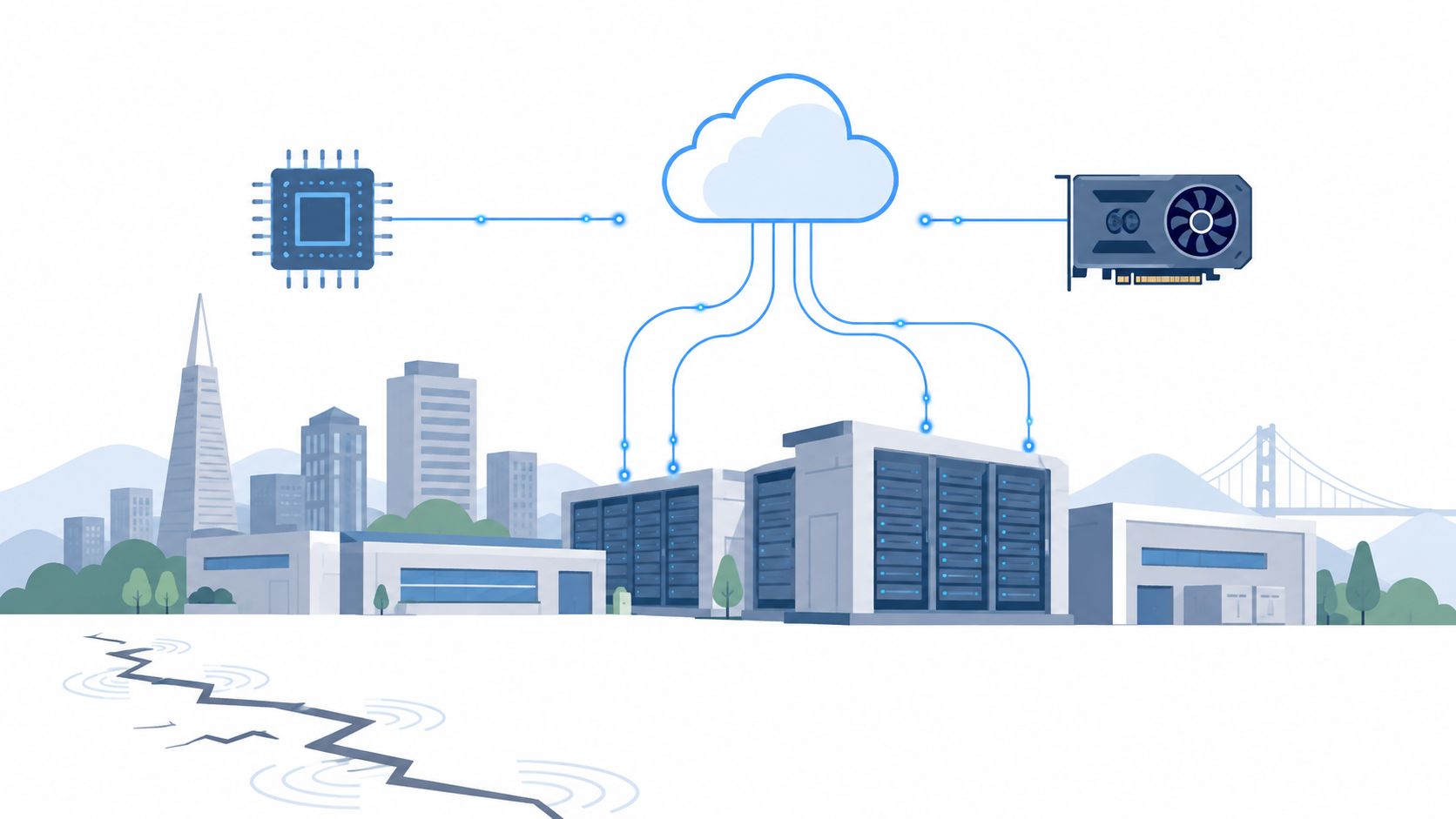
Silicon Valley still pulls outsized attention because it sits near cloud teams, software headquarters, and the people designing the next generation of infrastructure. The region mixes legacy colocation with hyperscale deployments, but the practical tradeoff is clear. High real estate costs, seismic risk, and tight environmental expectations make every new build harder.
The Bay Area also rewards teams that need distributed, low-latency architecture. Google, Meta, Apple, and multiple GPU-focused operators all keep infrastructure nearby to support cloud services, AI training, and North American traffic handling. For colocation planning, the market is less about cheap expansion and more about ecosystem access, especially when private connectivity and inter-facility routing matter.
A useful way to assess the region is to study operator concentration before choosing a sub-market. One internal example is the Equinix SV3 Silicon Valley facility profile, then compare it with neighboring sites in San Jose or Sunnyvale to judge whether the broader corridor offers enough diversity for redundancy planning. The Bay Area is often the right answer for engineering proximity, but not always the right answer for scale.
Bay Area siting works best when the project's value comes from network proximity, not from spare land.
3. Dallas-Fort Worth Metroplex
Dallas-Fort Worth has become one of the most practical growth markets for teams that want scale without coastal land constraints. Pew notes that Texas has 395 data centers, which helps explain why the region keeps attracting cloud and colocation investment Pew's US data center geography summary. The metro sits in the middle of North American traffic patterns, which makes it useful for distribution, recovery planning, and regional cloud deployment.
The region's appeal is not just geography. It also offers a deep mix of land availability, power planning, and operator presence. Teams looking at DFW usually compare Plano, Arlington, and similar sub-markets to see where they can balance cost, cooling, and latency without overcommitting to a single corridor. That is why a facility profile like Flexential Dallas Plano DFW01 can be a useful starting point for benchmarking nearby options.
Why DFW gets short-listed
- Middle-of-country routing: Useful for balancing East and West Coast traffic.
- Real estate flexibility: More room for phased expansion than in many coastal metros.
- Power planning: Grid conversations happen early, which matters for large footprints.
- Operator depth: More choices can support redundancy and negotiation.
DFW works especially well for organizations that need capacity growth without sacrificing connectivity. The region keeps showing up in site selection meetings for a simple reason, it offers a path to scale that still feels operationally manageable.
4. Chicago and Midwest, Illinois, Indiana, Wisconsin
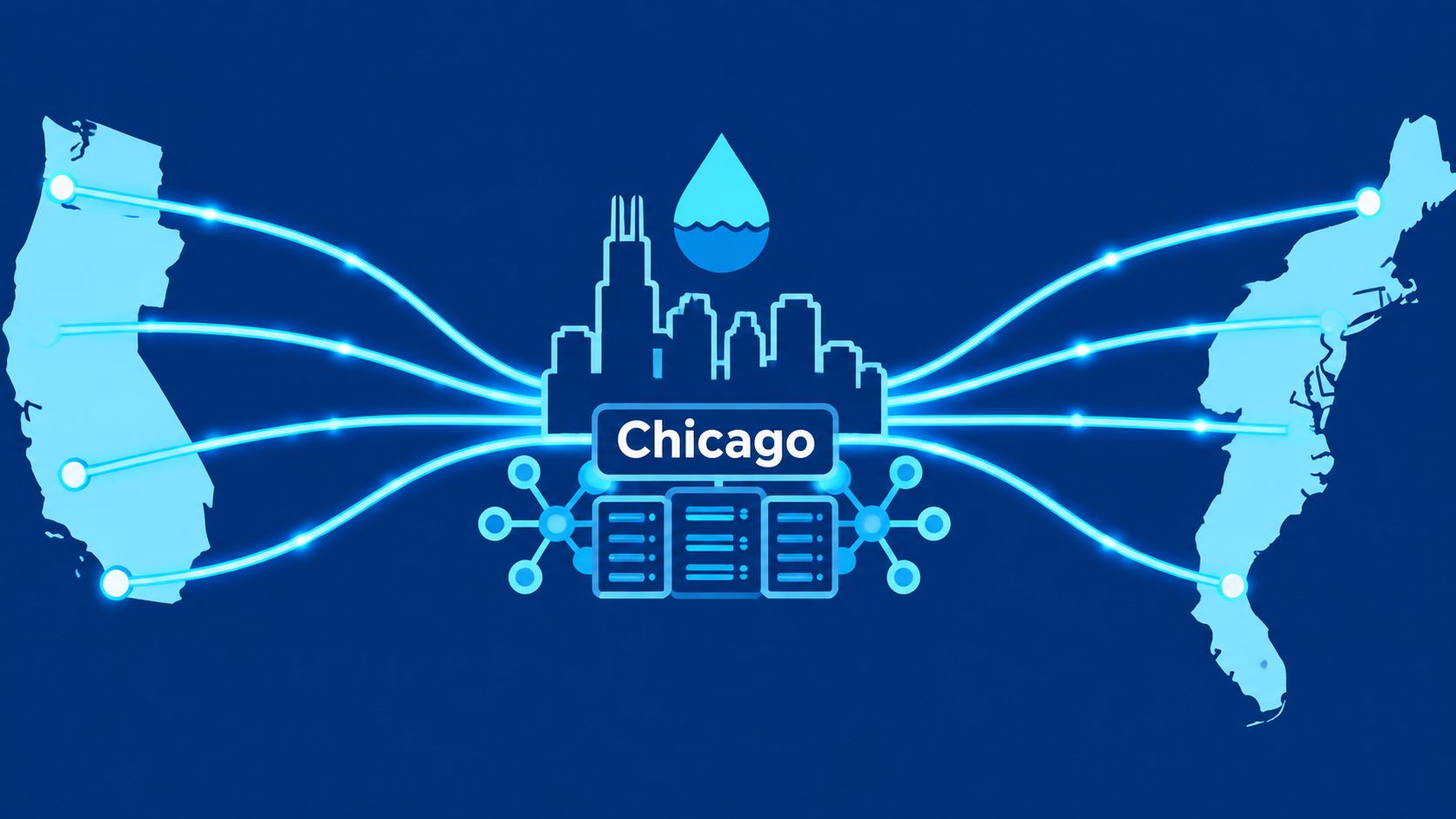
Chicago functions as the Midwest's interconnection anchor, and that role matters more than its raw footprint alone. Dgtl Infra's market ranking places Chicago at 805 MW among the top U.S. markets, while the same ranking shows strong capacity concentration in a few major metros Dgtl Infra's United States data center market data. For teams that need east-west traffic handling, Chicago often sits at the center of the routing conversation.
The broader Midwest adds a second layer of usefulness. Illinois is the obvious starting point, but Indiana and Wisconsin can offer greenerfield opportunities when a project wants lower land costs or a wider siting search. That matters for developers trying to avoid overpaying for mature submarkets while still staying within a well-connected region. The pattern is simple, Chicago handles the exchange function, and nearby states help with expansion.
Where the Midwest stands out
- Carrier density in Chicago: Strong for interconnection-heavy workloads.
- Greenfield flexibility nearby: Indiana and Wisconsin can make phased growth easier.
- Balanced operating profile: Often easier to justify than a premium coastal build.
- Cooling and sustainability planning: Great Lakes context can shape water and energy narratives.
The Midwest is a good fit when the project needs connectivity first, but still wants enough physical room to grow. It is also a sensible option for teams that want to place resilience infrastructure outside a single coastal zone.
5. Phoenix, Arizona, Tempe, Chandler, Mesa
A Phoenix site can look straightforward on paper, then turn into a more detailed exercise once the operational tradeoffs come into view. The region draws attention because it offers room, western reach, and a strong solar narrative. Dgtl Infra's ranking places Phoenix at 1,380 MW, which shows how much capacity has already accumulated there Dgtl Infra's United States data center market data. That scale makes Phoenix hard to overlook in any serious US site-selection review.
The harder question is how a project will perform after go-live. Extreme heat and water stress shape facility design, cooling strategy, and long-term operating confidence. Teams evaluating Phoenix need to look past land and power availability, then ask how the site will behave over time as cooling loads rise or environmental expectations tighten. A site that works in the first design review can still become difficult if the operating model is not built for local conditions.
What matters most in Phoenix
- Cooling design: High heat makes equipment and mechanical planning critical.
- Water strategy: Long-term supply questions should be part of the first diligence pass.
- Sub-market choice: Tempe, Chandler, and Mesa can differ in cost and utility fit.
- Renewable alignment: Solar access can support sustainability positioning.
Sub-market detail matters here. Tempe, Chandler, and Mesa may sit under the same regional label, but they can produce different outcomes for cost, utility fit, and site flexibility. That is why teams often compare them side by side instead of treating Phoenix as a single uniform market. The right choice depends on whether the project needs a more controlled operating profile, a broader siting search, or a cleaner path for expansion.
Phoenix often fits workloads that need western coverage without paying Bay Area premiums. It works best for organizations that can accept heat-related operational complexity in exchange for scale and strategic location.
6. Los Angeles and Southern California, Irvine, Santa Ana, Long Beach
Southern California remains a key gateway for Pacific-facing traffic, content distribution, and enterprise workloads that need proximity to major business centers. The region's value comes from network position, not from cheap expansion. Real estate is expensive, seismic planning matters, and power and water constraints can shape every decision.
Orange County often becomes the practical alternative when downtown Los Angeles looks too tight. Irvine and Santa Ana can offer more workable combinations of access, redundancy, and site flexibility for colocation and edge use cases. That is why the market is often evaluated at the sub-market level, not just as a single metro.
A useful first pass is to look at the Equinix Southern California facility profile only if the goal is Bay Area comparison, but for Southern California-specific planning the better habit is to compare operator footprints and redundancy patterns across the LA basin. The important question is whether the location supports Pacific routing, disaster recovery, or regional content caching with enough resilience to justify the cost.
Southern California is rarely the cheapest answer. It is often the most strategically connected answer for Pacific traffic and regional redundancy.
7. Portland, Oregon and Seattle, Washington, Prineville, Boardman, Puget Sound
The Pacific Northwest is a power-driven market. Google's Prineville campus and other regional builds show why hyperscale operators keep returning to Oregon and Washington for compute-heavy workloads. The region benefits from renewable energy positioning, especially for teams that need a credible sustainability narrative alongside capacity.
The tradeoff is not small. Geographic isolation from major interconnection hubs means some projects accept less connectivity density in exchange for power and operating advantages. That makes the region especially attractive for large single-purpose campuses, backup capacity, or workloads that can tolerate a more distributed architecture.
Prineville and Boardman are useful reminders that the opportunity is often outside the biggest city names. Rural Eastern Oregon, in particular, can look very different from Seattle proper when developers are comparing land, utility access, and long-term cooling strategy. For projects that depend on heavy compute, the Northwest can still be one of the most compelling American siting regions.
What teams typically evaluate
- Power availability: Utility capacity planning can make or break expansion timing.
- Cooling sustainability: Water stress and hydroelectric context both matter.
- Connectivity tradeoffs: Network design must account for relative isolation.
- Sub-market economics: Rural sites can change the capex picture significantly.
8. Denver, Colorado and Mountain West, Boulder, Fort Collins
Denver and the Front Range are often treated as a secondary market, but that label misses what makes the region useful. It offers central positioning, moderate costs, and enough renewable energy interest to support a modern infrastructure story. For operators trying to diversify away from coastal concentration, that mix can be attractive.
The limitation is interconnection depth. Denver is not trying to replace the great coastal hubs. It is trying to offer a viable alternative for select workloads, especially when a team wants a smaller but still strategically placed footprint. Boulder and Fort Collins can also enter the conversation when a project wants to trade metro density for different land economics or university-adjacent talent access.
Elevation is a real planning factor here. Equipment specifications, cooling assumptions, and utility expectations all need review before a build moves forward. A site may look attractive on a map, but still need engineering adjustments before it can support the intended workload.
In the Mountain West, the best site is often the one that matches the workload precisely instead of trying to serve every use case at once.
9. Atlanta, Georgia and Southeast, Charlotte, Jacksonville
Atlanta has emerged as a strong Southeast growth point because it sits between major coastal demand centers and has become more attractive for hyperscale buildouts. Dgtl Infra's ranking puts Atlanta at 1,065 MW, which shows how much capacity the metro has already pulled in Dgtl Infra's United States data center market data. That scale helps explain why the city keeps appearing in expansion conversations.
The Southeast also gives buyers a second layer of options. Charlotte and Jacksonville can serve as lower-cost alternatives or support markets for teams that want regional diversity without moving too close to Northern Virginia. Those cities can be especially appealing when latency, utility planning, and hurricane resilience are all part of the same decision.
The right Southeast site usually balances fiber growth with weather risk. That means operators need to look carefully at route diversity, insurance assumptions, and the timing of utility upgrades. The market is growing, but it still rewards disciplined diligence more than quick assumptions.
10. New York City and East Coast, New Jersey, Connecticut, Massachusetts
New York City remains essential for finance, trading, and transatlantic connectivity. The city's premium position comes with premium constraints, especially in land cost and expansion limits. For many organizations, New Jersey and Connecticut are not backup ideas, they're the practical options when Manhattan is too constrained.
The East Coast is also where transatlantic routing decisions become visible. Submarine cable access, peering density, and carrier relationships can all shape which facility is the best fit for a trading platform or global enterprise network. That is why teams often compare Manhattan against nearby secondary markets rather than treating the metro as a single choice.
For any organization tied to financial services or European connectivity, the useful question is not whether New York matters. It's how much of the workload needs to sit inside the most expensive part of the corridor, and how much can be pushed into nearby states while preserving performance.
Top 10 U.S. Data Center Locations Comparison
| Region | Implementation complexity | Resource requirements | Expected outcomes | Ideal use cases | Key advantages |
|---|---|---|---|---|---|
| Northern Virginia (Ashburn, Sterling, Leesburg) | Very high, dense market, permitting and utility coordination | Very high power & fiber density; premium real estate | Massive capacity, strong interconnection, low regional latency | Hyperscale, colocation, major IX and federal workloads | Unmatched carrier density, market liquidity, pipeline depth |
| Silicon Valley & Bay Area (San Jose, Sunnyvale, Hayward) | Very high, seismic codes, strict environmental rules, scarce land | High-power needs, premium real estate, specialized labor | Low-latency premium services, high cost, scalable specialized compute | Low‑latency enterprise, R&D, GPU/AI and premium colocation | Proximity to tech HQs, innovation ecosystem, interconnection hubs |
| Dallas‑Fort Worth (DFW) Metroplex | Medium, greenfield-friendly but cooling and grid planning required | Abundant land, reliable ERCOT power, growing fiber | Cost-efficient large-scale capacity, moderate latency to coasts | Hyperscale expansion, regional distribution, cost-sensitive workloads | Low capex/opex, land and power availability, logistics access |
| Chicago & Midwest (IL, IN, WI) | Medium, mature interconnection but some aging facilities | Mature fiber backbone, abundant power/water, urban land limits | Excellent east–west connectivity, balanced costs, high redundancy | Interconnection hubs, transit routing, enterprise & colocation | Premier IX presence, central geography, carrier diversity |
| Phoenix, AZ (Tempe, Chandler, Mesa) | Medium, heat and water sustainability challenges | Large greenfield land, strong solar resources, water‑constrained | Low renewable energy cost, high cooling demand in summer | Greenfield hyperscale, renewable‑focused deployments | Competitive solar economics, incentives, ample land for scale |
| Los Angeles & Southern California (Irvine, Santa Ana, Long Beach) | High, seismic risk, tight permitting, expensive land | Premium coastal real estate, submarine cable access, carrier diversity | Optimal Pacific Rim connectivity, high operating costs | Asia‑Pacific gateway, media/CDN, content delivery workloads | Submarine cable access, media ecosystem, international reach |
| Portland & Seattle / Pacific Northwest (Prineville, Boardman, Puget Sound) | Medium, remote sites, grid capacity planning required | Very low‑cost hydro power, large rural land tracts, growing fiber | Lowest power costs, efficient cooling, higher geographic latency | Power‑hungry compute, large-scale hyperscale, sustainability‑focused | Hydroelectric power, natural cooling, renewable alignment |
| Denver & Mountain West (Boulder, Fort Collins) | Low–Medium, emerging market, some elevation impacts | Moderate land and renewable supply, evolving fiber | Balanced cost and latency, moderate scalability | Regional diversification, specialized compute, greenfield sites | Central geography, renewable mix, cooler climate aiding efficiency |
| Atlanta & Southeast (Charlotte, Jacksonville) | Low–Medium, growing infra, some weather risks | Abundant low‑cost land and power, improving fiber | Cost-effective expansion with improving interconnectivity | Regional hub, redundancy for East Coast, cloud growth | Lower costs, incentives, strategic Southeast positioning |
| New York City & East Coast (NJ, CT, MA) | Very high, extreme real estate & regulatory complexity | Premium urban space, dense fiber, constrained power availability | Premium colocation, transatlantic connectivity, high operating cost | Financial sector, low-latency trading, transatlantic services | Proximity to finance, transatlantic cables, rich carrier ecosystem |
Final Thoughts
Choosing among data center locations in the US is really a balancing act between network proximity, utility reality, land economics, and community impact. Northern Virginia and New York reward closeness to dense carrier ecosystems. Dallas-Fort Worth, Atlanta, and Chicago offer scale with stronger expansion paths. Phoenix and the Pacific Northwest reward power and land strategies, but they come with cooling and environmental tradeoffs. The Bay Area and Southern California stay relevant because they solve very specific connectivity and business proximity problems that cheaper regions can't always replace.
The best siting decisions now depend on more than a metro name. Pew's finding that 38% of Americans live within 5 miles of an operational data center shows how visible these facilities have become Pew's US data center geography summary. That means site selection now intersects with local utilities, zoning boards, water planning, and community expectations much earlier than it used to. A strong project team looks at the operating cluster, the pipeline behind it, and the local stress factors before the land is locked.
That's also why a good directory matters. Data Centers List brings facility location, status, and capacity context into one place, which helps turn a broad market scan into a workable shortlist. For developers, investors, and site selectors, that kind of visibility makes it easier to compare mature hubs with emerging ones and understand where the next bottleneck may show up.
If the next project needs a clearer view of facility locations, pipeline status, and market concentration, visit Data Centers List to compare US markets side by side. Its map and facility profiles can help teams narrow a shortlist, check status, and see how each location fits a broader siting strategy.