Data Center Design Standards: Essential Guide 2026
Master data center design standards with this comprehensive guide. Covers Uptime tiers, ASHRAE, electrical codes, and AI-era needs.
20 min read
Data centers are no longer niche mechanical rooms hidden behind enterprise walls, they have become grid-scale infrastructure. A 2023 CRS summary put U.S. data center electricity use at roughly 176 TWh, or about 4.4% of U.S. annual electricity consumption, and noted projections that demand could double or triple by 2028 (Energy Department best-practice guide). That's the right place to start, because data center design standards now shape not just uptime, but power planning, zoning, carbon reporting, and long-term operating cost.
The challenge is that the standards stack is layered. ANSI/TIA-942 gave the industry a common tiered language for reliability, while building codes and fire standards define the legal floor, and energy standards such as ASHRAE Standard 90.4 set efficiency expectations. On top of that, newer guidance is pushing design teams to confront AI-era power density and even community-impact rules that technical standards never fully covered. That mix is why a project can be compliant on paper and still be underbuilt for modern workloads.
Table of Contents
- Why Data Center Design Standards Matter Now
- Understanding the Tiered Reliability Model
- Energy Efficiency Benchmarks and Thermal Guidelines
- Building Codes and Safety Compliance Requirements
- Designing for AI-Era Power Density
- Community Impact and Permitting Standards
- Standardization Strategy for Scalable Deployment
- Comparing Major Standards Bodies and Frameworks
- Quick Reference Guide for Design Teams
Why Data Center Design Standards Matter Now
A data center project can satisfy the permit set and still fail the business case if the standards stack is handled as an afterthought. These facilities now sit inside utility planning, local zoning review, fire and electrical compliance, and corporate carbon reporting, so design choices are no longer isolated to the engineering team.
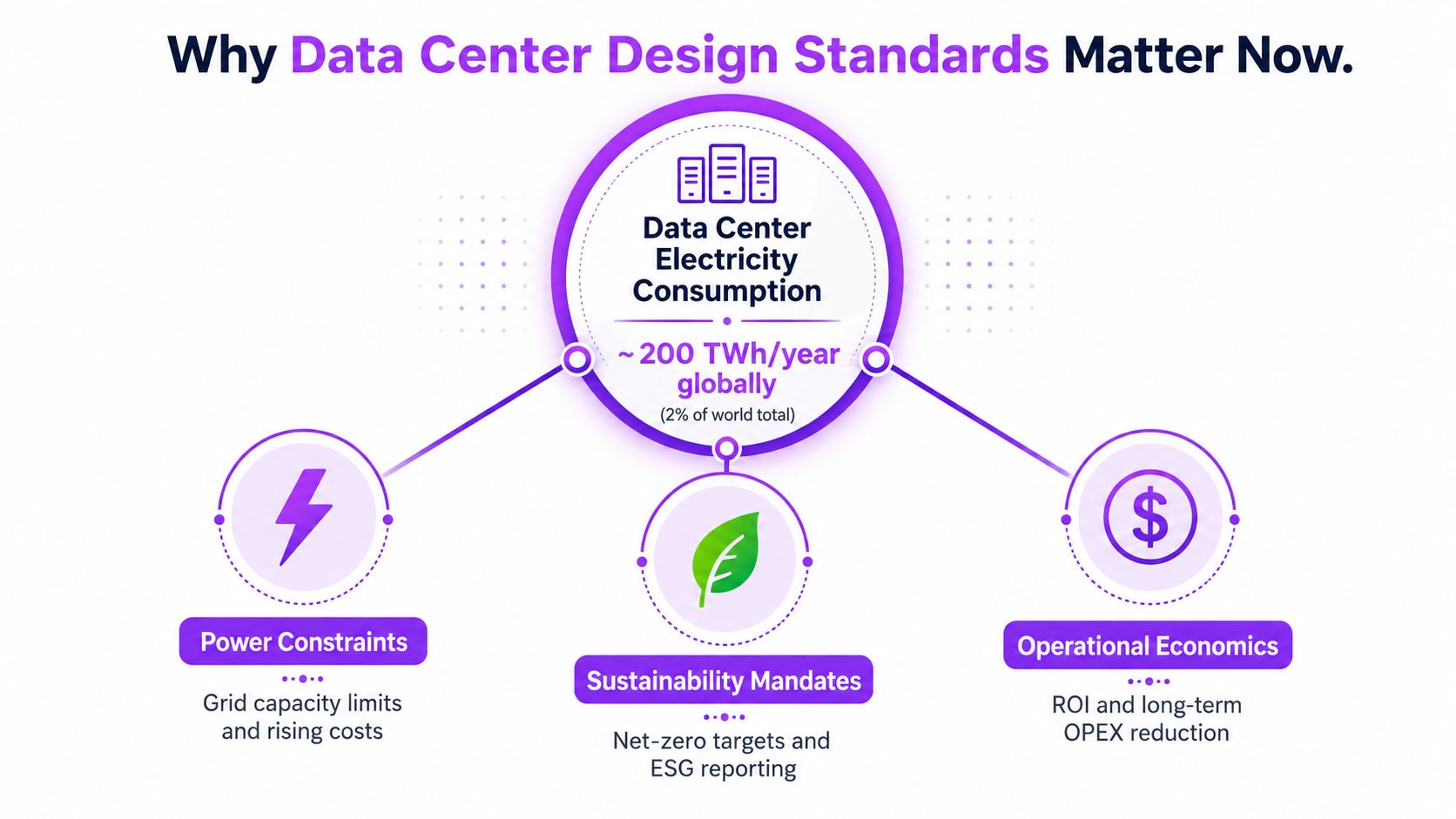
The standards stack is now layered
A serious project has to satisfy several overlapping frameworks at once. ANSI/TIA-942 remains a widely cited infrastructure design standard and formalized the four-tier reliability model that still acts as shorthand for resilience discussions (Structure Magazine). U.S. projects are also shaped by the local building and fire code stack, including the IBC and NFPA 70, with data-center-specific engineering often layering in NEC Articles 645 and 685, NFPA 70E, NFPA 110/111, IEEE 493, and IEEE 1584 (Consulting-Specifying Engineer).
That distinction matters because compliance and operational targets do not match. Codes set the legal floor. Reliability tiers, thermal limits, and power-quality assumptions define what the facility can support once the load profile shifts.
Practical rule: Treat standards as a hierarchy, not a checklist. If the code is the floor, reliability tiers and thermal guidance define how much headroom the facility really has.
Why the requirements keep expanding
The reason standards are multiplying is simple. The industry is no longer designing only for steady enterprise loads. It is now building for mixed tenancy, denser racks, tighter utility constraints, and sites that face stronger public scrutiny over noise, screening, and visual impact. Local planning requirements can change the exterior layout as much as the electrical one, which is why permitting review belongs at the start of design, not after the basis of design is fixed.
The pressure is coming from the load profile as well. Legacy guidance was built around racks in the 5 to 10 kW range, while AI-oriented deployments can push cooling, distribution, and maintenance planning into a different operating regime. That gap is where current frameworks start to thin out. Existing standards still define the minimum acceptable envelope, but they do not by themselves answer how to keep power delivery stable, maintain serviceability, and preserve expansion room when density rises faster than the site was originally planned for.
The practical takeaway is straightforward. A modern standards review has to ask three questions at once. What is legally required, what is operationally needed, and what assumptions in older guidance no longer match the actual load. For teams comparing reliability language and infrastructure terms, a data center glossary can help keep procurement, engineering, and permitting discussions aligned without blurring those distinctions.
Understanding the Tiered Reliability Model
The four-tier model still shapes procurement language because it gives owners and designers a shared way to describe resilience. ANSI/TIA-942 formalized that structure, and tier vocabulary became a shorthand for comparing facilities across markets, often alongside Uptime Institute concepts in commercial and enterprise projects. The important point is not the label alone, it is the operational promise attached to it.
What each tier means in practice
Tier 1 is the basic site infrastructure level. It can support the load, but it does not remove major single points of failure.
Tier 2 adds redundant-capacity components. That improves resilience, but maintenance still needs careful planning because redundancy is not the same as independent maintainability.
Tier 3 is the point many development teams find most practical. It is built for concurrent maintainability, which means planned work can happen without taking the critical load down.
Tier 4 is the most demanding level, with fault tolerant design intent. It makes sense only when the business case justifies the added complexity and capital burden.
| Tier Level | Classification | Key Characteristics | Typical Applications |
|---|---|---|---|
| Tier 1 | Basic site infrastructure | Minimal redundancy, direct dependency on primary components | Low-criticality environments, temporary deployments |
| Tier 2 | Redundant-capacity | Some redundant components, better protection against a single failure | Smaller enterprise facilities, cost-sensitive builds |
| Tier 3 | Concurrent maintainability | Maintenance can occur without shutting down the critical load | Most modern enterprise and colocation projects |
| Tier 4 | Fault tolerant | Designed to survive worst-case unplanned events without critical load impact | Highest-criticality operations and stringent SLA environments |
How the tier label changes procurement
Tier language is not just an engineering preference, it becomes a contract tool. Owners use it to define uptime expectations, scope redundancy, and set capital planning boundaries. That is why teams should be careful about assuming the highest tier is always the right answer.
A facility can be fully code-compliant and still fail the business requirement if its maintainability does not match the operating model.
The practical question is usually whether Tier 3 concurrent maintainability is enough, or whether a project needs Tier 4 fault tolerance. For many portfolios, Tier 3 is the more defensible choice because it balances resilience, serviceability, and cost without overbuilding everything to the most extreme standard. The data center terms reference can help teams keep terminology aligned during early design reviews, especially when stakeholders use tier language loosely.
Energy Efficiency Benchmarks and Thermal Guidelines
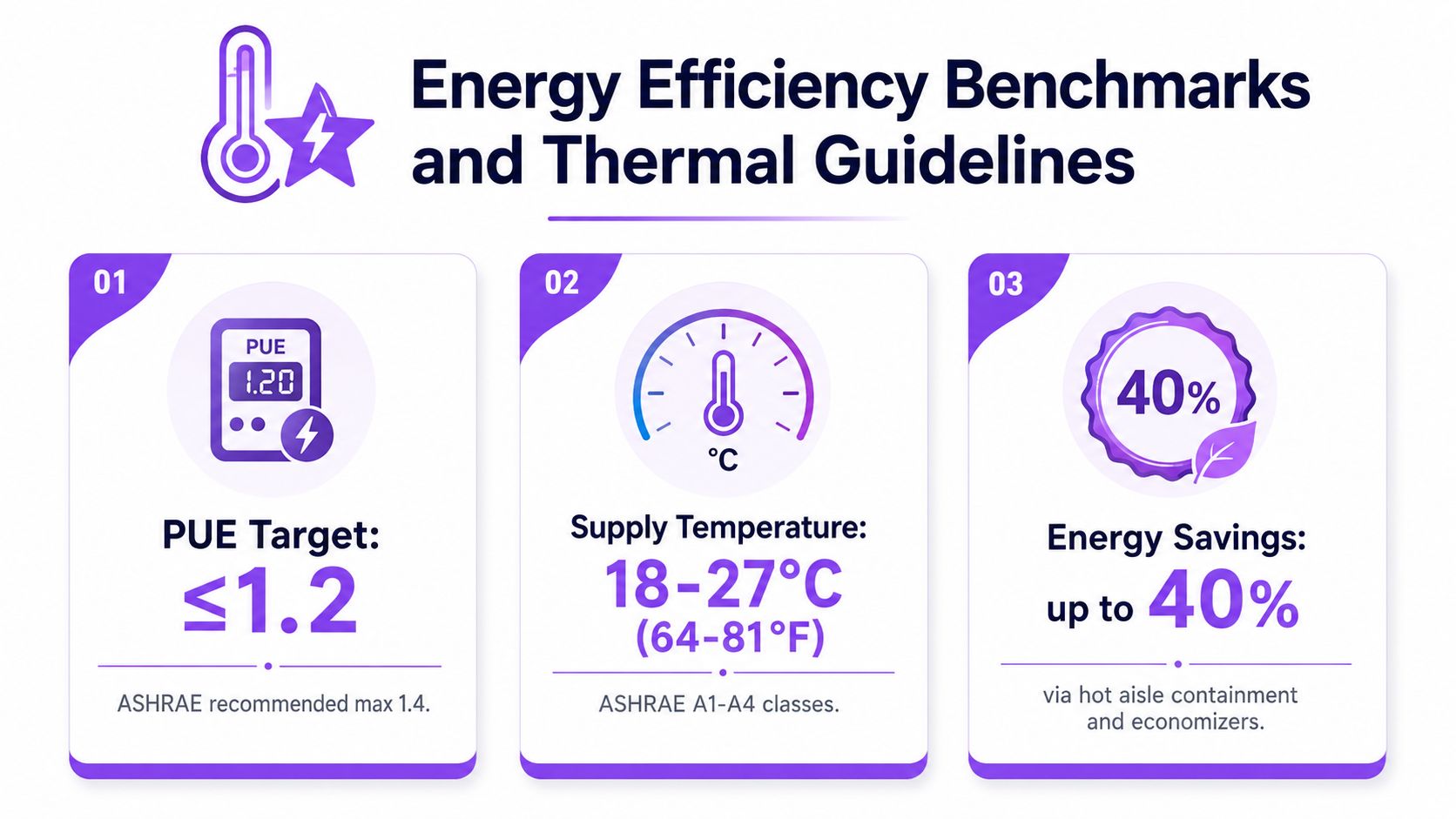
Efficiency belongs in the design standard, not in a late-stage tuning exercise. The U.S. Department of Energy's best-practice guide gives design teams a usable benchmark for cooling performance, with 0.8 kW/ton as a good-practice target and 0.6 kW/ton as a better target (Energy Department best-practice guide). Those figures do not guarantee a sound design, but they do separate disciplined concepts from ones that will waste energy under load.
The thermal question is really an operations question
The old argument that efficiency and reliability must conflict is too simple. Better airflow control, tighter containment, and deliberate thermal zoning can reduce waste without weakening the facility. The test is whether the design team models the full load path, from IT equipment through distribution losses and control behavior, instead of focusing only on the IT load itself.
ASHRAE remains central because it anchors both thermal guidance and the energy standard written for this building type. ASHRAE Standard 90.4 is the dedicated energy standard for data centers, while ISO/IEC 30134 KPI metrics give owners a formal way to track performance instead of relying on informal efficiency claims (McKinsey, Energy Department best-practice guide).
How efficiency shows up in design choices
A team that treats efficiency as a design requirement starts with airflow, not the chiller schedule. That shifts attention to a few decisions that change how the building behaves in operation.
- Containment first. Hot-aisle or cold-aisle containment needs early review because it changes fan work, return temperatures, and control logic.
- Climate-aware economizers. Free cooling only works where the local climate, water strategy, and sequence of controls support it.
- KPI discipline. ISO/IEC 30134 gives the owner a consistent way to track performance instead of arguing from one-off test results.
- Cooling benchmark checks. The 0.8 kW/ton and 0.6 kW/ton markers help expose whether a design is merely acceptable or efficient.
The broader context is clear. The same DOE guide notes older analysis that data centers were 10 to 100 times more energy intensive than an office, and EPA estimates placed them at about 3% of U.S. electricity consumption at the time (Energy Department best-practice guide). More recent CRS analysis put U.S. use at about 176 TWh, roughly 4.4% of U.S. annual electricity consumption, with projections that demand could double or triple by 2028 (Energy Department best-practice guide). That makes efficiency a planning constraint, not a side benefit.
Building Codes and Safety Compliance Requirements
A data center can satisfy every permit check and still be a poor operating platform. The reason is simple, code compliance defines the minimum legal and safety threshold, while the actual facility target must also support uptime, maintainability, and the load profile the owner expects.
The legal stack comes first
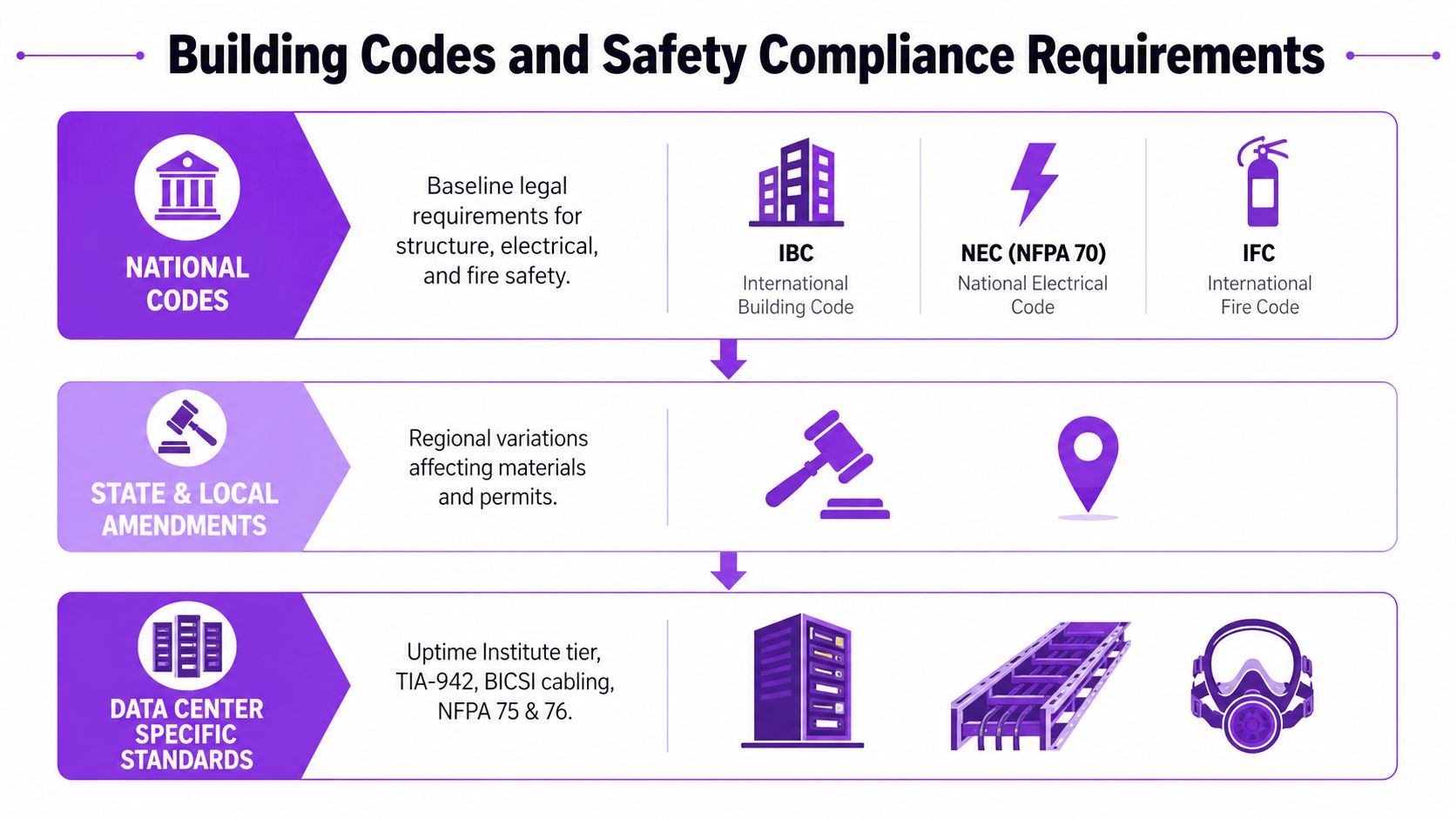
The first layer is the code stack adopted by the jurisdiction. In practice that means the IBC and NFPA 70 (National Electrical Code), with the IFC and related codebooks often entering through state or local adoption patterns. These documents govern structure, electrical safety, fire protection, and whether the project can be permitted at all.
Local amendments sit below that layer and often shape the design in ways teams underestimate. Material selections, mechanical room layout, egress, generator placement, and permit negotiations can all change once the authority having jurisdiction applies its own rules. A repeatable reference design still needs local adaptation before it is buildable.
The data-center-specific layer is different
Passing code review does not mean the facility is ready for critical service. The specialist layer is where the design is tested against how a data center operates.
That layer often includes NEC Articles 645 and 685, NFPA 70E, NFPA 110/111, IEEE 493, IEEE 1584, ASHRAE guidance, and standards from FM Global, UL, NETA, and SMACNA (Consulting-Specifying Engineer). These frameworks shape emergency power-off behavior, electrical safety boundaries, testing, switching philosophy, and the quality of installation and commissioning. They also expose a practical gap that matters more in AI-era builds, because legacy code language was written around lower rack densities and simpler heat rejection strategies.
A project team should also read those standards against the operating plan. A campus such as Hut 8 River Bend AI Data Center Campus may be permitted under the same basic code family as a conventional enterprise facility, but the compliance burden becomes harder once power density, redundancy, and maintainability rise together.
Compliance says the building can be approved. Resiliency says the load can keep running while people maintain it.
That distinction matters for development teams. Code minimums address legality and safety. Tier decisions and TIA-942 planning address service continuity, fault tolerance, and maintainability. If those layers are reviewed as one, the result can be a facility that is safe and permit-ready, yet still underspecified for the workload it is meant to serve.
Designing for AI-Era Power Density
The gap between legacy design standards and AI-era power density is widening. Older frameworks were built around air-cooled facilities and rack levels that sat well below the loads now being pushed into AI clusters, so they are useful starting points but not enough on their own. ASHRAE's AI Data Center Energy Performance framework points to a different operating model, one centered on density-based cooling, adaptive planning, and evaluation of higher-voltage distribution such as 800 VDC for extreme rack densities (ASHRAE AI framework).
The old separation between cooling and electrical design no longer holds
AI facilities collapse the old boundaries. Cooling selection now affects electrical room sizing. Electrical topology affects rack layout. Rack layout affects maintainability. Once the load rises sharply, those disciplines have to be designed together rather than reviewed in sequence.
That is the practical failure point in many standards stacks written around conventional server rooms. Teams should test whether the current concept still works for liquid cooling, rear-door heat exchangers, or direct-to-chip architectures. If the answer is unclear, the project needs a reset, not a minor revision.
The market is already moving in that direction. Public descriptions of AI power requirements point to workloads that extend far beyond conventional rack norms, and operators are planning for sustained load levels that older standards did not anticipate. One useful internal reference point is the Hut 8 River Bend AI data center campus, which shows how AI-oriented development now centers on power, cooling, and campus-scale planning rather than single-building conventions.
What practitioners need to add
A modern AI-ready concept usually needs a different review checklist:
- Density-based cooling assumptions. Cooling should be selected from the expected heat profile, not inherited from a legacy layout.
- Adaptive planning. The design should allow for changing load patterns and future equipment refresh cycles.
- Higher-voltage thinking. The mention of 800 VDC in ASHRAE's framework is a signal that conventional distribution assumptions may not be enough for extreme densities.
- Integrated discipline reviews. Electrical, thermal, and architectural teams need a shared model of the facility, not separate silos.
The main risk is false confidence. A project can look standards-compliant if the review only checks traditional categories, while still being functionally obsolete for AI workloads. The stronger facilities are the ones that treat these signals as design inputs early, then revise assumptions before the floor plan is locked.
Community Impact and Permitting Standards
Community review now affects data center design as much as equipment selection. In many markets, permitting has expanded to cover façade articulation, generator and substation screening, noise control, and the treatment of public-facing elevations, especially where local resistance is strong. The practical result is that site selection and massing now reflect local expectations that technical standards alone do not fully address.
Local rules now shape the building form
The ULI 2024 local-guidelines research documents requirements such as fully enclosed or screened cooling and power equipment, differentiated entrances, and façade treatment over long blank walls. Those are not cosmetic requirements. They change how much yard area a project needs, how the elevation is broken up, and how much screening structure has to be carried in the base design.
Planning teams need to engage earlier than they often did in older delivery models. A concept that leaves the public edge unresolved can lose time in entitlement, trigger redesign, or force late architectural additions that interfere with the original operational layout. That risk is higher now because local review often tests whether the building reads as an industrial asset or a managed neighbor.
What to test before the permit package is frozen
A practical review starts with three questions.
- Public visibility. Which façades will be visible from nearby roads or neighborhoods, and what treatment will they receive?
- Mechanical screening. Which cooling and power assets need enclosure, and how will screening affect airflow and maintenance access?
- Noise and access balance. How will the project preserve security and operating efficiency while meeting neighborhood expectations?
Permitting has become a design input, not a final approval step.
That shift matters because zoning, appearance, and community-response rules now influence the same early massing decisions as utility service, fire setbacks, and equipment routing. The standards conversation has therefore moved beyond engineering alone and into the politics of place. For developers, the gap between code minimums and operational targets is no longer limited to power and thermal design, it also shows up in the public realm and in how much flexibility remains after entitlement starts.
Standardization Strategy for Scalable Deployment
Portfolio developers usually do not lose time because one concept fails. They lose time because each site turns into a custom case, and every exception forces a new round of design, review, and coordination. A widely cited best-practice target is to standardize 60% to 80% of the facility and leave 20% to 40% customized for site-specific constraints, because too much one-off design raises integration risk, slows deployment, and reduces operational consistency. That ratio is practical, not theoretical, because it gives teams a repeatable base without pretending every parcel, utility, and permitting path is identical.
Standardize the repeatable parts
The systems that should behave the same across sites are the best candidates for standardization. That usually includes power distribution topologies, cooling architecture families, monitoring frameworks, and commissioning expectations. When those elements are repeated, operators can train teams more easily, compare performance across sites, and troubleshoot faster when a fault appears.
The operator listings are useful because they show how portfolios are often grouped by brand and market, which is where repeatable design choices start to matter. A multi-site owner can compare facilities more meaningfully when the underlying design language is consistent, and that comparison is harder when every campus uses a different operating model.
Customize only what the site forces
Some variables have to stay local. Utility interconnections, seismic conditions, local code amendments, and planning constraints are site-specific, and they shape the design whether the team wants them to or not. Those are the places where customization is justified, because treating them as interchangeable usually creates hidden risk.
A clean governance model keeps that boundary clear. A project team should define a standard package for repeatable systems, then document exceptions in a controlled way before procurement starts. That approach reduces the common failure mode where local teams revise the design during delivery and the portfolio loses consistency by attrition. It also helps teams spot where older standards still assume lower rack power than AI-era deployments now require, so the standard package can hold its place while the site-specific layer absorbs the differences.
The operational upside is not only speed. Standardization also makes maintenance, spare parts strategy, and technician training more predictable. In a sector where uptime commitments are tight and power density is rising, repeatability becomes a resilience tool as well as a cost-control tactic.
Comparing Major Standards Bodies and Frameworks
A data center can pass one authority and still fall short of the operational target set by another. That gap is widening as legacy frameworks, many of them built around 5 to 10 kW rack assumptions, meet AI-era designs with much higher power density. Project teams need to map the authorities deliberately, because each one governs a different part of the build and a different part of the risk profile.
TIA, ASHRAE, NFPA, IEEE, ISO/IEC, and regional frameworks such as EN 50600 each address a distinct slice of the design problem. Some define telecommunications and facility structure, some focus on thermal performance and energy, some govern fire and electrical safety, and others provide benchmarking or regional infrastructure guidance. The practical task is to use each framework for what it controls, then close the gaps where one body stops and the next one starts, as outlined in Structure Magazine, Consulting-Specifying Engineer, and the Energy Department best-practice guide.
How to map the standards
Some frameworks are voluntary best practices, while others enter a project as enforceable code or an adopted standard. That distinction matters during design review, because the legal minimum and the operational target are rarely the same thing. If a standard is aspirational but the code is mandatory, the code governs compliance, while the standard still informs a stronger design.
| Standards Body | Primary Focus | Authority Level | Key Publications |
|---|---|---|---|
| TIA | Telecommunications infrastructure and tiered facility design | Voluntary standard used broadly in procurement | ANSI/TIA-942 |
| ASHRAE | Thermal, HVAC, and energy guidance | Voluntary standard, widely adopted in engineering practice | Thermal guidance, Standard 90.4, AI framework |
| NFPA | Fire and electrical safety | Often incorporated into enforceable code stacks | NFPA 70, 70E, 75, 76, 110, 111 |
| IEEE | Electrical reliability, safety, and testing | Voluntary technical standards | IEEE 493, IEEE 1584 |
| ISO/IEC | Performance metrics and international benchmarking | Voluntary international standards | ISO/IEC 30134 |
| EN 50600 | European data center infrastructure guidance | Regional framework | EN 50600 series |
| Uptime Institute | Tier concepts and operational certification language | Voluntary framework used in market practice | Tier classification concepts |
What this means for project teams
Enterprise projects usually start with code, then layer in TIA-942, ASHRAE, and the relevant electrical and fire standards. That sequence reflects how authority is assigned in practice. Code sets the floor, while the voluntary frameworks help teams define maintainability, environmental performance, and the level of resilience the owner wants to buy.
Colocation and hyperscale projects place more weight on standardization, commissioning discipline, and portfolio-wide consistency. They also feel the mismatch between older standards and present-day rack densities more sharply, because a design that works at lower loads can become difficult to cool, maintain, or expand once AI hardware enters the mix. Edge projects may use a lighter physical footprint, but the same logic still applies. Compliance, maintainability, and operational intent have to be defined early, or the facility is forced into compromises later.
The mistake to avoid is treating these frameworks as substitutes for one another. They overlap, but they do not duplicate. A strong standards strategy assigns each body to its proper role, then separates legal requirements from design ambitions before the team commits to procurement or layout decisions.
Quick Reference Guide for Design Teams
A project review should ask whether the facility is compliant, maintainable, efficient, and adaptable to the intended load. Those are different questions, and they need different evidence. The fastest way to lose control of a design is to assume that one sign-off proves all four.
Project-stage checklist
- Concept stage. Confirm the code stack, the intended tier target, and the expected rack density before the layout hardens.
- Schematic stage. Test whether power paths, cooling topology, and maintainability goals align.
- Design development. Verify that energy benchmarks, thermal assumptions, and KPI tracking are built into the basis of design.
- Permit stage. Recheck local amendments, façade treatment, screening needs, and equipment placement.
- Commissioning stage. Validate the design under realistic load, not just on paper.
Common failure points
- Code compliance mistaken for resilience. A permitted design can still be operationally fragile.
- Tier chosen without workload analysis. The wrong reliability target wastes capital or creates avoidable risk.
- Efficiency treated as a retrofit. Cooling and airflow decisions belong at concept stage.
- AI density ignored until late. Once the floor plan is fixed, the options narrow fast.
A good standards review ends with fewer assumptions, not more. If the team can't explain why each framework applies, the design is probably too vague.
The working glossary
TIA-942 is the tiered infrastructure standard widely adopted as a common language. ASHRAE 90.4 is the data-center energy standard. ISO/IEC 30134 provides KPI structure. NFPA 70 and the IBC establish the legal baseline in many U.S. projects. Tier 3 means concurrent maintainability, while Tier 4 means fault tolerant design intent.
For teams evaluating acquisitions, greenfield sites, or phased expansions, the smartest next step is to compare the facility's disclosed power, status, and location context against the target design standard before committing to scope. Data Centers List gives developers, analysts, and operators a practical way to review existing, planned, and under-construction facilities in one place, which makes standards discussions much more grounded.