What 24 Hour Data Means for Operations
Learn what 24 hour data means, how continuous telemetry and reporting support monitoring, capacity planning, retention, and incident response.
16 min read
Global data centers consumed about 415 terawatt-hours of electricity in 2024, roughly 1.5% of worldwide electricity demand. By 2030, the International Energy Agency's base case projects that consumption could nearly double to around 945 TWh. 24 hour data usually means information collected, processed, or reported across a full day, with continuous telemetry providing the strongest operational interpretation.
A facilities team may be watching a dashboard right now while a cooling alarm sits at the edge of attention, a power trend changes between shifts, or a morning report hides what happened during the night. The phrase 24 hour data sounds precise, but it can describe very different things: an uninterrupted sensor stream, a daily summary, event records collected only when conditions change, or a service designed to stay available around the clock.
That distinction matters because data coverage isn't the same as service availability. A report covering the previous day may contain useful totals without preserving the sequence of events. A continuous stream may capture every change but still fail operationally if timestamps are inconsistent, records aren't retained, or nobody has authority to act on an alert.
For data center operators, the useful question isn't whether a system has a full day of information. The question is whether capture, retention, interpretation, and action work together as one control loop.
Table of Contents
- Why a Full Day of Data Matters
- Understanding the Core Concept
- How Continuous Monitoring Works
- Key Aspects of Useful Operational Data
- Using Data for Capacity Decisions
- Retention and Availability Implications
- Supporting Incident Response and Recovery
- A Practical Operating Framework
Why a Full Day of Data Matters
At 02:00, a facility can behave differently than it does during the afternoon. Workload distribution may shift, outdoor conditions may change, and a different operator may be handling alarms and maintenance. A convenient daytime snapshot can show that temperature and power are within acceptable operating conditions while missing the sequence that produced a nighttime deviation.
A full-day observation window gives operators a broader view of sequence and coverage. It can show whether a rise in rack power preceded a cooling response, whether a warning cleared on its own, or whether a recurring condition appears during a particular shift. The value comes from seeing relationships across time, not from treating twenty-four hours as a magic design threshold.
Start with the window, then inspect the gaps
A daily report might calculate maximum temperature, total energy use, or the number of alarms across a completed period. That report can support management review, but it may discard the intermediate readings needed to explain why a peak occurred. Continuous telemetry preserves the path between conditions, provided the system records readings at the required interval.
Operators should therefore ask four practical questions:
- What period does the dataset cover? A calendar day, a previous rolling day, or an arbitrary operational window can produce different conclusions.
- What happened between reported events? Event-only logs may omit stable periods and gradual drift.
- Which shifts and conditions are represented? A full-day window is useful only when its timestamps and sources are trustworthy.
- Who reviewed the information? Coverage without an assigned response path creates evidence, not control.
A complete day also exposes handover risk. Uptime Institute guidance recommends at least one to two qualified operators on-site at all times for 24x7 data center operations, because people must respond to alarms, perform maintenance safely, and manage power, cooling, and network incidents before they cascade into downtime. The guidance is summarized in Uptime Institute's data center staffing coverage.
Operational rule: A full-day report can reveal a pattern, but only continuous, interpretable evidence can explain the order of events well enough to guide intervention.
The practical lesson is simple. A twenty-four-hour window should be treated as a test of time coverage, continuity, and context, not as proof that a facility has been monitored continuously.
Understanding the Core Concept
The phrase 24 hour data has four common meanings, and each supports a different operational decision.
Continuous collection means sensors or systems produce readings throughout the day. Temperature, humidity, rack power, door state, and alarms can form a time-ordered stream. This is the strongest interpretation for incident response because it preserves changes between major events.
Event-based logging records only notable state changes. A system may log an alarm when a threshold is crossed, then record a recovery event when conditions return to normal. This approach can be efficient, but it may not show the gradual drift that preceded the alarm or the environmental changes that influenced it.
Rolling 24-hour reporting summarizes the most recent full day at any moment. A dashboard viewed in the morning and the same dashboard viewed later can cover different periods. Rolling reports are useful for current trend review, but the underlying history must be retained if analysts need to reproduce what the dashboard showed earlier.
Continuous service availability describes whether a facility or service remains usable without interruption. It isn't a statement about how much telemetry exists. A service can remain available while its monitoring history has gaps, and a monitoring platform can collect data continuously while the service it observes experiences an outage.
A camera analogy makes the difference clear. Continuous telemetry resembles a recording that preserves the sequence between two visible incidents. Event logging resembles a camera that saves only motion-triggered clips. A daily report resembles selected frames and a written summary. Service availability asks whether the building remained open, not whether every frame was saved.
Use precise language in requirements
Infrastructure teams should specify the intended meaning instead of requesting “24 hour data” alone. A procurement requirement might need a continuous sensor stream, a searchable daily summary, event retention, or evidence that operators can access the system at any time.
That precision prevents a common failure. A supplier may deliver a polished report that covers the previous day, while the operations team expects raw or near-real-time telemetry for intervention. Both parties can describe the output as 24-hour data, yet the result won't support the same work.
The distinction also improves governance. Analysts can define which records must be retained, operators can define which signals require alerts, and decision-makers can separate service uptime from monitoring availability. Those are related controls, but they aren't interchangeable.
How Continuous Monitoring Works
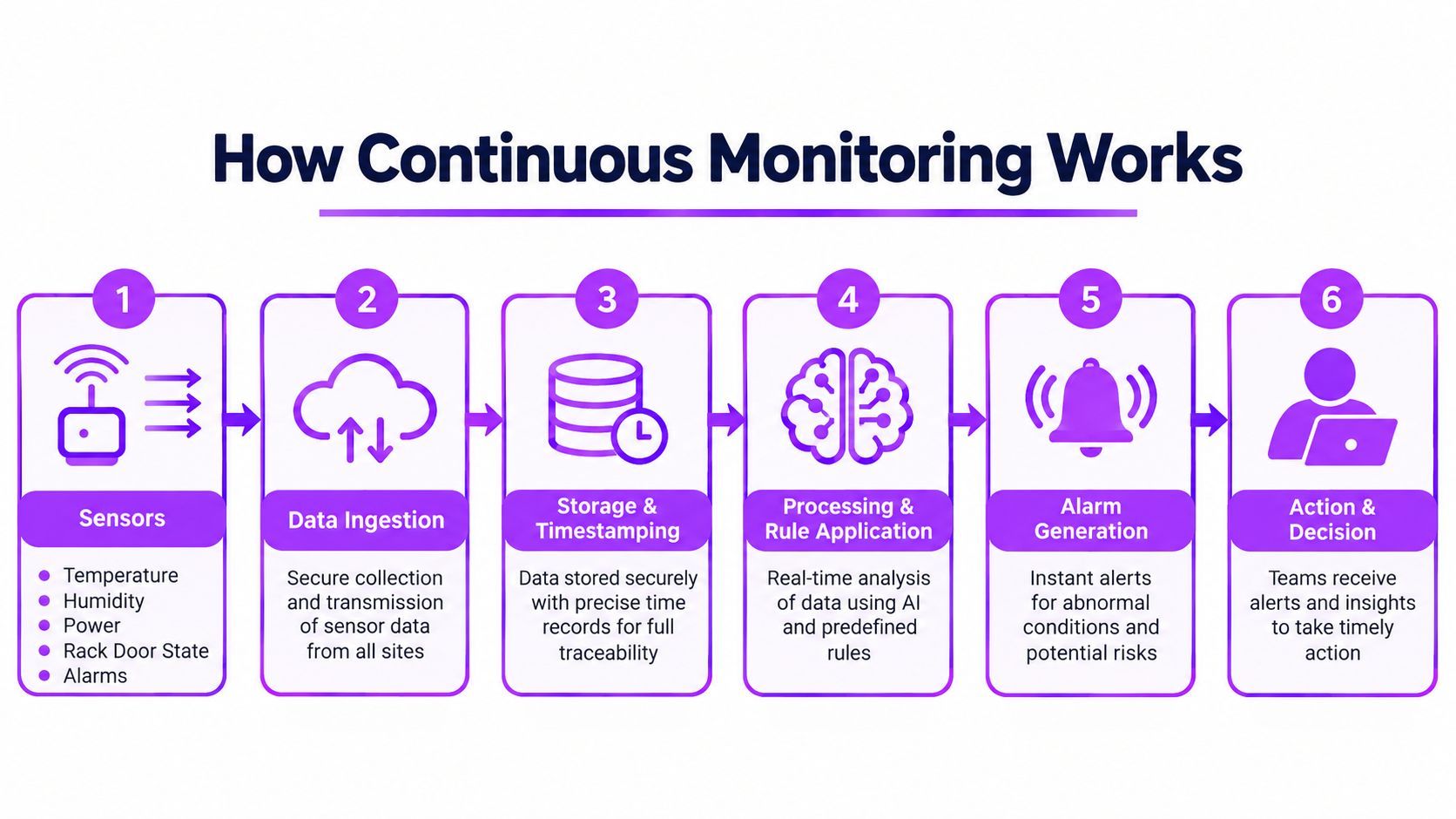
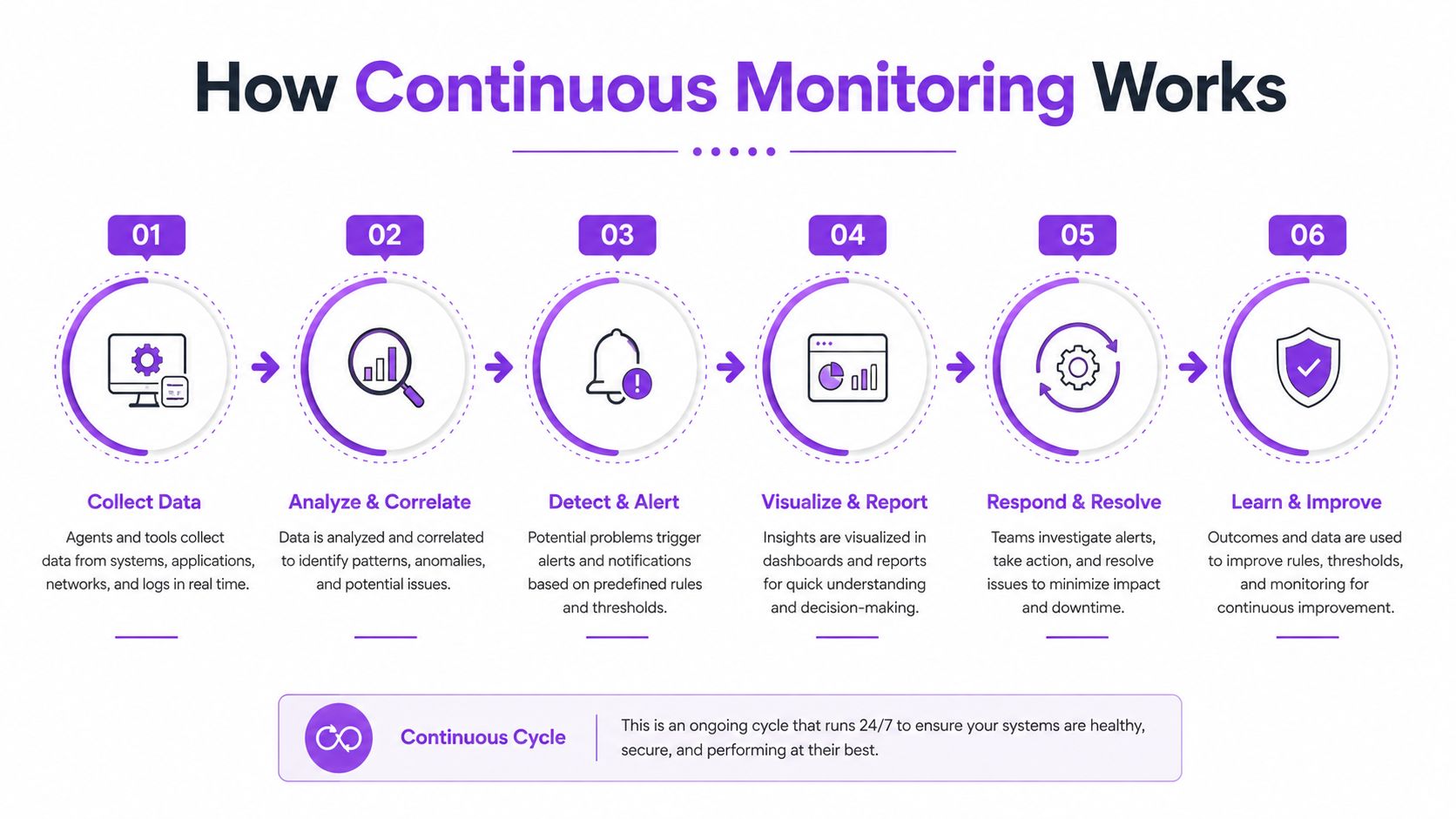
A day of facility telemetry begins with signals, not a report. Sensors and control systems collect readings such as temperature, humidity, power consumed by each rack, rack-door state, and alarms. The monitoring layer ingests those readings, attaches timestamps and source information, stores the history, and applies rules that determine whether an operator should investigate.
Consider a representative cooling and power event. Rack-power demand begins rising in one area, while supply-air temperature moves away from its usual pattern. A single dashboard value might show only that temperature is higher than normal. The time-ordered stream can show that the power change came first, that the cooling response followed, and that a door event or alarm occurred during the same period.
Turn readings into an operational response
The operator doesn't need every signal to become an alarm. The monitoring system can correlate conditions and create an alert when the combination warrants attention. The response may involve checking airflow, confirming equipment state, reviewing recent maintenance, or escalating to a specialist. The key is that the alert includes enough history to distinguish a developing condition from an isolated reading.
At shift handover, the same history becomes a shared operating record. The incoming operator can see when the condition began, which checks were completed, whether the trend stabilized, and what remains unresolved. That reduces dependence on memory or informal notes.
Uptime Institute's staffing guidance reinforces why this loop includes people. Qualified operators must be available to respond to alarms and manage incidents safely, even in facilities with redundant electrical and thermal systems. Data center operator information can provide market and organization context, but it doesn't replace site-specific procedures or live telemetry.
Preserve the order of events
A useful monitoring system connects six functions:
- Collection captures the physical or system state.
- Ingestion moves signals into a monitoring environment.
- Timestamping establishes event order.
- Analysis applies rules, correlations, and trend logic.
- Alerting directs attention to conditions requiring review.
- Action records what a qualified person did next.
If any link fails, the chart may still look complete. A value without a reliable timestamp can't establish sequence. An alert without an owner can't produce intervention. A response without retained history can't support later verification.
The control loop therefore ends only when the action and its result are recorded. Continuous monitoring isn't just a stream of values. It's a system for turning changing conditions into accountable decisions.
Key Aspects of Useful Operational Data
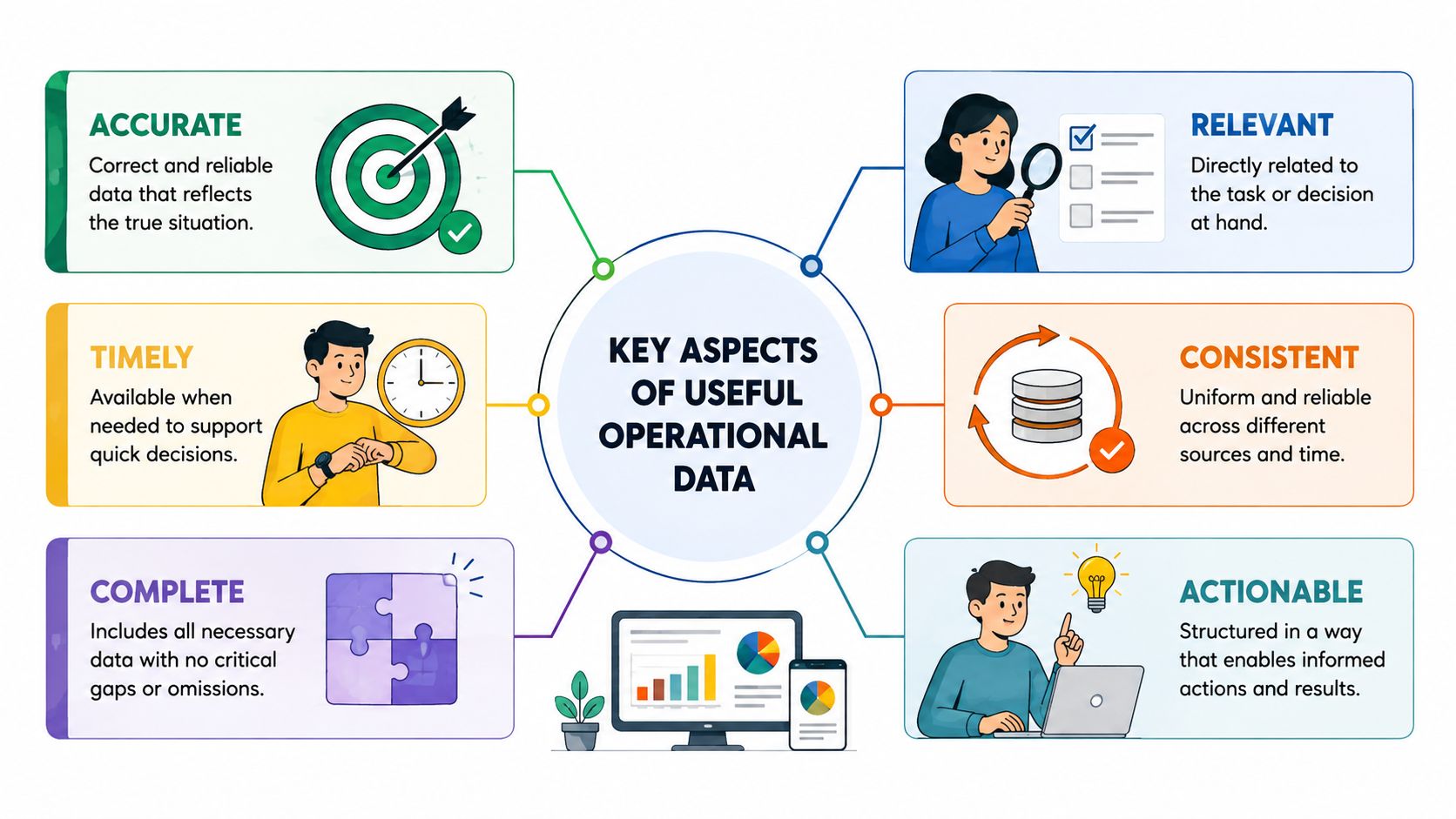
A full day of records becomes decision-ready only when the records carry enough context to support comparison and reconstruction. The first specification question is granularity. A dataset collected at a fine interval can reveal drift and short-lived peaks, while a heavily aggregated summary may conceal the transition that matters during an incident. The right interval depends on the decision, but the requirement should be explicit.
Time synchronization comes next. Every source should use a consistent time basis, and the system should distinguish the time a measurement occurred from the time it arrived. Without that distinction, a delayed alarm can appear to precede the condition that caused it.
Test the dataset before trusting it
A practical review should examine:
- Measurement scope: Identify which rooms, racks, cooling assets, power paths, and network systems are represented.
- Source metadata: Record the sensor, device, location, unit, firmware context, and collection method where relevant.
- Completeness: Check for missing intervals, silent sensors, duplicate readings, and unexplained gaps.
- Late arrivals: Separate delayed records from genuine changes in facility state.
- Derived values: Label averages, maxima, totals, and alerts as calculations rather than raw observations.
- Quality status: Mark maintenance periods, calibration concerns, overrides, and known sensor faults.
A daily chart can look continuous even when one sensor stopped reporting and the platform carried forward its last value. That chart may still be visually smooth, but it can mislead a capacity review or delay recognition of a hotspot. Operators need a way to distinguish measured conditions from inferred or repeated values.
One colocation operator reported continuously supervising over 19,000 variables, including cooling-air temperature, rack-door openings, and rack-level power consumption, as described in the data center monitoring document. The operational implication is not that every facility needs the same inventory. It is that scale makes metadata, filtering, and event history essential. Without them, more signals can create more noise rather than better control.
Data quality test: If an analyst can't identify what a value measures, when it occurred, where it came from, and whether it is complete, the value isn't ready to support a consequential decision.
The final check is actionability. A technically accurate record still has limited value if no team knows which decision it informs, who owns the response, or how the result will be verified.
Using Data for Capacity Decisions
Capacity planning should treat a full day of telemetry as one observation within a longer history, not as a design basis by itself. Rack-power data can show how demand moves across a facility, while environmental readings can reveal whether a high-density area runs hotter during certain workload patterns. The analyst's task is to connect load, location, timing, and available headroom.
A single peak may be an isolated operating condition. A repeated pattern across retained histories may indicate that a rack row, power path, or cooling zone needs investigation. The distinction prevents teams from making investment decisions from one dramatic point or one convenient average.
Read the relationship between power and environment
Rack-level power trends are most useful when paired with cooling-air temperature and related environmental telemetry. Rising power with stable environmental conditions may indicate available thermal capacity. Rising power with a developing hotspot suggests that density, airflow, containment, sensor placement, or cooling response deserves closer review.
Operators can use the history to ask:
- Which racks experience sustained demand rather than short-lived activity?
- Does load concentrate in a particular room or electrical path?
- Do temperature changes follow power changes, or do they appear independently?
- Are reported peaks caused by customer workload, maintenance state, or instrumentation issues?
- Does the observed pattern support additional density, further investigation, or no change?
The answer doesn't come from a single number. It comes from aligned readings and a clear record of the assumptions behind any derived summary.
Connect operational evidence to market context
Site-selection and infrastructure teams also need facility context beyond live telemetry. Data Centers List organizes facility information by location, operator, status, and IT power capacity, with capacity fields identified as disclosed or AI-estimated. That type of directory evidence can help frame market supply and pipeline questions, while data center predictive modeling can support broader analytical work.
The two evidence types serve different purposes. Telemetry describes what a specific environment is doing. A facility directory helps compare sites and markets using labeled capacity information. Neither should be treated as a substitute for the other.
| Observed Evidence | Practical Question |
|---|---|
| Rack-power trend | Is demand sustained, variable, or concentrated in a particular area? |
| Load distribution | Which rooms, rows, or power paths require closer planning attention? |
| Temperature history | Does environmental behavior change with observed load? |
| Alarm sequence | Did a capacity concern precede a warning or follow another event? |
| Data completeness | Can the apparent pattern be trusted, or did missing records distort it? |
A sound capacity decision names the evidence, the uncertainty, and the next validation step. That discipline is more valuable than treating “24 hour data” as a guarantee of planning accuracy.
Retention and Availability Implications
Continuous collection doesn't guarantee that useful history will remain available. A monitoring platform may show current readings in real time while retaining only summaries, storing raw records in a separate archive, or restricting historical access to a small group. Visibility now and evidence later are different capabilities.
The distinction becomes important after an incident ends. An operator may need the alert timeline, raw sensor values, acknowledged state changes, maintenance notes, and recovery indicators. If the system retained only a daily maximum, it may prove that a peak occurred but not establish its cause or order.
Define the lifecycle of each record
Retention decisions should begin with the intended use:
- Immediate operations: What must appear quickly enough for an operator to respond?
- Incident analysis: Which raw readings and event histories are needed to reconstruct sequence?
- Service reporting: Which derived measures support internal or contractual review?
- Compliance evidence: Which records must remain searchable and attributable?
- Archive recovery: Can authorized staff restore older information and verify its integrity?
Aggregation can reduce storage requirements, but it also removes detail. Access permissions can protect sensitive records, but they can prevent an incident team from reviewing evidence when time matters. A restored archive may contain the data, yet still be operationally weak if timestamps, metadata, or event relationships are missing.
The facility directory at Data Centers List's data center directory serves a different information lifecycle. It provides searchable market and facility context, while an operator's monitoring environment holds site-specific operational evidence. Analysts should keep those roles separate when designing workflows.
Verify availability instead of assuming it
A practical retention review asks whether a user can find a record, interpret it, and export or preserve it in a usable form. It also asks whether the system itself has continuity across network interruptions, maintenance, access changes, and archive restoration.
Retention principle: Data is operationally available only when the right person can retrieve the right history, understand its context, and use it to support a decision.
No universal retention period fits every facility or purpose. The defensible approach is to define the decision first, then retain the level of detail and access needed to verify it.
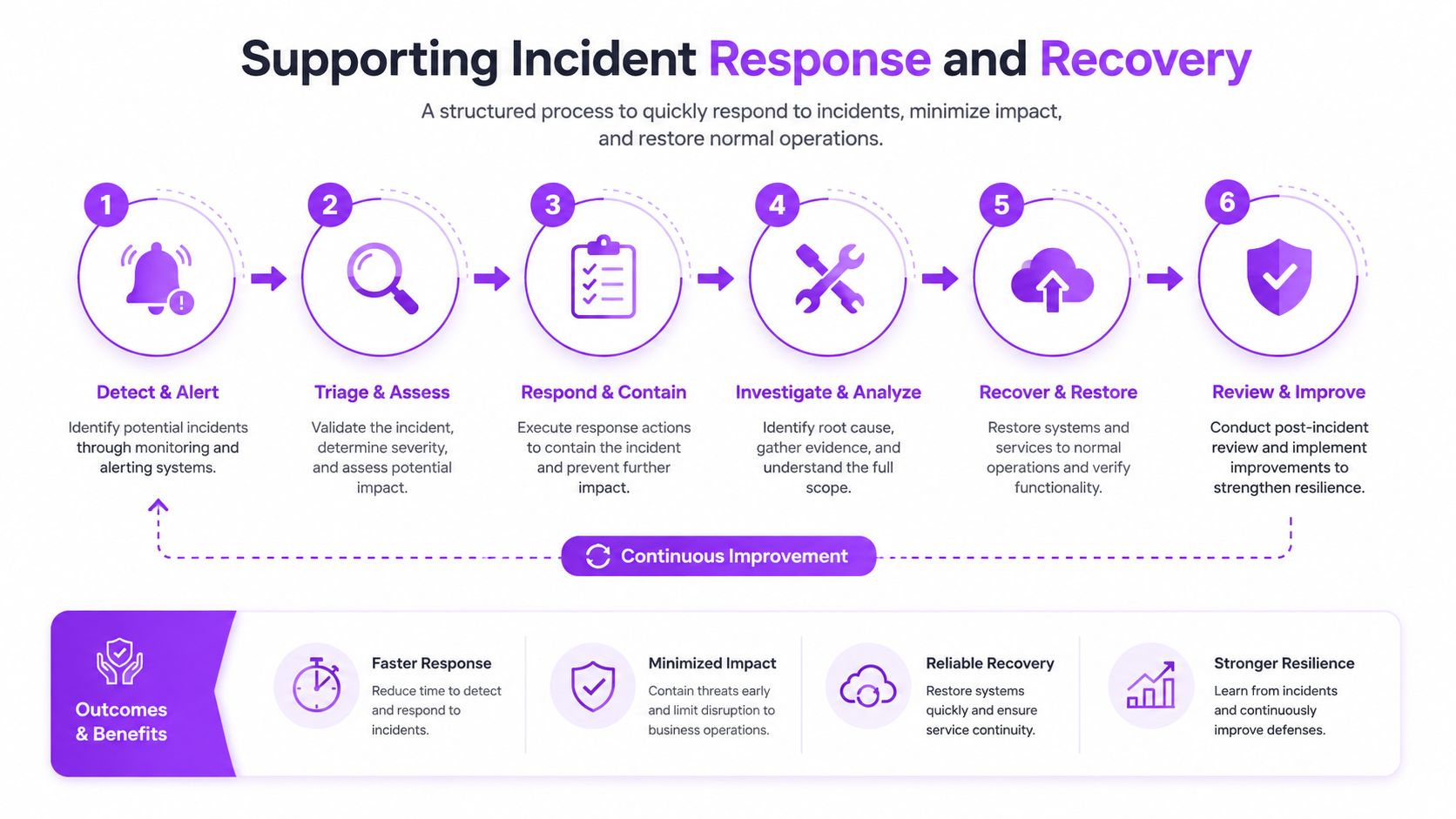
Supporting Incident Response and Recovery
During an infrastructure fault, continuous and retained data shorten the path from symptom to explanation. An alarm may identify a high temperature, but trend history can show whether the rise followed a power change, a cooling control action, a door opening, or another alarm.
A disciplined response follows the event sequence:
- Detection: A rule identifies an unusual condition.
- Assessment: The operator checks related signals and recent history.
- Escalation: The responsible team receives context, not only an alarm label.
- Intervention: Staff inspect or adjust the relevant power, cooling, network, or physical condition.
- Stabilization: Telemetry confirms whether the response changed the trend.
- Review: The team preserves the timeline and verifies the cause, action, and outcome.
Use sequence to separate cause from symptom
Suppose a cooling alarm appears after rack power changes in one zone. The alarm is a symptom that requires assessment, not necessarily the primary failure. Event order, adjacent sensor readings, equipment state, and prior maintenance records can help the response team determine whether cooling failed first or whether the cooling system reacted to a new load condition.
Shift handover adds another layer of control. The incoming operator needs to know what changed, what was checked, which action was taken, and whether conditions remained stable. A retained event history supports that handover and gives the post-incident review evidence that isn't dependent on recollection.
Uptime Institute guidance, cited earlier, emphasizes qualified on-site staffing because redundancy and automation don't eliminate the need for human intervention. Sensors can detect conditions, but trained operators and documented procedures determine whether the response is safe and effective.
Recovery also requires verification. A cleared alarm doesn't automatically prove that the underlying condition is resolved. Operators should compare the post-intervention trend with the earlier sequence, document the result, and preserve the relevant records for later analysis. That turns 24 hour data from passive history into an operational record of detection, decision, and recovery.
A Practical Operating Framework
A workable framework starts with four checks:
- Clarify the meaning: Specify whether the requirement concerns continuous telemetry, event logs, rolling reports, or uninterrupted service.
- Verify coverage: Test timestamps, intervals, source scope, missing records, and delayed arrivals.
- Define retained history: Match raw data, summaries, access, and archives to incident, reporting, compliance, and planning needs.
- Name the decision: Connect each dataset to a responsible action, such as escalation, capacity review, maintenance validation, or market comparison.
Data Centers List can supply facility and market context through location, operator, status, and labeled disclosed or AI-estimated capacity fields. Those fields complement live operational telemetry, but they don't replace it.
Data Centers List offers a searchable global directory and map for comparing data center facilities, operators, locations, statuses, and capacity context. Visit Data Centers List to connect site-level market research with the operational questions that continuous 24 hour data should answer.